By Hank Tolman
Manufacturer: ASRock Inc.
Product Name: ASRock Fatal1ty 990FX Killer AM3+ Motherboard
Model Number: Fatal1ty 990FX Killer
UPC: 4717677322637
Price As Tested: $104.79 (Newegg / Amazon)
Full Disclosure: AMD provided the product sample used in this article.
The AMD 990FX Chipset has been around for a while now, but it has recently come back into the spotlight with the release of a few new CPUs from AMD’s FX series. With that release we were pleased to receive a 990FX motherboard that we hadn’t previously looked at. In this article, Benchmark Reviews takes a look at the ASRock Fatal1ty 990FX Killer motherboard; a 990FX motherboard focused on gaming performance. Motherboards manufacturers are all about differentiating themselves by including features that make them stand out. The ASRock Fatal1ty 990FX Killer motherboard is definitely a motherboard that stands apart.
 ASRock categorizes their high-end motherboards into three series; Extreme, Overclocking, and Gaming. The three different series of motherboards are easily distinguished by their color schemes. The Gaming motherboards have red highlights on the PCIe and RAM slots while the Overclocking motherboard’s highlights are yellow. The Extreme series motherboards are all black. The ASRock Fatal1ty 990FX Killer motherboard, with its red highlights, definitely fits into the gaming category. Of course, ASRock isn’t the only manufacturer to release a line of 990FX motherboards. There is a lot of competition out there. Manufacturers can’t just rely on the chipset features to sell motherboards. Each company adds their specific features, thermal management systems, tweaks, and perks. Let’s get down to business and explore the ASRock Fatal1ty 990FX Killer motherboard to find out what sets it apart.
The ASRock Gaming motherboards sport the Fatal1ty title, and it is proudly broadcast with its logo on the box of the Fatal1ty 990FX Killer. The Fatal1ty title comes to ASRock motherboards via their partnership with Fatal1ty, Inc. If you are unfamiliar, Fatal1ty is the pseudonym of the famous professional gamer Johnathan Wendel. After a hugely successful professional e-sports gaming career, Fatal1ty started his own brand and partners with many manufacturers to make products focused towards gamers.
 The Killer part of the ASRock Fatal1ty 990FX Killer motherboard comes from another ASRock partnership, this time with Qualcomm. The Qualcomm Atheros Killer E2200 Intelligent Networking Platform is designed to maximize network performance towards online games and streaming media. The Killer E2200 uses Qualcomm’s Advanced Stream Detect technology to detect and accelerate game traffic over other network traffic. That means my wife’s Pinterest habit shouldn’t make me lag. The Killer E220 also prioritizes chat programs such as TeamSpeak and Ventrilo.
 The four DIMM slots on the ASRock Fatal1ty 990FX Killer motherboard are color-coordinated, black and red, and they are clearly labeled. DDR3_A1 is the closest to the APU socket, followed by A2, then B1, and B2 is closest to the 24-pin power connector. If you want to take advantage of both channels, make sure you use either both red or both black DIMM slots. ASRock Fatal1ty 990FX Killer motherboard is touted as supporting RAM speeds of up to 2450MHz+ when overclocking. The 990FX chipset itself supports 2100MHz RAM when overclocked and it supports speeds up to 1866MHz normally. The four DIMM slots support up to 64GB of memory.
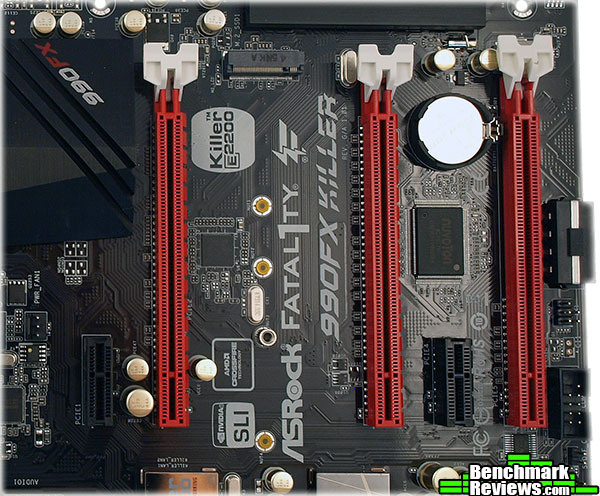 The ASRock Fatal1ty 990FX Killer motherboard is a full ATX motherboard, and a gaming motherboard to boot. Even so, it only sports three full PCIe slots and two PCIe x1 slots. For the full PCIe slots, the first two run at x16 and the last one runs at x4. They are, of course, PCIe 3.0 slots, so they have plenty of bandwidth to play with. The three slots limit you to triple CrossFireX or SLI configurations, but that should be plenty to keep you in the playable FPS range.
 There is a reason why a fourth full PCIe slot is absent. If you look closely, you’ll see another port in between the first and second PCIe slots. That’s the m.2 SSD slot. The ASRock Fatal1ty 990FX Killer motherboard was actually the first motherboard to implement m.2 Gen2 x2 with 2 PCIe lanes for a full 10Gb/s theoretical bandwidth. That’s twice as fast as the 5Gb/s on m.2 Gen2 x1 solutions and, according to ASRock, runs up to 3X faster than the m.2 SATA 3.0 implementations. To use the m.2 slot on the ASRock Fatal1ty 990FX Killer motherboard, you’ll have to disable the eSATA port on the rear I/O panel, as the two share PCIe lanes.
Just opposite the PCI slots are the SATA 3.0 6Gb/s ports. The 990FX chipset, with the SB950 southbridge supports six SATA 3.0 ports. Five of them are here on this end of the motherboard and the sixth is located on the I/O panel in the form of an eSATA port. Of the five SATA ports that are located here at the bottom of the motherboard, four are situated horizontally. This allows for the use of longer video cards that can often cover up the SATA ports. As a gaming motherboard, it’s important that the ASRock Fatal1ty 990FX Killer motherboard makes accommodations for stuff that gamers are likely to have, including long video cards. The fifth SATA port here is a vertical port. It’s always nice to have one vertical port, as the horizontal ports are, in my experience, more difficult to plug in to. The 990FX chipset, to no one’s surprise, supports RAID 0, 1, 5, and 10 configuations.
 To round out our closer look, let’s take a gander at the I/O panel. The ASRock Fatal1ty 990FX Killer motherboard I/O starts off with two legacy PS/2 ports. I feel like ASRock is catering to whiny, non-conformist gamers here. I don’t even like to see one PS/2 port on current motherboards, but two is just overboard. The justification is the n-key rollover capability of PS/2 keyboards. Seriously, though, if 64-key rollover isn’t enough for you, you need to re-evaluate your gaming style. USB keyboards have reached the point that PS/2 is now antiquated. As it is the ASRock Fatal1ty 990FX Killer motherboard only offers 10 of the 14 available USB 2.0 ports available from the 990FX chipset and the SB950 southbridge. Replacing those PS/2 ports with USB 2.0 ports would tickle my fancy just fine.
Speaking of the 10 USB 2.0 ports used by the ASRock Fatal1ty 990FX Killer motherboard, six of them are here on the rear I/O panel. The other four are available through headers on the motherboard. Four of the seven USB 3.0 ports are also located here on the back panel, along with an eSATA port. The Qualcomm Atheros Killer E2200 LAN port is back here as well, accompanied by 7.1 channel audio ports, including an S/PDIF port.
The key to selling motherboards is in the details. There are many 990FX motherboards that come in a variety of price ranges. What really sets each motherboard apart are the manufacturer specific features embedded in each board. ASRock sets itself apart from other manufacturers through a set of specific features that can really appeal to certain users. In the case of the ASRock Fatal1ty 990FX Killer motherboard, ASRock is tailoring the motherboard towards gamers.
 The ASRock Fatal1ty 990FX Killer motherboard is home to ASRock’s A-Style features. A-Style is a series of lifestyle features that includes a lot of interesting functionalities. To start with, A-Style includes Home Cloud, which supports remote desktop and wake-on internet. You can control your PC from a smartphone, tablet, or computer from anywhere with an internet connection, even if your home computer is turned off. With wake-on internet, you can turn your computer on from anywhere. Home Cloud gives you complete access to your computer and all the files on it. You can view pictures or videos from your system, or stream music. I like this idea, especially for my wife. She is constantly complaining because her iPhone only has 8GB of storage. With all the apps, music, videos, and pictures on it, she doesn’t have any room to take more pictures! She doesn’t want to move them off the device, however. She wants to be able to show them to friends and family whenever she gets the chance; much to their chagrin, I am sure. Home Cloud could allow her to keep all those items at her fingertips while lightening the load on her smartphone.
 I’m more interested in Home Cloud for the document sharing, but there is plenty more you can do as well. You can monitor cameras hooked up to computer, or watch TV if your PC is connected. There are a lot of possibilities. ASRock and other manufacturers have really been improving the onboard sound quality of their motherboards. I remember a time when onboard sound wasn’t very good at all. That’s not the case as much anymore, but audiophiles might still be a little put off by a lot of onboard sound options. A new audio codec, built in amplifiers, component isolation, and the like are a few ways that motherboard manufacturers can really make their devices stand out from the rest without increasing the cost of the motherboard by too much.
 The ASRock Fatal1ty 990FX Killer motherboard is home to Purity Sound, a combination of hardware and software audio solutions and technologies. ASRock Fatal1ty 990FX Killer motherboard uses the Realtek ALC1150 audio codec for 7.1 channel HD audio. The ALC1150 includes a 115dB signal to noise ratio Digital to Analog Converter (SNR DAC) with a differential amplifier. Purity Sound adds to that the Texas Instruments NE5532 premium headset amplifier with support for headphones up to 600 ohms to replace traditional audio capacitors. Rounding out Purity Sound is an EMI shielding cover for the codec and PCB isolated shielding to block noise from onboard components.
 Another of the features that ASRock uses to set the ASRock Fatal1ty 990FX Killer motherboard apart from the competition is a high density glass fabric PCB designed to help with humidity and moisture issues. I really don’t have much of a problem with humidity shorting out any of my components because I live in Southern Arizona. If you happen to be from a more tropical environment, the high density glass fabric PCB on the ASRock Fatal1ty 990FX Killer motherboard could extend the life of your motherboard. Along with a lot of other manufacturers, ASRock has moved to using gold capacitors for some of their higher-end products. The gold capacitors obviously cost more, but they are touted as being ultra-stable and extremely long-lasting. Interestingly enough, I’ve repaired a lot of motherboards over the last few years by replacing leaking capacitors, including solid caps. While the use of gold caps is relatively recent, I haven’t seen any leaking gold caps.
The ASRock Fatal1ty 990FX Killer motherboard uses a digital PWM design rather than a traditional analog design. This isn’t really unusual, but it is a very nice touch that should draw any potential overclockers. A digital VRM design allows overclockers to be much more precise in their voltage regulation. ASRock Fatal1ty 990FX Killer motherboard uses an 8+2 phase power design. In terms of voltage control, the ASRock Fatal1ty 990FX Killer motherboard should be an excellent overclocker. ASRock also offers XFast5 RAM on the ASRock Fatal1ty 990FX Killer motherboard. ASRock measures the 5x faster RAM speeds by creating a virtual disk from system memory and using Photoshop tests.
*Specifications taken from ASRock website.
| General | |
| A-Style | – ASRock Cloud – Purity Soun |
| CPU | – Supports Socket AM3+ processors – Supports Socket AM3 processors: AMD Phenom II X6 / X4 / X3 / X2 (except 920 / 940) / Athlon II X4 / X3 / X2 / Sempron processors – Supports 8-Core CPU – Supports UCC feature (Unlock CPU Core) – Digi Power design – 8 + 2 Power Phase design – Supports CPU up to 140W – Supports AMD’s Cool ‘n’ Quiet Technology – FSB 2600 MHz (5.2 GT/s) – Supports Untied Overclocking Technology – Supports Hyper-Transport 3.0 (HT 3.0) Technology |
| Chipset | – Northbridge: AMD 990FX – Southbridge: AMD SB950 |
| Memory | – Dual Channel DDR3 Memory Technology – 4 x DDR3 DIMM Slots – Supports DDR3 2450(OC)/2100(OC)/1600/1333/1066 non-ECC, un-buffered memory – Max. capacity of system memory: 64GB* – Supports Intel Extreme Memory Profile (XMP) 1.3 / 1.2 – Supports AMD Memory Profile (AMP)*Due to the operating system limitation, the actual memory size may be less than 4GB for the reservation for system usage under Windows 32-bit OS. For Windows 64-bit OS with 64-bit CPU, there is no such limitation. |
| BIOS | – 32Mb AMI UEFI Legal BIOS with GUI support – Supports “Plug and Play” – ACPI 1.1 Compliant wake up events – Supports jumperfree – SMBIOS 2.3.1 support – CPU, DRAM, NB, HT, CPU VDDA, PCIE VDDA, CPU NB Voltage multi-adjustment |
| Audio, Video and Networking | |
| Graphics | – n/a |
| Audio | – 7.1 CH HD Audio with Content Protection (Realtek ALC1150 Audio Codec) – Premium Blu-ray Audio support – Supports Purity Sound – 115dB SNR DAC with differential amplifier – TI NE5532 Premium Headset Amplifier (Supports up to 600 ohm headsets) – Direct Drive Technology – EMI shielding cover – PCB isolate shielding – Supports DTS Connect |
| LAN | – PCIE x1 Gigabit LAN 10/100/1000 Mb/s – Qualcomm Atheros Killer E2200 Series – Supports Wake-On-LAN – Supports Energy Efficient Ethernet 802.3az – Supports PXE |
| Expansion / Connectivity | |
| Slots | – 3 x PCI Express 2.0 x16 Slots (PCIE2/PCIE3 @ x16 mode; PCIE5 @ x4 mode) – 2 x PCI Express 2.0 x1 Slots – Supports AMD Quad CrossFireX, 3-Way CrossFireX and CrossFireX – Supports NVIDIA Quad SLI and SLI |
| Storage | – 5 x SATA3 6.0 Gb/s Connectors, support RAID (RAID 0, RAID 1, RAID 0+1, JBOD and RAID 5), NCQ, AHCI and Hot Plug – 1 x M.2_SSD (NGFF) Socket 3, supports M.2 SATA3 6.0 Gb/s module and M.2 PCI Express module up to Gen2 x2 (10 Gb/s)*M.2_SSD (NGFF) Socket 3 is shared with the eSATA3 connector. |
| Connector | – 1 x IR Header – 1 x COM Port Header – 1 x TPM Header – 1 x Power LED Header – 2 x CPU Fan Connectors (1 x 4-pin, 1 x 3-pin) – 3 x Chassis Fan Connectors (1 x 4-pin, 2 x 3-pin) – 1 x Power Fan Connector (3-pin) – 1 x 24 pin ATX Power Connector – 1 x 8 pin 12V Power Connector (Hi-Density Power Connector) – 1 x SLI/XFire Power Connector – 1 x Front Panel Audio Connector – 1 x SPDIF Out Connector – 2 x USB 2.0 Headers (Support 4 USB 2.0 ports) – 1 x Vertical Type A USB 3.0 – 1 x USB 3.0 Header by Etron EJ188 (Supports 2 USB 3.0 ports) |
| Rear Panel I/O | – 1 x PS/2 Mouse Port – 1 x PS/2 Keyboard Port – 1 x Optical SPDIF Out Port – 5 x USB 2.0 Ports – 1 x Fatal1ty Mouse Port (USB 2.0) – 4 x USB 3.0 Ports (ASMedia Hub) – 1 x eSATA3 Connector – 1 x RJ-45 LAN Port with LED (ACT/LINK LED and SPEED LED) – HD Audio Jacks: Rear Speaker / Central / Bass / Line in / Front Speaker / Microphone |
| Other Features / Miscellaneous | |
| Unique Feature | – F-Stream – ASRock Instant Boot – ASRock Instant Flash – ASRock APP Charger – ASRock XFast RAM – ASRock Crashless BIOS – ASRock OMG (Online Management Guard) – ASRock Internet Flash – ASRock UEFI System Browser – ASRock UEFI Tech Service – ASRock Dehumidifier Function – ASRock Easy RAID Installer – ASRock Easy Driver Installer – ASRock Fast Boot – ASRock X-Boost – ASRock Restart to UEFI – Hybrid Booster: – CPU Frequency Stepless Control – ASRock U-COP – Boot Failure Guard (B.F.G.) – Turbo 50 / Turbo 60 Overclocking – Good Night LED |
| Support CD | – Drivers, Utilities, AntiVirus Software (Trial Version), Google Chrome Browser and Toolbar, Start8 (30 days trial), XSplit, Killer Network Manager |
| Accessories | – 1 x ASRock SLI_Bridge_2S Card – Quick Installation Guide, Support CD, I/O Shield – 4 x SATA Data Cables – 1 x M.2_SSD (NGFF) Socket 3 Screw |
| Hardware Monitor | – CPU/Chassis temperature sensing – CPU/Chassis/Power Fan Tachometer – CPU/Chassis Quiet Fan (Auto adjust fan speed by CPU temperature) – CPU/Chassis Fan multi-speed control – Voltage monitoring: +12V, +5V, +3.3V, CPU Vcore Voltage |
| Form Factor | – ATX Form Factor – Premium Gold Capacitor design (100% Japan made high quality conductive polymer capacitors) |
| OS | – Microsoft Windows 8.1 32-bit / 8.1 64-bit / 8 32-bit / 8 64-bit / 7 32-bit / 7 64-bit |
| Certifications | – FCC, CE, WHQL – ErP/EuP ready (ErP/EuP ready power supply is required) |
Testing a motherboard is difficult. It is hard to provide solid statistics for what performance a motherboard increases or sustains. With more and more sub-components controlled by the CPU, the amount of difference a motherboard makes in performance tests is becoming negligible. That is precisely why manufacturers are beginning to focus on additional features to add value to their motherboards.
For the testing portion of this article, I tested the ASRock Fatal1ty 990FX killer using the FX-8370, FX-8370E and FX9590 CPUs. I also tested the Steamroller based Kaveri A10-7850K APU, which I found to be an excellent value earlier this year, using the ASUS A88X Pro motherboard. Finally, I crossed over and used the Biostar HiFi Z78X motherboard, paired with the i5-4670, to round out the testing.
The i5-4670 matches up pretty closely in price to the FX-9590, so the match-up should give us a good indication of how the two compare. That being said, we aren’t really looking at the two CPUs in this article.
FM2+ Test System
- Motherboards: ASUS A88X Pro
- Processor: AMD A10-7850K
- System Memory: 8GB AMD Radeon DDR3 2400MHz
- Disk Drive: Seagate 1TB SSHD ST1000LM014
- PSU: Corsair CMPSU-850TX 850W 80-Plus Certified
- Video Card: XFX R9-280X
- Operating System: Windows 7 Professional 64-bit
Intel Test System
- Motherboard: Biostar HiFi Z87X
- Processor: Intel Core i5-4670
- System Memory: 8GB AMD Radeon DDR3 2400MHz
- Disk Drive: Seagate 1TB SSHD ST1000LM014
- PSU: Corsair CMPSU-850TX 850W 80-Plus Certified
- Video Card: XFX R9-280X
- Operating System: Windows 7 Professional 64-bit
AMD 990FX Test System
- Motherboard: ASRock Fatal1ty 990FX Killer
- Processors: AMD FX-8370; AMD FX-8370E; AMD FX-9590
- System Memory: 8GB AMD Radeon DDR3 2400MHz
- Disk Drive: Seagate 1TB SSHD ST1000LM014
- PSU: Corsair CMPSU-850TX 850W 80-Plus Certified
- Video Card: XFX R9-280X
- Operating System: Windows 7 Professional 64-bit
Compute Benchmarks
- AIDA 64
- SiSoftware Sandra 2014
- Cinebench R15
AIDA64 is a full 64-bit benchmark and test suite utilizing MMX, 3DNow! and SSE instruction set extensions, and will scale up to 32 processor cores. An enhanced 64-bit System Stability Test module is also available to stress the whole system to its limits. For legacy processors all benchmarks and the System Stability Test are available in 32-bit versions as well.
The Queen benchmark is a simple integer benchmark focuses on the branch prediction capabilities and the misprediction penalties of the CPU. The Photoworxx benchmark performs common photo and image editing tasks. The Queen benchmark seems to be made specifically for the AMD processors. The scale right up the list, with all of them thrashing the i5-4670; including the A10 APU. The Photoworxx tests bring things back into perspective and show a good estimation of processing that is very common today. In the Photoworxx test, the FX CPUs all outpace the i5-4670, albeit by much slimmer margins than in the Queen test.
The final test on this chart is a floating point test. Julia tests single-point precision (32-bit). As you can see above, the AMD FX processors are no match for the competition when it comes to floating point performance.
 This integer benchmark measures combined CPU and memory subsystem performance through the public ZLib compression library. CPU ZLib test uses only the basic x86 instructions, and it is HyperThreading, multi-processor (SMP) and multi-core (CMP) aware. AMD has made great strides in the compression test over the last few processor revisions. In this case, the AMD FX CPUs all perform very well.
SiSoftware Sandra is a 32- and 64-bit client/server Windows system analyzer that includes benchmarking, testing and listing modules. It tries to go beyond other utilities to show you more of what is really going on under the hood so you draw comparisons at both a high and low-level in a single product. You can get information about the CPU, GPGPU, chipset, video adapter (GPU), ports, printers, sound card, memory, network, Windows internals even .NET and Java.
 The above tests show CPU bandwidth in GB/s for each of the associated tasks. The results of these tests were quite interesting. I would expect to see an increase in bandwidth on par with the increase in clock speed of the AMD processors. That doesn’t appear to be the case, however. I ran the tests over and over again trying to understand why the FX-9590 scores so poorly in the Encryption and Hash tests.
I still am not sure why this is the case, but in any event, the FX-8370E and FX-8370 processors do score quite closely to the Intel i5-4670. It is difficult to pick out a winner here, due to the fluctuations, but they all perform quite closely.CINEBENCH is a cross-platform testing suite that measures hardware performance and is the de facto standard benchmarking tool for leading companies and trade journals for conducting real-world hardware performance tests. With the new Release 15, systems with up to 256 threads can be tested. CINEBENCH is available for both Windows and OS X and is used by almost all hardware manufacturers and trade journals for comparing CPUs and graphics cards.
 The Cinebench test is one of my absolutely favorite tools for benchmarking processors. It cuts through and tests only the processor. In my opinion, it is definitely one of the best indicators of where a processor stands. As you can see from the results, the FX-8370E and FX-8370 can’t keep up, or even come close, to the single core, hyper-threaded score of the i5-4670. Even the 4.7GHz FX-9590 doesn’t come close. The tale is quite different when we look at the high-speed octa-core FX CPUs in the multi-core test. Both the FX-8370E and the FX-8370 have no trouble pushing past the i5-4670 here. In a market where multi-core processing is becoming the norm, the less expensive FX processors seem to have the advantage.
PCMark 8 is designed to be an extremely realistic benchmark that takes actual tasks that are commonly used in different environments and testing them, then compiling the results and assigning a score. During the PCMark 8 tests, worksheets and documents are opened, edited, and saved. Music and videos are played. Video conferencing is simulated. An internet browser is opened and runs through a series of pages and requests. The tests cover the gamut of tasks that are commonly associated with home use, work use, and creativity based usage.
 One of the advantages that the AMD processors had in this particular test was their ability to use the R9-280X GPU and OpenCL to help out. This is, in part, the very beginnings of what AMD envisions in their heterogeneous compute future. Whether that is the sole reason that the AMD FX-8370 and FX-8370E outpace the i5-4670 in the home and creative suites is up for interpretation. Even with the OpenCL support, the i5 still pulls out a win in the work suite.
IMPORTANT: Although the rating and final score mentioned in this conclusion are made to be as objective as possible, please be advised that every author perceives these factors differently at various points in time. While we each do our best to ensure that all aspects of the product are considered, there are often times unforeseen market conditions and manufacturer changes which occur after publication that could render our rating obsolete. Please do not base any purchase solely on our conclusion, as it represents our product rating specifically for the product tested, which may differ from future versions.
Benchmark Reviews begins our conclusion with a short summary for each of the areas that we rate. Performance is a difficult thing for a motherboard manufacturer to improve on when the CPU and the chipset control almost everything. There are some things a manufacturer can control, however. One of those things is the power management, and ASRock uses a digital PWM and an 8+2 power phase design to allow for stable and consistent power performance. The ASRock Fatal1ty 990FX Killer motherboard also focuses on another area under their control, the audio codec, to improve performance. The Purity Sound greatly enhances audio performance.
I like the look of the ASRock Fatal1ty 990FX Killer motherboard. I understand that it is difficult to judge the appearance of a motherboard, considering that it is typically hidden away inside of a case. Even with a windowed case, the other components cover up a lot of the motherboard. That being said, I like it when motherboard manufacturers take the time to put some cosmetic features on their motherboards. The ASRock Fatal1ty 990FX Killer motherboard’s gaming color scheme is mirrored on the heat-sinks. The heat-sinks also sport flashy designs, which I like.
As for construction quality, the ASRock does a lot to ensure the durability and stability on the Fatal1ty 990FX Killer. The ASRock Fatal1ty 990FX Killer motherboard starts off with a digital PWM. It also uses premium gold caps that last longer and operate more stably. Perhaps the best construction feature on the Fatal1ty 990FX Killer, though, is the high density glass fabric PCB designed to help the motherboard to deal with moisture and avoid short circuits.
If you are audiophile, the ASRock Fatal1ty 990FX Killer motherboard offers all the functionality you could want. The Purity Sound system offers EMI shielding, a differential amplifier in addition to a headset amplifier to offer improved frequency response and better base. The ASRock Fatal1ty 990FX Killer motherboard also offers enhanced functionality for gamers with the Atheros Killer E2200 NIC, the 2450MHz RAM support, and, of course, the m.2 Gen2 x2 slot. The ASRock Fatal1ty 990FX Killer motherboard doesn’t leave out casual users, however, offering A-Style for sharing your stuff across all of your devices.
The ASRock Fatal1ty 990FX Killer motherboard will cost you around $104.79 (Newegg / Amazon). That is a price that I can live with for a fully featured motherboard like the Fatal1ty 990FX Killer. The Purity Audio features, the high quality components, the E2200 NIC, the m.2 Gen2 x2 port, and more make the Fatal1ty 990FX Killer worth the price. As a gamer, I find the Fatal1ty 990FX Killer to offer all the features I need and a price I like.
+ Purity Sound w/ 2 amplifiers
+ m.2 Gen2 x2 slot
+ Atheros Killer E2200 NIC for Gamers
+ Good, Competitive Price
– 2 PS/2 ports taking up space on I/O
- Performance: 9.00
- Appearance: 9.00
- Construction: 9.00
- Functionality: 9.50
- Value: 9.50

13 thoughts on “ASRock Fatal1ty 990FX Killer AM3+ Motherboard Review”
The FX-9590 results in AIDA might be because of throttling – I think that Fatal1ty board is only rated for the 125W CPUs, not sure if it does any downclocking or anything for the 220W FX CPUs (the 9590 and 9370 aren’t officially supported on that board). It’d be interesting to hear what the temperatures were on that 9590 during those tests.
Excellent review, my thoughts were similar to TomJ on using the 9 series AMD in this board. Being a high density glass board, maybe less susceptible to the temp warping, but doubt it- not being an engineer or even close. I knew there was a board made by ASRock that was certified for the 220W processors though. that and only the Gigabyte UD7, I think.
Seeing that the 9590 was included in the testing did catch my eye though. and for just over $100 new is an even greater eye catcher. Am needing to upgrade a couple of AM3 boards since I can not find any new Phenom II 4 or 6cores retailing anymore. Not even sure how long this AM3+ will last for my FX processors . thanks again for a great review.
Interesting review, but it seemed to quickly morph into a processor comparison rather than the motherboard review indicated.
No benchmarks with an m.2 SSD installed??!! Like, what are the boot times, program load times compared to other systems with an SSD connected to SATA This is one of the few AMD boards with m.2…. come on guys!
While you’re at it, rant about how car review magazines never test all the different tires available for that model. The M.2 slot on this board supports SATA 6 Gb/s M.2 cards, so it would perform pretty much the same as other SATA 6Gb/s SSDs. The only difference would be if a M.2 PCI Express Gen2 x2 card is used, which could reach 10 Gb/s. Of course, the sky is the limit for what is tested, and then it becomes an SSD review. See here: https://techplayboy.com/category/comprehensive-product-reviews/computer-hardware-reviews/pc-storage/
They are, of course, PCIe 3.0 slots???? mine is 2.0 and on ASROCK site they wrote : 3 PCIe 2.0 x16, 2 PCIe 2.0 x1 . maybe you got a new Rev ?
Fatal1ty Killer,supports processor TDP 220W? As demonstrated in the test FX9590
They actually are NOT, of course, PCIE Gen 3.0 slots.
I’ve been reading around and I thought the 990FX Killer isn’t compatible with the 9590 FX? I’ve bought both and it said the CPU isn’t on the Mobo Support List? Am I doing something wrong?
All right! need for downgrade BIOS version 1.0 I have the same problem. Good luck) if that write [email protected]
Great review, great board! I like the look of the gaming series motherboards, they look better than the extreme or overclocking series.
Still a nice board, and I happen to like the inclusion of PS2 ports on the rear for the keyboard, if you’re whining about lack of USB ports when there is that many, you are doing it wrong.
It’s not pcie 3.0 it’s only 2.0
Comments are closed.