By Tom Jaskulka
Manufacturer: Phanteks Company
Product Name: EVOLV
Model Number: PH-ES314E_WT
UPC: 886523300304
Price As Tested: $144.99 (Amazon | Newegg)
Full Disclosure: The product sample used in this article has been provided by Phanteks.
What a difference a year makes. In Q3 of 2013, Phanteks branched out from their well-known CPU cooling and fan items and released the Enthoo Primo computer case. Their first chassis won multiple awards and was quickly followed by the Enthoo Pro; a more accessible case that still exuded a premium feel from this brand-new case company. The Enthoo Luxe arrived quite a few months later, adding a splash of color to the lineup. With the premium tower, full-tower and mid-tower segments covered, Phanteks has delved into the smaller form factors. Today, Benchmark Reviews will review Phanteks’ latest offering, the micro-ATX Enthoo EVOLV. With rear-hinged aluminum panels, snap-on front and top covers concealing 200mm/140mm fans and multiple radiator mounts along with a few other surprises, will this aluminum-clad water-cooling oriented chassis pack as much of a punch as its bigger brothers?
|
Case Specifications
|
|||
|
Dimension
|
230 mm x 450 mm x 400 mm (W x H x D)
|
||
|
Form Factor
|
Micro Tower Chassis
|
||
|
Material(s)
|
Aluminum Exterior, Steel Chassis
|
||
|
Motherboard Support
|
uATX, mITX
|
||
|
Front I/O
|
2x USB 3.0, Mic, Headphone
|
||
|
Side Window
|
Yes
|
||
| Expansion & Drive Bays | |||
|
Expansion slots
|
4
|
||
|
External 5.25″
|
1 (modular)
|
||
|
Internal 3.5″
|
3
|
||
|
Internal 2.5″
|
5 (1 slot for upgrade)
|
||
|
Cooling
|
120mm fan
|
140mm fan
|
200mm fan
|
|
Front
|
2x
|
2x | 1x (included) |
|
Top
|
3x
|
2x | – |
|
Rear
|
1x
|
1x (included) | – |
|
Liquid Cooling
|
120mm radiator
|
140mm radiator
|
|
|
Front
|
Up to 240
|
140 | |
|
Top
|
Up to 240
|
Up to 280 | |
|
Rear
|
120
|
140 | |
|
Clearance
|
|||
|
Graphic card
|
318mm
|
||
| PSU |
216mm (remove Midplate cover for PSU longer than 180mm)
|
||
|
CPU cooler
|
192mm
|
||
|
Cable management
|
24mm (216mm below midplate)
|
||
|
Radiator (Top)
|
68mm to Motherboard (offset)
|
||
|
Packaging Information
|
PH-ES614L
|
||
|
Package Dimension
|
308mm x 540mm x 463mm (WxHxD)
|
||
|
Net Weight
|
9 Kg
|
||
|
Gross Weight
|
10 Kg
|
||
|
Warranty
|
|||
|
Length
|
5 Years Limited
|
||
As always, we’ll start with a glance around the exterior of the Phanteks Enthoo EVOLV. As this is Phanteks’ first micro-ATX case, there’ll be some interesting angles to cover.
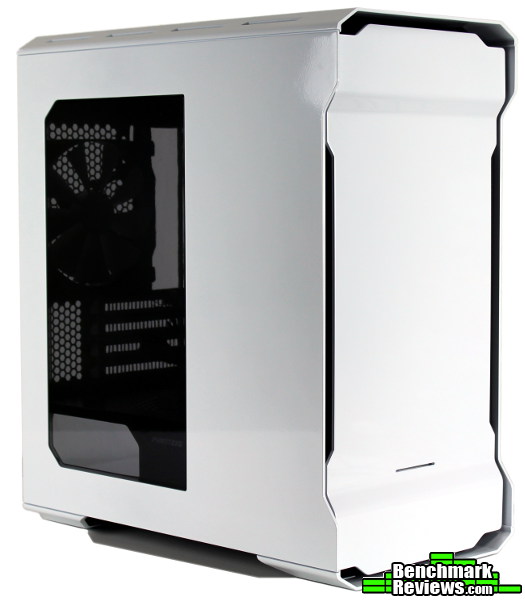
The most visually striking feature of the Phanteks EVOLV is the solid aluminum exterior panels. The quality of the paint in our glossy Glacier White sample is a notch above what you may be used to, with a clear coat that is almost automotive quality. The front angled corners add a bit of visual flair and a bit of functionality since they make for perfect gripping points to open the rearward-swinging side panels.

The EVOLV features a tinted window on the left panel. The window quality itself is again a notch above what many may be accustomed to. It certainly isn’t one of those easily-scratched “shatters when tapped” acrylic sheets, and it’s as thick as the panels themselves. It’s even offset a little to be flush with the exterior which is a nice touch.

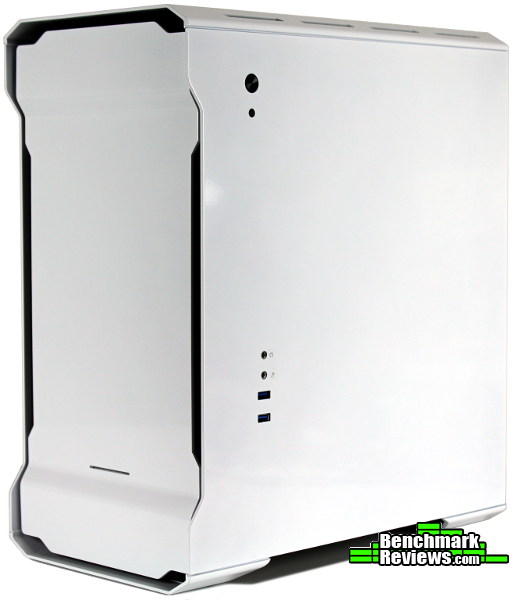
The right panel features the power button at the top accompanied by the reset button (which hides the HDD activity LED in a ring within). A standard set of 3.5mm headphone/microphone jacks alongside two USB 3.0 ports completes the only features on the right side panel.
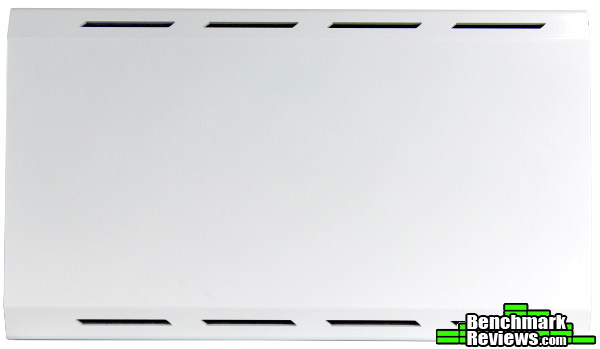
The top panel contains a few vents along the angled sides, but most of the airflow up here will be directed through the “vanes” under the front and rear edges (a better view of this can be seen in the photo of the rear section of the EVOLV). This is the only airflow-capable panel that does not contain a removable dust filter – instead, the vents themselves are covered by a fine mesh glued from the inside. Since most users would probably set any fan up top in an exhaust orientation, this is barely worth a mention.

The bottom sits high enough off the ground to feed some fresh air to a filtered power supply intake, and four soft rubber pads ensure the EVOLV does not move from where it is placed. Indeed, a fully loaded system will not slide if placed on a hard surface! The four HDD cage screws are visible towards the front of the EVOLV; the four slots in between are for mounting a water-cooling pump with the included bracket supplied by Phanteks.
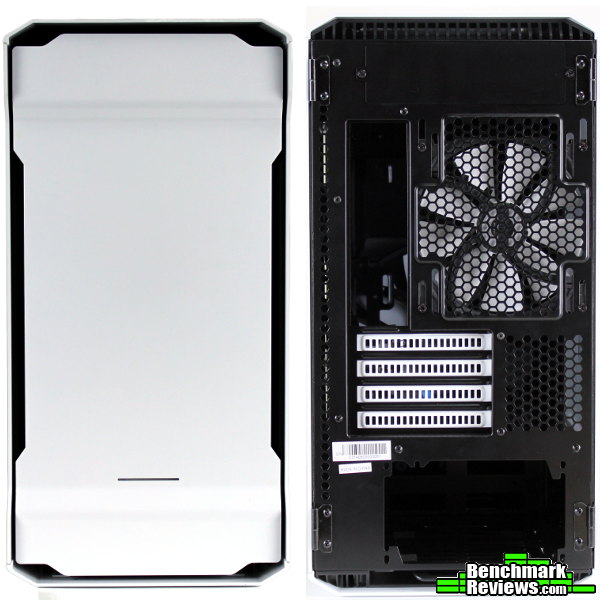
The angled front panel is mostly featureless except for the power LED that shines through the slit at the bottom. It hides a few surprises though, which we’ll see in detail a bit later. It’s comprised of the same 3mm thick aluminum as the side and top panels, and is tool-less as well (it simply pulls off with a well-tuned amount of force).
The rear of the EVOLV looks pretty normal at first glance. The power supply sits underneath the four PCI slots, with one of Phanteks’ new SP series 140mm fans immediately above those. This location is slotted for 120mm fans as well, and just above that is more than enough room for push/pull arrangements on standard radiators (the slots just underneath the top cover are exhaust/intake vents for the top fan locations). Between those vanes and above the 140mm SP fan is the 5.25″ bay – that’s right, the optical drive bay on the EVOLV opens to the rear! Personally, I think this an excellent solution that fits in the “why haven’t we seen this before” category. The few times I’ve actually used an optical drive or bay device it wouldn’t have mattered if the drive tray was behind the case – the only possible issue I could see with this is for those users that place their computer cases inside an enclosed desk compartment (which could make it hard to access anything behind the EVOLV). Let’s be honest though – this isn’t a case that you hide in your desk, so I really don’t think the intended audience for this case should find any fault with this location (most users will use the space for radiators anyway).
With our tour of the exterior complete, let’s look at some of the more detailed features of the Phanteks Enthoo EVOLV.

While I normally don’t highlight accessories, there are some interesting items included that deserve your attention. The manual is of surprising quality, and instead of a bag of screws and fasteners Phanteks includes a toolbox complete with all screws in separate compartments. That alone is a nice touch, but Phanteks doesn’t stop there. A water pump bracket complete with vibration-dampening pads is included as well (I can see why this company has quickly gained their reputation for water-cooling-friendly chassis). The larger bracket pictured is for the 5.25″ bay at the rear of the enclosure, and the bag contains a red, green and blue LED individually wired with quick disconnects to swap with the installed white power LED in the front panel. Finally, a few plastic zip ties and some of Phanteks’ reusable cable wraps are included.

All of the panels (top, front and sides) are simply held in by aluminum posts and snap into the rest of the chassis. I was very glad to see that the posts are spherically-shaped and made of metal as these can be very easy to snap off if they’re made of plastic. The front panel hides a 200mm Phanteks SP fan behind a snap-in mesh filter, and the panel itself is more than offset enough to prevent any restriction of airflow.

The left side panel simply snaps open and swings out to the rear revealing a fairly standard internal layout. The most prominent feature is the vertical drive bracket in the front which is drilled to mount one 3.5″ drive in the middle or two 2.5″ drives (where the rubber grommets are, top and bottom). For those users with a custom liquid cooling loop the additional holes in this bracket are for reservoirs and pumps.

Opening the right side panel offers an even better glimpse of the micro-ATX layout of the EVOLV. The tool-less 3.5″ HDD bay in the lower corner allows for easy swapping of drives or can be taken out entirely to fit larger radiators (or pumps and reservoirs, for that matter). There are two mounting locations for 2.5″ drives that use Phanteks’ “drop and lock” SSD trays behind the motherboard. The I/O and power button boards are pretty standard, but it’s notable that they are attached to the chassis instead of the side panel. Finally, Phanteks includes their PWM fan hub (which allows up to six 3-pin fans to be controlled by a PWM header on the motherboard). This is especially handy in the micro-ATX form factor as the smaller motherboards rarely include as many fan headers as the larger ATX boards.
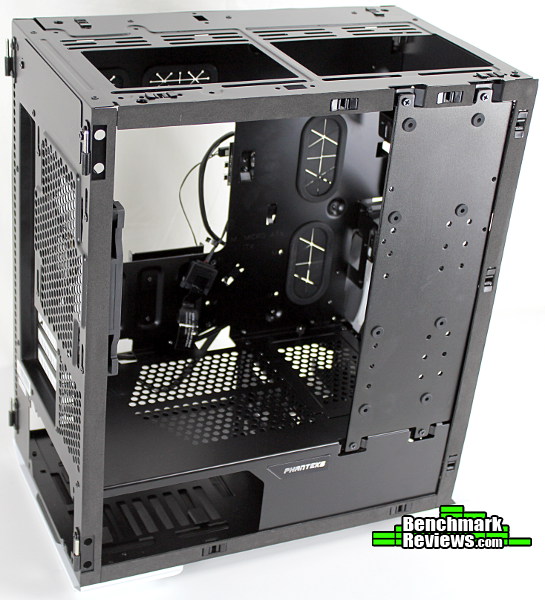
The EVOLV sits a little tall for a micro-ATX case, but the extra room for radiators is an acceptable tradeoff. The picture above highlights the foam dampening material for the side panels pretty well, subduing the noise when snapping the panels closed as well as isolating any vibrations from the chassis frame.

The midplate is perforated with a number of holes to provide some ventilation to graphics cards. The front 200mm fan extends down into the HDD tray/PSU area, so these holes are for more than just appearance. The mesh portion above the HDD trays in front can be removed with two thumbscrews, opening this area up for large radiators of the 240mm variety. While the front panel will accept 2x140mm fans in place of the supplied 200mm only the top frame of the EVOLV is officially compatible with the larger 280mm radiators.

A better perspective of the fan mounting options up top can be seen here. If you look closely you can see the front mounting holes for 120mm/140mm fans too. The top panel is compatible with 240mm or 280mm radiators, and the slots allow for enough freedom to make room for hoses, barbs and fittings common to many water-cooling setups.

The power supply area should have enough room for most power supplies, but it looks like it might get cramped pretty quickly for some of the higher-end modular units one would need to power an SLI or Crossfire system. At least the HDD cage can be removed if absolutely necessary. We’ll see in the build section if this turns out to be a hassle; at least you won’t be limited to SFX or 140mm power supplies like some mini-ITX chassis.

The EVOLV has two tool-less 3.5″ HDD trays located just inside the front corner. While the trays themselves are plastic, they aren’t the flimsy versions seen on some cases. Let’s take a look how these trays (and everything else) work in the next section.
Placing components into a chassis is the best way to uncover any quirks or issues, so let’s get to it!
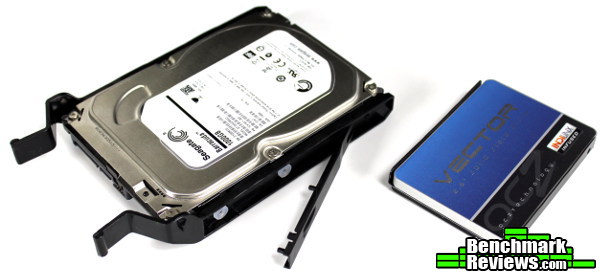
The 3.5″ HDD trays provided by Phanteks are plastic but solid. Drives are retained by two pivoting wings that snap into the corresponding holes on the side of a drive which makes for simple and effective tool-less drive installation. I’m a little disappointed to see the tool-less solution doesn’t extend to SSDs or other 2.5″ drives, as these will require the use of screws (either using the 3.5″ drive trays or Phanteks’ “Drop N Lock” SSD trays).

Micro-ATX standoffs are pre-installed, streamlining the installation of the motherboard and CPU. I was able to fit the Xigmatek Dark Knight II 120mm tower cooler (which was already mounted to the CPU/motherboard from another build) in the EVOLV without needing to remove the vertical drive bracket. To make your life easier just go ahead and remove that bracket during your initial build using the four cross-tip screws – when it comes time for GPUs, you’ll be glad you did.
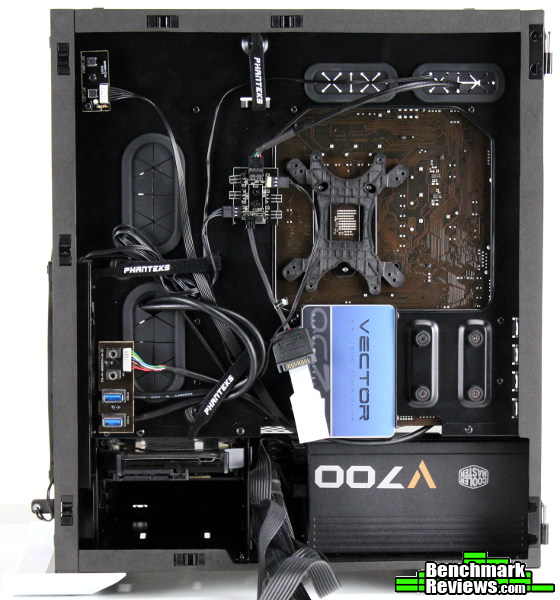
I wanted to make sure I had all of the cable bundles I would need attached to the modular power supply, since it didn’t look like I’d have room to do it later. With the drives and motherboard installed, I could start routing cables – made all the easier by the large grommeted cable routing holes and pre-installed Phanteks cable wraps. I would have liked to see at least one tie-down point for the 8-pin EPS/CPU12V cable, since I usually route that one along the rear of the case. There are a series of holes for ventilation along the back panel so I suppose one could just use a twist tie to keep that cable in place. With approximately 25mm (about an inch) of space for cables between the motherboard tray and side panel though, it probably won’t be necessary.
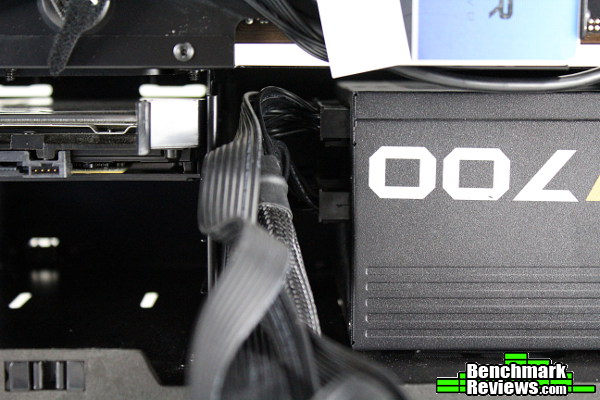
The Cooler Master V700 power supply is 170mm long, not including the modular power connectors. It fit without much of an issue but you’ll need to make sure you have all of the cables plugged in when you install it! The hard drive bay can be removed if some extra space is needed, but I feel the space provided is adequate for an enthusiast-oriented micro-ATX case.
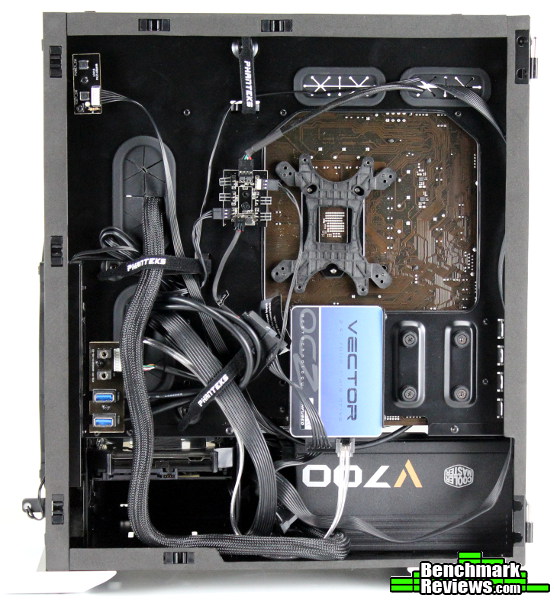
With all of the components in the wiring gets a little more interesting. I even forgot to hook up the 3.5″ hard drive in this picture, so there’s a few more cables yet to add to the bunch. The stiff USB 3.0 cable was difficult to tie down as always, but for the most part managing the cables in the EVOLV was very easy. The hook and loop cable ties were very easy to use, another nice touch by Phanteks.

Interestingly enough, the specific hardware configuration pictured above isn’t a valid one. On the ASRock Z77 Pro4-M motherboard, the second PCI-Ex16 slot is only a PCI-E x1, which means a CrossFireX configuration won’t register in Catalyst Control Center (not to mention NVIDIA – they require at least two x8 slots for SLI). Since the EVOLV only has four PCI slots available to fill, I can’t use the fourth (bottom) PCI-Ex16 on this motherboard to enable CrossFire – at least not with a dual-slot GPU. I was hoping to test the EVOLV’s capability to cool two GPUs, but it looks like a motherboard swap is in order. I’m betting the airflow from the front 200mm fan would keep things manageable, but (as with any dual-GPU solution) blower-style coolers would be preferred – or water-cooling, for that matter.

On that topic, even though the build is finished (with the window giving a nice view of the installed hardware, I might add) let’s take out those two XFX 270X’s and explore some different water-cooling options.
Since the Phanteks chassis are known for their water-cooling accommodations, let’s take a look at a few potential cooling options in the EVOLV. While I don’t have a stand-alone pump and reservoir handy, a Swiftech H220 and Kraken G10 GPU cooling bracket should at least represent some common enthusiast water-cooling options. Those that want to build a full custom loop can already see the possibilities I’m sure, but those users will almost certainly have a specific configuration in mind. For the rest of us, the introduction of relatively inexpensive GPU brackets like the G10 from NZXT allow an intermediate step up to the world of water-cooled GPUs.

The reference cooler for AMD’s R9 290 GPU didn’t do any favors for the card, so NZXT’s Kraken G10 is a popular upgrade for many enthusiasts. The hoses for the Corsair H55 Quiet Edition AIO cooler that I’ve coupled with the G10 were long enough to reach the top fan mounting points but I didn’t want to snake the cooling lines over the CPU tower cooler.

Thankfully, I could easily borrow the top 120mm fan mounting point in front. I didn’t even need to remove the front 200mm fan! There wasn’t quite enough space to add the radiator and fan directly in front of the reference R9 290; I’m sure you could swap out the front 200mm fan or just place the radiator directly behind it (if you’re comfortable with the 200mm fan doing all of the GPU cooling).

It’s a bit unorthodox but I was pleasantly surprised how easily the EVOLV handled this configuration. A push/pull setup on the H55 radiator would get a little cramped (you’ll have to bend the main 24-pin ATX cable an uncomfortable amount), but it could be done.

The GPU gets its own filtered intake without really impeding any of the stock airflow from the 200mm fan. The front mesh filter blocks off this portion with a plastic insert; it simply snaps out for configurations like this.

Of course, the typical solution would be to add fans and radiators to the area above the motherboard. There’s more than enough space (the manual states about 68mm) up here for push/pull arrangements on normal radiators – even thicker radiators for that matter, depending on your motherboard.
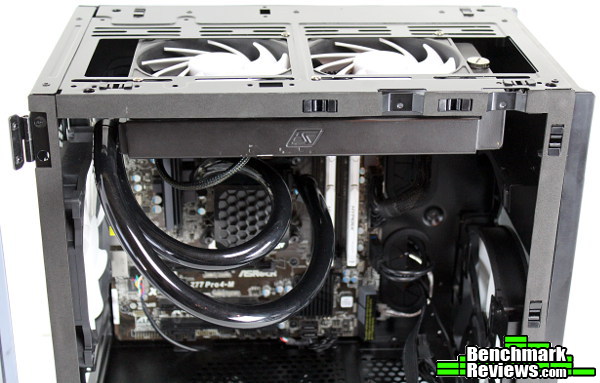
While the Swiftech H220 isn’t terribly abnormal for a 240mm cooler, I’ve encountered a few issues with clearance in the past with it’s protruding reservoir and swiveling barbs – neither of which posed an issue for the Phanteks Enthoo-EVOLV. The slots up top allowed for extremely flexible arrangement, although space for push/pull arrangements on thick radiators could potentially cause an issue for tall RAM, depending on the motherboard of course. Still, this more than a reasonable amount of room for a micro-ATX tower.
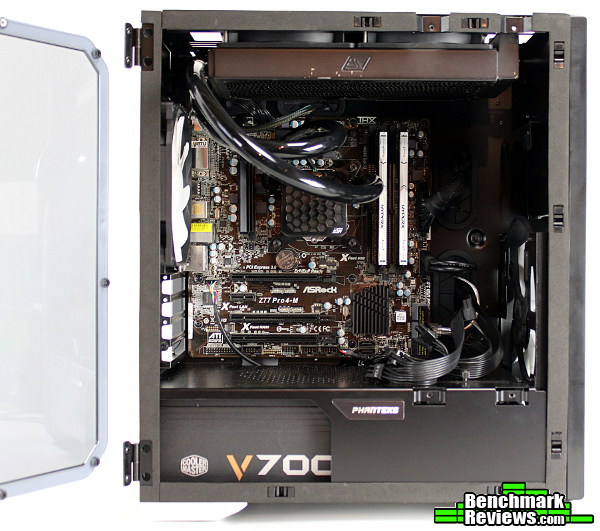
With the Swiftech H220 installed, it’s easy to see there would be more than enough room for another set of fans; there’s still room to add the R9 290 with it’s own 120mm radiator and fan too. The EVOLV is one of the few mATX enclosures currently on the market that could accommodate two 240mm radiators, so with the right set of components it would be feasible to water-cool two GPUs and the CPU in this chassis. That’s pretty impressive, and should appeal to those that want a nice home for a high-performing and quiet gaming system.
Overall, I enjoyed my time with Phanteks’ Enthoo-EVOLV. If I could use one word to describe the experience, it would be “premium.” There was just a sense of hefty, premiumness from every angle. I don’t even care that premiumness isn’t a word, it’s the first thing that stands out about the EVOLV. Phanteks really raises the bar for what a user can expect from a premium chassis, even in a form factor as non-traditional as Micro-ATX.
I’m not sure the EVOLV is as much of an evolution as the name would suggest – although the rear-facing 5.25″ bay is a delightfully unique solution (far better than ridding the chassis entirely of a space for an optical drive/bay device). This isn’t by any means a “bad thing.” Phanteks placed a lot of premium touches on this enclosure, but overall it subscribes to a pretty tried-and-true internal layout. What it doesn’t subscribe to is cutting corners. The Enthoo-EVOLV has to be the most premium-feeling, well built chassis I’ve worked with, easily in the same league as SilverStone (I would say Lian Li as well, but I don’t have any personal experience with their products).
What is unique about the EVOLV (other than the glossy, extremely thick aluminum panels) is the attention paid to custom water-cooling loops. The accessory box includes a pump bracket! If that isn’t enough, the vertical drive bracket contains multiple holes for reservoirs and pumps, and the mid-floor plate can be removed for longer radiators (or to install a pump in place of the tool-less HDD cage). It’s clear this chassis isn’t intended for a simple air-cooled build (although it certainly doesn’t struggle with those either). The only thing the EVOLV seems to be missing is a fifth PCI slot. With a different motherboard this wouldn’t be an issue, but this choice may limit some builders.

I’ll try and summarize my experience with Phanteks’ Enthoo-EVOLV in terms of Performance, Appearance, Construction, Functionality and Value categories, but as always I feel like I should add a disclaimer. You must understand that my own preferences and uses for cases differ from most; while I try to view each case as objectively as I can, I probably can’t avoid my own bias from affecting my conclusion in some manner. I implore you to think in depth of your OWN uses and preferences, and use my reviews as a guide or simply as another perspective.
I was satisfied with the performance of the Enthoo-EVOLV. The front Phanteks SP 200mm fan is a welcome feature, and the rear 140mm SP series fan completes an above-standard stock cooling arrangement. While it’s unfortunate I couldn’t test a CrossFireX arrangement with my motherboard due to the four PCI slot limit of the EVOLV, I didn’t run into any temperature issues (either CPU or GPU, water or air) with the configurations that I did try. I’m willing to bet CrossFire or SLI’d GPUs would still run a little warm in this chassis – even with the emphasis on water cooling, I’m surprised to see a fifth PCI slot didn’t make the cut. At least the flexibility in fan and radiator mounting options are adequate for most mATX builds and should allow a user to customize the performance of the EVOLV to meet their needs.
I like the way the EVOLV looks. It’s appearance is interesting enough to draw attention, but conservative enough to not appear gaudy or over the top. The appearance from every angle is attractive, and the EVOLV practically emanates a premium aura. The glossy finish on our Glacier White sample is beautiful, and although fingerprints could become an issue the high-shine finish wipes off very easily (the white does a great job of hiding them regardless). I’d love to see white in a matte finish as well, but that’s better served by the Satin Black version I suppose.
The next category is pretty easy – I simply couldn’t find any fault with the EVOLV’s construction. It was top-notch all around, and among the best I’ve ever tested. The 3mm-thick aluminum panels all over the exterior are definitely not the “soda can” variety, and are covered in a high-gloss (and high quality) white paint that actually protects the finish as well as changing the color. I actually thought the side panels were steel the first time I worked with them due to their thickness and rigidity, but I’m glad they’re aluminum – the EVOLV is heavy enough for a mATX tower. The rubber grommets don’t fall out like some other cases I’ve used, the threads on the PCI slot thumbscrews are nicely done, and even the cable wraps are the high-end versions, not the fuzzy-hooks-that-catch-on-everything types.
I think the EVOLV has an above-average amount of functionality for a micro-ATX chassis, with its various fan/radiator combinations and water-cooling accommodations. I’m a little disappointed to find that a fifth PCI slot didn’t make it into the EVOLV, allowing for some spacing between CrossFire and SLI graphics cards. That’s about the only misstep though, as the snap-on (and hinged!) panels that allow easy access to the entire chassis are but one of the many functional touches added throughout. I would like to have seen some tool-less SSD trays too, but it seems only Corsair has jumped on that wagon so far.
All of these premium touches must come at a premium price, right? With an MSRP of $144.99 (Amazon | Newegg) for the Glacier White version (the Satin Black edition is $10 less at $134.99), the EVOLV is actually priced pretty fairly when the aluminum construction and numerous premium touches are taken into account. Keep in mind, the value crowd really isn’t the target for a chassis like this – some of the cooling configurations I demonstrated were over $200 total, and they were just AIO coolers! Custom water cooling loops don’t have to be much more expensive, but $300 just on cooling probably isn’t a stretch – so why not give your system a nice home while you’re at it?
The value equation may not make sense to everyone, as there are micro-ATX cases that have just as much room for radiators and cost a little less. At $139.99, the EVOLV has to fight its way past the BitFenix Prodigy M and Fractal Design Node 804, both of which have five PCI slots (if you can’t tell, that’s a tough one for me to get over!). With five PCI slots, I think the EVOLV would be a shoe-in for a Gold Tachometer award – as it is, this is definitely a quality chassis well worth a look. While the EVOLV’s price is certainly worth it for what you receive, I’m not sure I could make a recommendation for all users; for those water-cooling enthusiasts that prefer a little luxury and extra quality though, the Phanteks Enthoo-EVOLV is an excellent chassis.
+ Premium feel throughout
+ Water-cooling reputation well-deserved
+ Quality is top-notch
+ PSU cover / midplate helps in hiding cables
+ Hinged side panels will change your entire building experience…
– Still pretty heavy for a mATX tower, even with aluminum panels
– Only four PCI slots
– Only one Drop-N-Lock SSD tray included
-
Performance: 8.25
-
Appearance: 9.50
-
Construction: 10
-
Functionality: 8.25
-
Value: 8.00


