By Tom Jaskulka
Manufacturer: NZXT., Inc.
Product Name: HUE+ Smart RGB LED Controller
Model Number: AC-HUEPS-M1
UPC: 815671012517
Price As Tested: $59.99 (Newegg | Amazon)Full Disclosure: The product sample used in this article has been provided by NZXT., Inc.
Not the first time NZXT has played with RBG LED lighting, the HUE+ provides all of the functionality (and then some) of the original HUE in an even more streamlined package. Coupled with NZXT’s free standalone software package CAM, the HUE+ Smart RGB LED Controller provides eight configurable LED presets out of the box, ranging from breathing LEDs to color fades and marquee scrolling. For the endless tinkerers and those looking for even more fine control over their system lighting, the HUE+ with CAM 3.0 allows for each LED to be individually addressed! That’s an impressive repertoire for an LED controller, but is it worth the price of admission? Benchmark Reviews has an opportunity to find out – follow along as we take a closer look at the new NZXT HUE+ Smart RGB LED Controller.

We’ll look at what you receive with the HUE+, walk through a quick installation, and cover the lighting options available. We’ll also look at the latest CAM software and the HUE+ specific options contained therein.
Features
- Dual-channel illumination with support for up to 40 LEDs per channel
- Numerous lighting modes and countless customization options
- Digitally controlled with CAM software
- Simple and versatile installation with daisy-chained design
- Smart Lighting mode enables lights to react to changing PC conditions
- Visualize PC’s sound output with Audio mode
Specifications
| Output Channels | 2 |
| Output LED Quantity | Up to 40 per channel |
| LED Strip Width | 10mm |
| Output Channel Voltage | DC 5V |
| Dimensions | 100mm x 70mm x 23.5mm |
| Included Accessories | 1 x 500 mm Extension cable 1 x 300mm Extension cable 2 x 100mm Extension cable 4 x Screws 5 x Cable ties |
| Material | Steel, Plastic, PCB |
| LED Color | Color changing RGB |
| Form Factor | 2.5″ Drive Bay |
| Connections | 4 x LED Strip 1 x Molex Power 1 x Internal micro-USB cable 2 x 500mm Connection cable |
| Mounting | HUE+ Body: Screws LED Strip: Magnets and 3M Tape |
| LED Modes | Presets: Static, Fading, Breathing, Marquee, Covering Marquee, Alternating, Spectrum Wave, Pulse Smart: CPU Temperature, GPU Temperature, FPS Custom: Customize each LED Audio (Beta): HUE+ reacts to the changing audio output from your PC |
| LED Strip Length | 300mm, 10-LED |
| Control Method | CAM Software |
| Input Connector | 5V Molex 4-pin connector |
| Warranty | 2 years |
The HUE+ is a different device entirely from the original HUE, with completely different capabilities as well. First let’s take a look at the HUE+ device itself and the included accessories.

The packaging is relatively compact. Upon opening the box, two further boxes house the HUE+, LED strips, manual and an assortment of cables and connectors.

Zip ties, a 4-pin Molex power adapter, the USB cable (micro-USB/internal header), a set of extension cables (2x10cm, 30cm, and 50cm) , and the LED-to-HUE+ connection cables (50cm) complete the cable assortment. The HUE+ itself is packaged in the other box with the four magnetic LED strips positioned around it in a separate compartment.

A far cry from the 5.25″ bay device of the original HUE, the HUE+ controller is quite compact (100mm x 70mm). It’s a little tall (23.5mm) to fit in a space designed for 9mm tall SSDs, but it can be mounted to most drive trays that accommodate 2.5″ drives.
 The only external ports on the HUE+ are the power/data and LED strip connections.

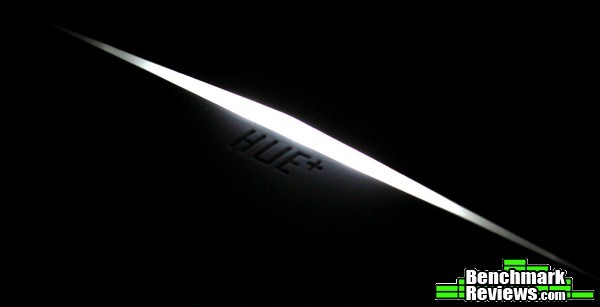
A white power LED (configurable with CAM 3.0, more on this later) is the only indication that the HUE+ is active. It’s relatively innocuous but a new software update allows for some control over this light. We’ll take a look at that in the software section, but first let’s get this kit installed!
There aren’t many requirements / prerequisites for a successful installation of the HUE+ LED kit. You’ll need a spare USB header on your motherboard and a free 4-pin molex; as long as you have space for the controller itself the hardest part is likely to be routing the extension cables between the LED strips. I decided to use a Corsair 380T mini-ITX case to try something a bit onorthodox for this installation – let’s see how it goes!
First I had to determine where to place the controller. Being an ITX case, I didn’t expect to be limited in cable length in any way (I wasn’t), so that meant I could place the controller wherever I wanted. There was a spot in front of the motherboard that was easy to access and would keep most cables out of the way, so that’s where I started.

From there I needed to find a place to install the LED strips. There are two channels on the HUE+ that can be independently controlled, effectively creating two “zones” within a case. I decided to use the front intake panel as zone/channel one, with the side panels as the second zone/channel. The Corsair 380T is a bit…oddly shaped for a computer chassis, which meant I didn’t have the typical rectangular side window to work with. The side panels on this case curve in towards the top and bottom, so only two of the four magnets in the LED strip would secure the LEDs in place. It didn’t get in the way of closing the side panel though, so this location worked out just fine.
As a potential pitfall, make sure to connect the LED strips correctly! The manual doesn’t highlight this quite as well as it should, but the arrow on the extension cable/connector should line up with the +5V marking on the LED strip (also designated by the black line on the strip itself).

I was able to route one of the 10cm extension cables underneath the motherboard tray, connecting the two LED cables on channel two with a minimum of fuss.

That left channel one. Feeding the connecting cables through the front panel was easy enough, and there was a perfect space alongside the front panel frame that LED strips could tuck into nicely. This part of the case is plastic, so the magnets wouldn’t work here – the HUE+ LED strips are also lined with double-sided tape, so this wasn’t much of an issue.

The HUE+ LED strips light up white prior to installing the CAM software, so at least you know everything is connected and working correctly. The LEDs aren’t at full strength in this daylight picture, but as with most LEDs you won’t get the full effect until the lights are off. It’s worth mentioning here that the HUE+ does not currently save any customized settings upon powering off the system – only when the CAM software is running again will your custom settings return.

Turning the lights off showcases the LEDs even more. The Corsair 380T uses a translucent frame on the side panels which is highlighted pretty nicely with the side LED strips. The front panel area is very well lit – with a little more time, one could probably hide the LED strips completely to get an even more impressive effect.

The two zones are independently configurable – just select an individual channel and set the profile that contains the effect you’d like for that zone.
NZXT recently released an updated version of their CAM software (version 3.0 adds a Games tab that tracks FPS performance of games that you play; this feature requires a CAM account to use). While I’ll focus on the HUE+ functionality, we’ll start with a quick overview of the standard components of CAM.

The first/default screen is the Dashboard. It’ll dynamically display a quick overview of your system and its performance. If you have any NZXT devices installed, they’ll show on this screen as well. The Build tab shows a quick snapshot of the components in your system and any relevant data – it’s a great stand-in for typical programs like CPU-Z or many hardware monitors.

If you don’t see your HUE+, you can easily install it from the settings menu. Use the “Install NZXT Drivers” option, and you’ll be able to add the components that you need.
 Once the appropriate module has been installed, a tab appears with the device name up top. The HUE+ is primarily concerned with LEDs, so you’ll need to click on the “Configure LEDs” button (for the selected channels) to see the different options. Presets are listed first, and contain animated graphics of each listed LED configuration.

I took a quick video of the different presets, which can be viewed below:
The SMART tab is what allows the HUE+ to double as a system-monitoring device. GPU and CPU temps as well as FPS settings are available; each changing the color along a scale to represent the current state of the system. The preset scale runs from blue to red (and inverts it for FPS – red for low, blue for high). Each color is configurable to your preference.

Even colors other than the typical red/blue/green display vividly and accurately. Some lighting systems struggle with yellow, pink and orange; the HUE+ didn’t have a problem with any color I chose.

The Custom setting is more than just a custom profile – it allows you to individually color each specific LED! With the four included strips, that’s a 4×20 LCD display – almost enough to create some simple text or icons if stacked in an array. It’s both exciting and overwhelming to think of the possibilities with the additional LED strips added (20×8, 40×4, etc.). It’s currently limited to the Fixed and Breathing LED presets so animation is out of the picture for now, but this is an intriguing tab nonetheless.

The Audio function uses the LED strips as a sort of visual equalizer. The level will progressively light additional LEDs according to the volume of the sounds running through your system. It’s a pretty neat effect that gets pretty intense during a typical gaming session (explosions/gunfire/other drama inducing sounds tend to feature heavily in games for some reason), or adds a visual aspect to a music listening experience. There is a bit of noticeable lag between the sound/action happening on screen and the LED movement, but overall it was a fun setting to use.
As I mentioned before in the NZXT GRID+v2 review, the CAM software is surprisingly functional. It doesn’t seem to suffer from growing pains quite like some other solutions out there (I gave up on Corsair Link for a couple months…) and doesn’t appear to have a significant performance impact either – at least on enthusiast-class systems likely to include the Kraken/HUE+/GRID+ products. I’m happy to see the new upgrade still doesn’t require a mandatory account to use – NZXT seems content to require an account for only those actions that would need one (notifications, remote/logging, etc.), and if CAM stays this way it’ll continue to be one of my go-to software monitoring solutions.
You should really understand a little about me before reading the conclusion about this product: I’m a sucker for blinky lights and glowy things. Don’t get me wrong; I absolutely appreciate sophisticated, minimalistic approaches to design as well. The thing is, I work on a computer all day – when I come home, I want to see something more than just another expressionless black box. One of the best aspects of building your own PC is the sheer level of customization and personalization you have access to. A product like the NZXT HUE+ won’t make sense to everyone, but for those out there (like me) that are looking for something that adds a unique, eye-catching finishing touch, a multi-color LED system is just the thing.
It’s a solution in and of itself – other than the CAM software, it doesn’t rely on any other aspect of your system to work. That means I can transplant it into any system or chassis I want, whenever I want. Modularity is another benefit to the PC ecosystem, and with the NZXT HUE+ I can add an extreme level of LED lighting to any system I want (unlike proprietary/built-in systems like Chroma, AlienFX, etc.) It doesn’t have the ability to reflect in-game events like RoccatFX or AlienFX (yet?), but with the number of options available for customization you may not even notice – and there’s an advanced HUE API for those that want to take it to another level.
$60 means something different to everyone. Currently, that can buy a mid to high level gaming mouse/headset/keyboard, or 16GB of DDR3 RAM, or another 1TB of hard drive space (if not more). No doubt many of these things would take priority over a lighting kit, but if lighting is what you’re after it doesn’t get much better than the NZXT HUE+. There are still a few things I’d want to change (setting separate profiles for the individual channels could be a bit easier, and some on-board memory to save settings during a system power off – if only to enable a stored setting to be used on Linux machines or for those that don’t want to leave CAM running in the background, for example – wouldn’t go unappreciated either), but the fact remains – if you want custom lighting, the HUE+ is the kit to beat.
The performance of the HUE+ kit (performance, in this instance, refers to the quality of the lighting) was at least as good as any other LED strip I’ve used. The magnetic LED strips use very bright RGB LEDs on a white backing, and their proximity results in smooth, even lighting. Every color I tried displayed vividly and without distortion. A little more diffusion would help blend the individual LED elements a little more (with some colors you could see the individual red/green/blue lights, as with any RGB LED), but as that’s an issue with every multi-color LED used in these types of lighting kits it isn’t much of a concern.
The appearance of the HUE+ itself is simple and elegant. It should blend in to any system. The roughly 2.5″ drive size means it can be tucked away almost anywhere; it’s the four wiring strands in the back that’ll take some cable management work to hide. That’s a small price to pay for the overall impact on appearance for a HUE+ system – it’s well worth the effort involved.
I didn’t have any issues with the construction of the HUE+ kit. The wiring seemed up to par, and the controller itself seemed like it would hold up for the life of any system. I wouldn’t expect any issues transplanting the HUE+ kit into multiple cases.
The functionality provided by the HUE+ is nothing short of overwhelming. No other LED kit will provide for this level of functionality – the closest system I can think of would be AlienFX in a dedicated Alienware laptop or desktop, and that system is proprietary. The HUE+ can be installed in any desktop system you like. The Smart lighting can highlight FPS, CPU or GPU temps, it provides more lighting modes than any other LED kit, and the CAM software is very functional, easy to use and pretty powerful – and it’s evolving constantly to add even more features.
It’s the value that might trip up many users. LED strips can be found for as little as $15, multicolor kits for not much more. The typical RGB/infrared remote kits are easily found for under $30. The HUE+ kit costs $59.99 online (Newegg | Amazon), which is a pretty high price for a case accessory. Value is different than the outright cost, and it seems most computer enthusiasts have found a substantial value in the HUE+ Smart RGB LED Controller; it’s been regularly out of stock despite it’s launch in November 2015. If you compare the feature list of the HUE+ to any other LED kit, the $60 price ends up being a very good value.
The HUE+ is a must-have accessory for anyone that enjoys tinkering with custom lighting in their systems. While the price might be an obstacle for some – I’m not sure anyone would take away from their CPU or GPU budget, for instance – it’s an easy choice for anyone looking to add a splash of color to an already-completed system. When the sheer multitude of effects is considered, along with the Smart lighting functionality and Audio settings, it’s the only kit of choice right now for lighting enthusiasts. Being “best-in-class” is a pretty rare achievement, but I can’t deny the capabilities of the HUE+ are above and beyond anything else out there right now.
+ The most functional LED kit on the market right now
+ Smart lighting doubles as temp sensor
+ Lots of lighting modes to tinker with
+ Easy to install, magnetic strips are great to work with
+ CAM software works well, doesn’t need an account to use full functionality
+ Endlessly configurable
+ Primary function – that of an RGB LED kit – works flawlessly
+ Expandable with add-on LED strips
– Uses a motherboard USB header, already at a premium on some motherboards
– Almost 10% of a typical budget gaming system’s (~$600) cost
– HUE+ won’t store “last-used” setting, needs CAM running to set custom profile
-
Performance: 9.00
-
Appearance: 9.00
-
Construction: 9.00
-
Functionality: 9.75
-
Value: 8.50
Excellence Achievement: Benchmark Reviews Golden Tachometer Award.
COMMENT QUESTION: ?


One thought on “NZXT HUE+ RGB LED Controller Review”
Yeah this LED setup is hands down exactly what I’ve been waiting for. So much in fact I bought two complete sets as they did not have additional LED’s for sale separately. My CaseLabs Magnum STH-10 on a pedestal needed every strip but one on both controllers in order to get my window completely surrounded…..seven of eight strips were easily necessary for my rig. Not to mention I do have a faulty LED strip on top of that…something I hope to remedy with NZXT directly.
One must pay attention when connecting the strips as the author has reported……it will be obvious if there is a messed up connection. One caveat I do have with this setup is that when running both channels together with a scrolling/rolling marques both channels do not like to play well with each other when moving in specific directions. For example…..making channel one move backwards so that it may “flow” into channel two that is moving forward is (almost/not sure!!) impossible…… One has to do some Houdini mumbo-jumbo by switching off specific channels in order to adjust the other channel. Still not sure on this all together, but I hope to get it hammered out in time.
Truly an amazing piece of hardware and has come leaps and bounds from when it originally released. Now if they could actually meet the demand of their market I could see this selling out like if always has for a long time…
Comments are closed.