By David Ramsey
Manufacturer: Toshiba America Electronic Components, Inc.
Product Name: OCZ VX500 MLC Solid State Drive
Part Number: VX500-25SAT3-512G
UPC: 842024037934
Prices: 128GB – $66.50, 256GB – $96.99, 512GB – $154.99, 1TB – $334.99 (Newegg)Full Disclosure: Toshiba/OCZ provided the product sample used in this article.
OCZ Storage Solutions was acquired by Toshiba, and they’ve been repurposed as Toshiba’s consumer/enthusiast brand for solid state storage. Benchmark Reviews has previously tested both the budget OCZ Trion SSD and the premium OCZ RD400 m.2 PCIe SSD; the new VX500 represents the middle of Toshiba/OCZ’s SSD range. At the time of our reviews, the 512GB RD400 was $309.99 while the 480GB Trion 150 was $139.99; with a price of $154.99, the OCZ VX500 SSD is only slightly more than the budget Trion 150 (whose price has since dropped), but it’s still much less expensive than the RD400. Let’s see how the performance and features compare.

| Capacity | 512GB |
| Interface | SATA 6Gb/s |
| Form Factor | 2.5″ |
| Controller | Toshiba prioprietary |
| NAND | Toshiba 15nm MLC Flash |
| TRIM | Yes |
| Max. Read | Up to 550MB/sec |
| Max. Write | Up to 485MB/sec |
| Write Endurance | 296TB |
| Warranty | 5 years |
Benchmark Reviews has championed SSDs over hard disks for many years, as we feel that even when prices were much higher than they are now, the superior performance was worth it. Now that SSD prices have come down dramatically, there’s little reason for any but the most basic computers to use a spinning hard disk as a primary drive.
However, we’re now in the middle of another transition: within the last 18 months or so, standard SATA SSDs have all run up against what used to be the performance province of only the higher-end drives: the bandwidth limitations of the SATA interface. This means that no matter how fast your SSD is, you’re never going to see more than about 550MB/s transfer rates unless you stripe multiple drives together in RAID 0.
The solution, of course, is to move from SATA to PCI-E and to replace the AHCI protocol with the newer NvME protocol. However, while PCI-E drives offer much better performance, they’re significantly more expensive than SATA drives, and in most consumer workloads the extra performance makes little difference. We expect SATA drives to make up the bulk of the SSD market for at least a couple more years.
Now a sub-brand of Toshiba, OCZ’s products use Toshiba controllers and NAND in their solid state storage products. We don’t know much about Toshiba’s proprietary controller, such as its architecture, number of cores, clock speed, etc.
The OCZ VX500 512GB drive comes in a standard 2.5″, 7mm thick form factor. It’s unusual for a mid-range drive to use a screwed-together metal case these days.

At the back of the drive is an indented area with a specifications label. Here we can also see a set of four jumper pins, function unknown, next to the standard SATA power and interface connectors.

Opening the drive reveals the back of the screwed-in PCB– another rarity these days in this segment– which is devoid of any circuitry.

Removing the PCB from the metal case requires a little effort, even after the screws have been removed. Once off, the reason is evident: every chip has a pink thermal pad that’s pressed against the metal drive case for heat dissipation.

Frustratingly for hardware geeks like me, the thermal pads obscure the chip markings. It’s reasonable to assume that 8 of the 9 chips are Toshiba’s 15nm MLC flash memory, and that the remaining, larger chip is the controller. Normally I’d expect a separate DDR3 memory chip as a cache or buffer, but that’s probably built into the Toshiba Mystery Controller™.
In the next section I’ll look at Toshiba’s SSD Utility software.
The archaic custom of including utility media with computer accessories having died out some time ago, you’ll make a brief trip to the Toshiba/OCZ web site to download SSD Utility.
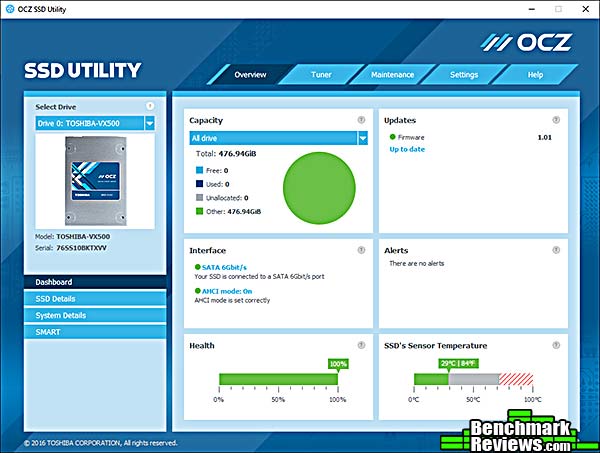
This simple and functional utility has the main divisions of Overview, Tuner, Maintenance, Settings, and Help across the top; for each selected tab, subdivisions appear at the lower left– in this case Dashboard, SSD Details, System Details, and SMART. The Dashboard screen shown above lets you quickly check how full the drive is, whether its firmware is up to date, any alerts, and overall “health” and drive temperature. While the SSD Details and System Details are things you probably already know, it’s nice to be able to look at detailed SMART (System Monitoring Analysis and Reporting Technology) information:

The Tuner section includes a simple performance benchmark…

…as well as an SSD Tuner section that allows you to set over-provisioning on the drive. Over-provisioning reduces the effective storage area of the drive by setting aside a designated portion of the drive’s storage space to buffer write operations, replace failed blocks, and other things the drive controller might require. Over provisioning is why you see some SSDs that might seem to have odd capacities like 120GB instead of 128GB, or 480GB instead of 512GB. The utility notes that over provisioning can “improve performance and lifetime of your drive”, and in this case allows you to allocate up to 143GB for this purpose. That’s overkill, but I’d have appreciated some guidance here on what an appropriate over provisioning amount might be. As delivered the drive has no over-provisioning.

The Settings part of the utility lets you designate some specific monitoring and alert functions; the defaults are shown below. It’s probably a good idea to leave these all on.

OK, let’s get to the benchmarks!
When we test storage devices, the two main metrics to consider are access time and transfer rate. Simply put, access time is the time is takes the storage device to start delivering data once the request has been received, while transfer rate is how fast (megabytes per second) the data comes once the transfer operation begins. With a hard disk, data transfer cannot begin until the disk’s head servo physically moves the read/write head to the correct track, and the rotation of the disk brings the designated sector under the head. Although modern servos are very fast, in the best case you’re still looking at several milliseconds to do this, while an SSD’s access time is always under a millisecond. The disadvantage is even worse if the data isn’t all in a contiguous space on the disk, since the head will have to be repositioned on the fly, leading to more delays.
Early consumer SSDs actually had slower transfer rates than the best hard disks, although their instantaneous access times more than made up for it. The zenith of consumer hard disk performance was probably reached in 2012 with the release of the Western Digital Velociraptor 1 terabyte disk. Spinning at 10,000RPM, this disk could under ideal circumstances (i.e. a synthetic bandwidth test) reach a sequential transfer rate of over 230MB/s. Keep this figure in mind as you read this review.
Early on in our SSD coverage, Benchmark Reviews published an article which detailed Solid State Drive Benchmark Performance Testing. The research and discussion that went into producing that article changed the way we now test SSD products. Our previous perceptions of this technology were lost on one particular difference: the wear leveling algorithm that makes data a moving target. Without conclusive linear bandwidth testing or some other method of total-capacity testing, our previous performance results were rough estimates at best.
Our test results were obtained after each SSD had been prepared using DISKPART or Sanitary Erase tools. As a word of caution, applications such as these offer immediate but temporary restoration of original ‘pristine’ performance levels. In our tests, we discovered that the maximum performance results (charted) would decay as subsequent tests were performed. SSDs attached to TRIM enabled Operating Systems will benefit from continuously refreshed performance, whereas older O/S’s will require a garbage collection (GC) tool to avoid ‘dirty NAND’ performance degradation.
It’s critically important to understand that no software for the Microsoft Windows platform can accurately measure SSD performance in a comparable fashion. Synthetic benchmark tools such as ATTO Disk Benchmark and Iometer are helpful indicators, but should not be considered the ultimate determining factor. That factor should be measured in actual user experience of real-world applications. Benchmark Reviews includes both bandwidth benchmarks and application speed tests to present a conclusive measurement of product performance.
- Motherboard: MSI Z170A GAMING M7 Socket LGA 1151
- Processor: 4.0GHz Intel Core i7-6700K Skylake CPU
- System Memory: 16GB DDR4 2133MHz
- Operating System: Microsoft Windows 10
The following storage hardware has been used in our benchmark performance testing, and may be included in portions of this article:
- Crucial RealSSD-C300 CTFDDAC256MAG-1G1 256GB SATA 6Gb/s MLC SSD
- Crucial m4 CT256M4SSD2 256GB SATA 6Gb/s MLC SSD
- Crucial M550 Solid State Drive515GBCT512M550SSD1
- Crucial MX100 Solid State Drive 512GBCT512MX100SSD1
- Crucial BX100 Solid State Drive 500GB CT500BX100SSD1
- Intel SSD 311 Series Larson Creek SSDSA2VP020G2E
- Intel SSD 320 Series MLC Solid State Drive SSDSA2CW160G3
- Intel SSD 335 Series Solid State Drive SSDSC2CT240A4K5
- Intel SSD 520 Series MLC Solid State Drive SSDSC2CW240A3
- OCZ Agility 2 OCZSSD2-2AGTE120G 120GB MLC SSD
- OCZ Agility 3 AGT3-25SAT3-240G 240GB MLC SSD
- OCZ Vertex 2 OCZSSD2-2VTXE120G 120GB MLC SSD
- OCZ Vertex 3 VTX3-25SAT3-240G 240GB MLC SSD
- OCZ Vertex 3.20 MLC SSD VTX3-25SAT3-240G.20 MLC SSD
- OCZ Vertex 4 VTX4-25SAT3-256G MLC SSD
- OCZ Vertex 450 VTX450-25SAT3-256G MLC SSD
- OCZ Vertex 460VTX460-25SAT3-240G MLC SSD
- OCZ Octane OCT1-25SAT3-512G MLC SSD
- OCZ Vector VTR1-25SAT3-256G MLC SSD
- OCZ Vector 150VTR150-25SAT3-240G MLC SSD
- Patriot Torqx 2 PT2128GS25SSDR 128GB MLC SSD
- WD SiliconEdge-Blue SSC-D0256SC-2100 256GB MLC SSD
- AS SSD Benchmark 1.6.4067.34354: Multi-purpose speed and operational performance test
- ATTO Disk Benchmark 2.46: Spot-tests static file size chunks for basic I/O bandwidth
- CrystalDiskMark 3.0.1a by Crystal Dew World: Sequential speed benchmark spot-tests various file size chunks
- Iometer 1.1.0 (built 08-Nov-2010) by Intel Corporation: Tests IOPS performance and I/O response time
- Finalwire AIDA64: Disk Benchmark component tests linear read and write bandwidth speeds
- Futuremark PCMark Vantage: HDD Benchmark Suite tests real-world drive performance
This article utilizes benchmark software tools to produce operational IOPS performance and bandwidth speed results. Each test was conducted in a specific fashion, and repeated for all products. These test results are not comparable to any other benchmark application, neither on this website or another, regardless of similar IOPS or MB/s terminology in the scores. The test results in this project are only intended to be compared to the other test results conducted in identical fashion for this article.
NOTE: OCZ now sells the Trion line of SATA SSDs as entry level drives; the VX series as mid-level drives, and the PCI-E NvME RD series as their high-end offering. I’ve removed the RD400 results from these charts since comparing its performance to SATA drives doesn’t tell us anything; you can see my review of this drive here. However, for each benchmark, I’ve outlined the scores of the VX and Trion drives in red for easy comparison.
Alex Schepeljanski of Alex Intelligent Software develops the free AS SSD Benchmark utility for testing storage devices. The AS SSD Benchmark tests sequential read and write speeds, input/output operational performance, and response times.
AS-SSD Benchmark uses compressed data, so sequential file transfer speeds may be reported lower than with other tools using uncompressed data. For this reason, we will concentrate on the operational IOPS performance in this section.
This benchmark provided a surprise: although the performance results were great with Toshiba’s native driver, the results for the 4K subsections of the test with the Windows driver were terrible…the lowest we’ve ever recorded, in fact.

OCZ VX500 Results
Compared to other SATA SSDs Benchmark Reviews has tested, the OCZ VX500 512GB drive turns in a solid mid-pack performance, although its writes are down about 30% from the chart-topping drives. Curiously, while its read results are much better than those of its entry-level Trion sibling, the latter’s write results on this benchmark are superior.

In the next section, Benchmark Reviews tests transfer rates using ATTO Disk Benchmark.
The ATTO Disk Benchmark program is free, and offers a comprehensive set of test variables to work with. In terms of disk performance, it measures interface transfer rates at various intervals for a user-specified length and then reports read and write speeds for these spot-tests. There are some minor improvements made to the 2.46 version of the program that allow for test lengths up to 2GB, but all of our benchmarks are conducted with 256MB total length. ATTO Disk Benchmark requires that an active partition be set on the drive being tested. Please consider the results displayed by this benchmark to be basic bandwidth speed performance indicators.

512GB OCZ VX500 ATTO Benchmark Results
In this case the entry-level Trion drive beats the VX500 in both read and write speeds, although the difference is admittedly small. Both drives are close to the bandwidth limit imposed by the SATA interface.

In the next section, Benchmark Reviews tests sequential performance using the CrystalDiskMark 3.0 software tool…
CrystalDiskMark 3.0 is a file transfer and operational bandwidth benchmark tool from Crystal Dew World that offers performance transfer speed results using sequential, 512KB random, and 4KB random samples. For our test results chart below, the 4KB 32-Queue Depth read and write performance was measured using a 1000MB space. CrystalDiskMark requires that an active partition be set on the drive being tested. Benchmark Reviews uses CrystalDiskMark to illustrate operational IOPS performance with multiple threads. In addition to our other tests, this benchmark allows us to determine operational bandwidth under heavy load.
CrystalDiskMark uses compressed data, so sequential file transfer speeds are reported lower than with other tools using uncompressed data. For this reason, we will concentrate on the operational IOPS performance in this section.
CrystalDiskMark 3.0 reports single-threaded sequential speeds reaching 534.4MB/s reads and 468.2MB/s writes. 4K tests at a queue depth of 32 produced 365.1MB/s read and 264.3MB/s write performance.

512GB OCZ VX500 SSD CrystalDiskMarkResults
The chart below summarizes 4K random transfer speeds with a command queue depth of 32. Although the VX500 very narrowly edges out the Trion in read speeds, the latter wins substantively on write speeds.

In the next section, we continue our testing using Iometer to measure input/output performance…
Iometer is an I/O subsystem measurement and characterization tool for single and clustered systems. Iometer does for a computer’s I/O subsystem what a dynamometer does for an engine: it measures performance under a controlled load. Iometer was originally developed by the Intel Corporation and formerly known as “Galileo”. Intel has discontinued work on Iometer, and has gifted it to the Open Source Development Lab (OSDL). There is currently a new version of Iometer in beta form, which adds several new test dimensions for SSDs.
Iometer is both a workload generator (that is, it performs I/O operations in order to stress the system) and a measurement tool (that is, it examines and records the performance of its I/O operations and their impact on the system). It can be configured to emulate the disk or network I/O load of any program or benchmark, or can be used to generate entirely synthetic I/O loads. It can generate and measure loads on single or multiple (networked) systems.
To measure random I/O response time as well as total I/O’s per second, Iometer is set to use 4KB file size chunks over a 100% random sequential distribution at a queue depth of 32 outstanding I/O’s per target. The tests are given a 50% read and 50% write distribution. While this pattern may not match traditional ‘server’ or ‘workstation’ profiles, it illustrates a single point of reference relative to our product field.
All of our SSD tests used Iometer 1.1.0 (build 08-Nov-2010) by Intel Corporation to measure IOPS performance. Iometer is configured to use 32 outstanding I/O’s per target and random 50/50 read/write distributionconfiguration: 4KB 100 Random 50-50 Read and Write.icf. The chart below illustrates combined random read and write IOPS over a 120-second Iometer test phase, where highest I/O total is preferred:

Here, the VX500 turns in a much better result than the Trion.
In our next section, we test linear read and write bandwidth performance and compare the speed of the VX500 SSD against several other top storage products using the AIDA64 Disk Benchmark.
Many enthusiasts are familiar with the Finalwire AIDA64 benchmark suite, but very few are aware of the Disk Benchmark tool available inside the program. The AIDA64 Disk Benchmark performs linear read and write bandwidth tests on each drive, and can be configured to use file chunk sizes up to 1MB (which speeds up testing and minimizes jitter in the waveform). Because of the full sector-by-sector nature of linear testing, Benchmark Reviews endorses this method for testing SSD products, as detailed in our Solid State Drive Benchmark Performance Testing article. One of the advantages SSDs have over traditional spinning-platter hard disks is much more consistent bandwidth: hard disk bandwidth drops off as the capacity draws linear read/write speed down into the inner-portion of the disk platter. AIDA64 Disk Benchmark does not require a partition to be present for testing, so all of our benchmarks are completed prior to drive formatting.
Linear disk benchmarks are superior bandwidth speed tools because they scan from the first physical sector to the last. A side affect of many linear write-performance test tools is that the data is erased as it writes to every sector on the drive. Normally this isn’t an issue, but it has been shown that partition table alignment will occasionally play a role in overall SSD performance (HDDs don’t suffer this problem).

As shown above, average read performance was just under 510MB/s. This particular read result is one of the “smoothest” I’ve seen from a SATA SSD, with only 15MB/s separating the minimum speed from the maximum speed.
AIDA64 linear write-to tests were next…

This chart was rather surprising: at just past 50% of the drive’s capacity, write performance falls into a hole, dropping to less than 100MB/s. Normally I’d attribute this to running off the edge of a cache, but I’m pretty sure the drive doesn’t have that much cache!
Now, remember that this test was run on a “clean” SSD. I thought it would be interesting to see what would happen if I ran the test again on a “dirty” drive, with block erasures required for almost every write:

It’s important to keep in mind that neither chart really reflects real-world conditions: the first test started with a “clean” SSD, so that all writes could proceed without any block erasures required. The second test results are with a completely “dirty” drive, with erasures required before virtually every write. In the “real world”, user results will be most similar to those in the first half of the first test, as the drive’s garbage collection routines and Windows TRIM will keep ample erased blocks available for most write operations.
The chart below shows the average linear read and write bandwidth speeds for a cross-section of storage devices tested with AIDA64. The Trion narrowly edges out of the VX500 in read speeds, although its more expensive stablemate wins on write speeds.

Linear tests are an important tool for comparing bandwidth speed between storage products, serve to highlight the consistent-bandwidth advantages of SSDs, which don’t suffer the read performance drop-off that HDDs do as the test proceeds away from the fast outer edge of the disk.
In the next section we use PCMark Vantage to test real-world performance…
PCMark Vantage is an objective hardware performance benchmark tool for PCs running 32- and 64-bit versions of Microsoft Windows 7. PCMark Vantage is well suited for benchmarking any type of Microsoft Windows 7 PC: from multimedia home entertainment systems and laptops, to dedicated workstations and high-end gaming rigs. Benchmark Reviews has decided to use the HDD Test Suite to demonstrate simulated real-world storage drive performance in this article.
PCMark Vantage runs eight different storage benchmarks, each with a specific purpose. Once testing is complete, results are given a PCMark score while and detailed results indicate actual transaction speeds. Since it simulates real-world consumer workloads, Vantage gives much more weight to read speeds, and fast iOPS are not as important as they would be in a server or other business environment. Here the VX500 records a substantial lead over the Trion.

Here are the detailed results for the VX500:
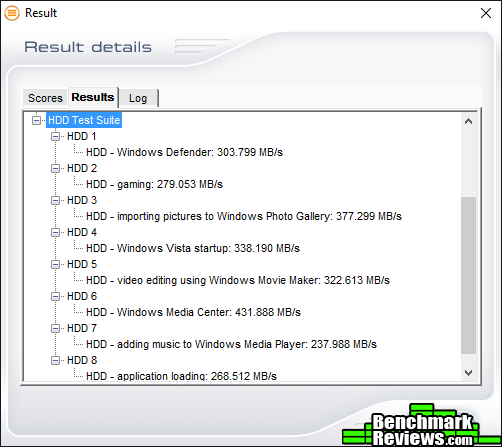
PCMark Vantage Results (OCZ VX500)
So in these benchmarks, the OCZ Trion and the OCZ VX500 trade replaces rather frequently. In the next section, I share my review conclusion and final product rating.
IMPORTANT: Although the rating and final score mentioned in this conclusion are made to be as objective as possible, please be advised that every author perceives these factors differently at various points in time. While we each do our best to ensure that all aspects of the product are considered, there are often times unforeseen market conditions and manufacturer changes which occur after publication that could render our rating obsolete. Please do not base any purchase solely on our conclusion, as it represents our product rating specifically for the product tested which may differ from future versions.
When TLC (triple level cell) NAND was introduced, it was immediately delegated to “value” SSD drives, since it had significant performance and endurance deficits compared to the more common (and more expensive) MLC NAND. However, new fabrication processes have improved both the performance and the durability of TLC NAND, and these improvements, combined with more advanced algorithms and TLC-specific SSD controllers, have substantially narrowed the performance gap.
In fact, it’s pretty safe to say that most users would not be able to discern any performance difference between these drives in day to day use. That being the case, why would one buy the 512GB VX500 at almost a 50% premium over the 480GB Trion 150?
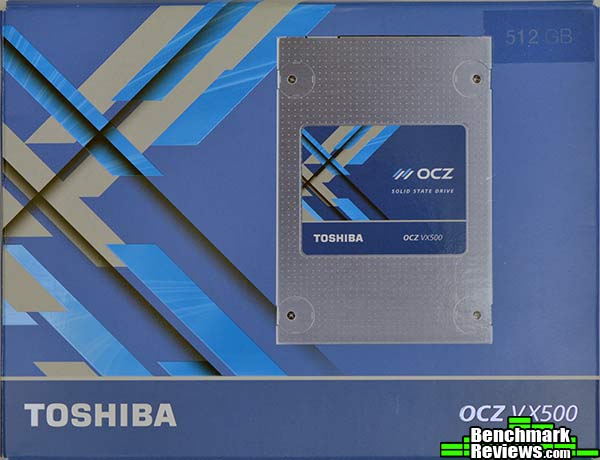
Honestly? Peace of mind more than anything else. Sure, the VX500 racks up some substantial wins, especially when the IOPS get flowing, but typical consumer workloads don’t strain the IOPS of any modern SSD, so this isn’t a metric that’s likely to make a difference. It’s interesting that Toshiba’s official specs for the VX500 quote the same sequential read speed (up to 550MB/s) as the Trion 150, and a slightly slower sustained write speed (up to 515MB/s compared to the Trion’s “Up to” 530MB/s). The distinguishing features are:
- Endurance: 296 TBW (terabytes written) as opposed to 109TBW.
- Warranty: 5 years on the VX500 vs. 3 years on the Trion.
- Software: Acronis True Image license with the VX500, nothing on the Trion 150.
As SSD price/performance ratios continue to converge, it becomes harder to declare a true winner in comparisons like this. By the time the endurance or warranty on the less expensive Trion drive runs out, you’ll probably be able to buy 1TB SSDs for well under $100.
Taken on its own, though, the OCZ VX500 512GB SSD is an excellent drive. Its price comes in at the low end of the 512GB SSD spectrum, and the inclusion of Acronis True Image backup utility enables purchasers to easily migrate their Windows installation to the new drive (a feature of True Image). The drive exceeded Toshiba’s specifications for sequential reads and writes in the ATTO utility, and overall performance was excellent, especially considering how much more money you’ll have to spend to get a drive with noticeably more performance. And to really get noticeably more performance, you’re going to have to move to a PCI-E NvME drive anyway.
As of October 2016 Newegg’s prices for OCZ VX500 are 128GB – $66.50, 256GB – $96.99, 512GB – $154.99, 1TB – $334.99, securing VX500 as a solid state drive with excellent value, especially considering its software bundle. But remember that SSD pricing is very volatile these days, and today’s bargain could be tomorrow’s overpriced tech.

+ Metal case, screw-together construction
+ Acronis True Image bundled
+ 5-year warranty
– Doesn’t convincingly outperform less expensive drives
- Performance: 8.75
- Appearance: 9.00
- Construction: 9.00
- Functionality: 9.25
- Value: 9.25
Excellence Award: Benchmark Reviews Golden Tachometer Award.
COMMENT QUESTION: Which brand of SSD do you trust most?

One thought on “Toshiba OCZ VX500 SSD Review”
One thing I can say in favor of OCZ SSDs right now is their support has been amazing. I’ve had a few very positive interactions with them that resulted in quick resolutions to the issues I was up against. That being said, I haven’t had any reason to talk to other companies because I haven’t had issues, including Samsung, PNY, Intel, Crucial, and AData.
Comments are closed.