By Olin Coles
Manufacturer: HP, Inc. (Hewlett-Packard Development Company, L.P.)
Product Name: SSD EX920 M.2 Solid State Drive
Part Number: 2YY47AA#ABC
UPC: 192018318373 EAN: 6955914605299
MSRP: 256GB $109.99, 512GB $199.99, 1TB $369.99Full Disclosure: The product sample used in this article has been provided by HP.
Hewlett-Packard, once a household name commonly associated with printers and personal computers, has now focused its efforts into peripheral and component products. Storage devices, such as external drives and internal hardware upgrades, have been a very competitive market segment for the past few years, paving the way for successful technology alliances, and allowing brands such as HP to offer some of the best solutions available.
In this article for Benchmark Reviews, we test the 1TB HP SSD EX920 M.2 (model 2YY47AA#ABC) against a host of other PCI-Express 3.1 NVME solid state drive competitors. HP suggests sustained sequential read speeds up to 3200 MB/s, and sustained sequential writes up to 1800 MB/s from their 1TB EX920 SSD, which utilizes 64-layer 3D NAND to deliver impressive storage density and reliability. Relative to solid state storage, one terabyte is an enormous amount of near-instant drive capacity. We’ll see if HP’s EX920 M.2 SSD is worth the money.

If you’ve kept up with technology news, you might notice that the primary storage interface on PCs has been updated from SATA 6Gb/s to the M.2 2280 form factor residing on the Peripheral Component Interconnect Express (PCIe) 3.0 interface. HP’s SSD EX920 is a NVME solid state drive using for modern M.2 interfaces, which are found on most current-generation desktop computers and notebook PCs.

Solid State Drive performance revolves around two dynamics: bandwidth speed (MB/s) and operational performance I/O per second (IOPS). These two metrics work together, but one may be more important than the other depending on the workload. Consider this analogy: bandwidth determines how much cargo a ship can transport in one voyage, and operational IOPS performance is how fast that ship moves back and forth. By understanding this and applying it to SSD storage, there is a clear importance set on each variable depending on the task at hand.
For casual users, especially those with laptop or desktop computers that have been upgraded to use an SSD, the naturally quick response time is enough to automatically improve the user experience. Bandwidth speed is important, but only to the extent that operational performance meets the minimum needs of the system. If an SSD has a very high bandwidth speed but a low operational performance, it will take longer to load applications and boot the computer’s Operating System than another SSD that offers higher IOPS performance.
HP SSD EX920 solid state drives are available for the full-sized 80x22mm M.2 2280 form factor, and offered in four capacities: 256GB, 512GB, 1TB, and 2TB. The 1TB HP EX920 solid state drive we’re testing will be available in April for $369.99 MSRP. This kit includes the SSD, M.2 retention screw, install guide, and warranty.
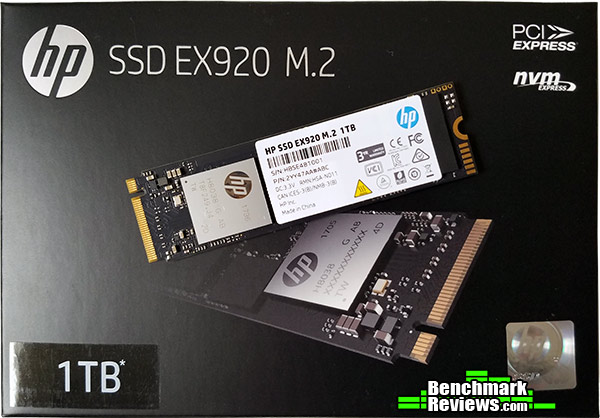
Solid state storage has become standard equipment for performance-minded consumers because they work equally well in PC, Linux, or Apple computer systems. Likewise, these storage devices easily install into modern desktop and notebook platforms equipped with a M.2 2280 card slot. EX920 is designed for performance enthusiasts, and gives personal computers a much faster response time that can really help boost productivity and user experience.
The HP SSD EX920 M.2 Solid State Drive utilizes 64-layer 3-bit TLC NAND technology, which is stronger than planar NAND and offers superior sequential performance. The 1TB model we received boasts a 300 Terabytes Written (TBW) endurance over three years, coinciding with HP’s 3-year limited warranty.
 HP SSD EX920 M.2 utilizes an HP PCIe-to-NAND controller to manage 4x PCIe Gen 3 bandwidth with the host, while managing multiple NAND flash memory across 8 channels. On each side of the SSD’s PCB is a single 512GB NANYA NT5CC256M16DP-DI 1600MHz DDR3 DRAM chip, delivering 1GB total buffer for EX920.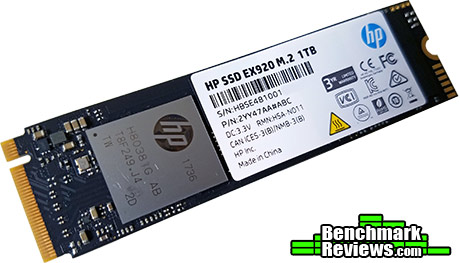
HP SSD EX920 is intended for the full-sized 80x22mm M.2 2280 form factor, secured with an included Philips head screw (although most devices have a retaining screw already in place). Like most other M.2 SSDs, the EX920 does not benefit from any heatspreader device to cool the NAND or DRAM chips on the board.
 In the next few sections we’ll benchmark test the HP SSD EX920, and compare this M.2 solid state drive to other NVME storage products intended for notebook and desktop installations. For reference, HP advertises up to 3200 MB/s read and 1800 MB/s write speeds for their 1TB EX920 solid state drive.
Early on in our SSD coverage, Benchmark Reviews published an article which detailed Solid State Drive Benchmark Performance Testing. The research and discussion that went into producing that article changed the way we now test SSD products. Our previous perceptions of this technology were lost on one particular difference: the wear leveling algorithm that makes data a moving target. Without conclusive linear bandwidth testing or some other method of total-capacity testing, our previous performance results were rough estimates at best.
Our test results were obtained after each SSD had been prepared using DISKPART, or similar proprietary tools such as Samsung Magician. As a word of caution, applications such as these offer immediate but temporary restoration of original ‘pristine’ performance levels. SSDs attached to TRIM enabled Operating Systems will benefit from continuously refreshed performance, whereas older O/S’s will require a garbage collection (GC) tool to avoid ‘dirty NAND’ performance degradation.
It’s critically important to understand that no single software tool for the Microsoft Windows platform can accurately measure comprehensive SSD performance in a comparable fashion. Synthetic benchmark tools such as ATTO Disk Benchmark and Iometer are helpful indicators, but should not be considered the ultimate determining factor. That factor should be measured in actual user experience of real-world applications. Benchmark Reviews includes both bandwidth benchmarks and application speed tests to present a conclusive measurement of product performance.
- Motherboard: MSI Z170A GAMING M7 (Intel Socket LGA 1151 Chipset)
- Processor: Intel Core i7-6700K 4.0 GHz Skylake CPU
- System Memory: 32GB (2x 16GB) Corsair Vengeance LPX DDR4 2400MHz C14
- M.2 NVME Storage HBA: Integrated Intel Z170 Controller
- SATA Storage HBA: Integrated Intel Z170 Controller
- Intel Rapid Storage Technology Driver 15.9.0.1015
- Operating System: Microsoft Windows 10 Pro, 64-bit
- AS SSD Benchmark 2.0.6485: Multi-purpose speed and operational performance test
- ATTO Disk Benchmark 3.05: Spot-tests static file size chunks for basic I/O bandwidth
- CrystalDiskMark 5.5.0 x64 by Crystal Dew World: Sequential speed benchmark spot-tests file size chunks
- Iometer 1.1.0 (built 08-Nov-2010) by Intel Corporation: Tests IOPS performance and I/O response time
- Finalwire AIDA64: Disk Benchmark component tests linear read and write bandwidth speeds
- Futuremark PCMark Vantage: HDD Benchmark Suite tests real-world drive performance
This article utilizes benchmark software tools to produce operational IOPS performance and bandwidth speed results. Each test was conducted in a specific fashion, and repeated for all products. These test results are not comparable to any other benchmark application, neither on this website or another, regardless of similar IOPS or MB/s terminology in the scores. The test results in this project are only intended to be compared to the other test results conducted in identical fashion for this article.
Alex Schepeljanski developed the free AS SSD Benchmark utility for testing storage devices. AS SSD Benchmark tests sequential read and write speeds, input/output operational performance, and response times.
AS-SSD Benchmark uses compressed data, so sequential file transfer speeds are reported lower than with tools using uncompressed data. For this reason, we will concentrate on the operational IOPS performance in this section.
Beginning with sequential transfer performance, the 1TB HP EX920 solid state drive produced read speeds averaging 2753 MB/s and write speeds averaging 1739 MB/s.
Single-threaded 4K IOPS performance tests delivered 66 MB/s reads and 161 MB/s writes, while the 64-thread 4K read test recorded 1354 MB/s with write speed at 1113 MB/s.

1TB HP SSD EX920 AS-SSD Results
The chart below is sorted by total combined AS SSD 4KB 64-thread performance for each NVM Express solid state storage device, which helps illustrate which products offer the best operational input/output under load:

In the next section, Benchmark Reviews tests transfer rates using ATTO Disk Benchmark.
The ATTO Disk Benchmark program is free, and offers a comprehensive set of test variables to work with. In terms of disk performance, it measures interface transfer rates at various intervals for a user-specified length and then reports read and write speeds for these spot-tests. Please consider the results displayed by this benchmark to be basic bandwidth speed performance indicators. Note that version 3.05 produces results identical to 2.47.
 1TB HP SSD EX920 ATTO v2.47 Benchmark Results

1TB HP SSD EX920 ATTO v3.05 Benchmark Results
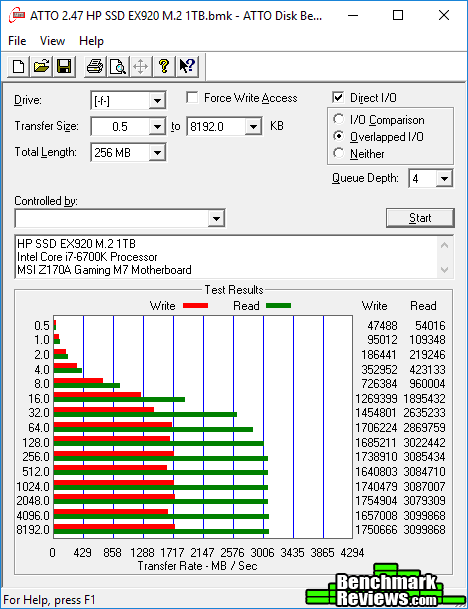
The 1TB HP SSD EX920 model provided for testing produced read speeds up to 3100 MB/s that plateaued from 256KB-8MB file chunks, which falls a bit short of the 3200 MB/s peak specification. Write speeds nearly reached their specified peak of 1800 MB/s, producing 1755 MB/s with ATTO that plateaued from 64KB-8MB.
Below is a comparison of all recent ATTO test results, sorted by combined total:

In the next section, Benchmark Reviews tests sequential performance using the CrystalDiskMark software tool…
CrystalDiskMark is a file transfer and operational bandwidth benchmark tool from Crystal Dew World that offers performance transfer speed results using sequential, 512KB random, and 4KB random samples. For our test results chart below, the 4KB 32-Queue Depth read and write performance was measured using a 1GiB space. Benchmark Reviews uses CrystalDiskMark to illustrate operational IOPS performance with multiple threads.
In addition to our other tests, CrystalDiskMark allows us to determine operational bandwidth under heavy load. CrystalDiskMark uses compressed data, so sequential file transfer speeds are reported lower than with other tools using uncompressed data. Note that versions prior to 6.x are obsolete, but share comparable test results.
CrystalDiskMark reports Sequential Q32T1 speeds reaching 3183 MB/s reads and 1776 MB/s writes, which nearly meet the specified peak read and write speed for this solid state drive.

1TB HP SSD EX920 CrystalDiskMark Results
4K Q32 IOPS performance reached 730.5 MB/s read speeds, and 537.2 MB/s write speeds, which are compared against other SSDs in the chart below and sorted by combined total. These values represent the operational performance levels for enthusiast storage solutions under load:

In the next section, we continue our testing using Iometer to measure input/output performance…
Iometer is an I/O subsystem measurement and characterization tool for single and clustered systems. Iometer does for a computer’s I/O subsystem what a dynamometer does for an engine: it measures performance under a controlled load. Iometer was originally developed by the Intel Corporation and formerly known as “Galileo”. Intel has discontinued work on Iometer, and has gifted it to the Open Source Development Lab (OSDL). There is currently a new version of Iometer in beta form, which adds several new test dimensions for SSDs.
Iometer is both a workload generator (performs I/O operations in order to stress the system) and a measurement tool (examines and records the performance of its I/O operations and their impact on the system). It can be configured to emulate the disk or network I/O load of any program or benchmark, or can be used to generate entirely synthetic I/O loads. It can generate and measure loads on single or multiple (networked) systems.
To measure random I/O response time as well as total I/O’s per second, Iometer is set to use 4KB file size chunks over a 100% random sequential distribution at a queue depth of 32 outstanding I/O’s per target. The tests are given a 50% read and 50% write distribution. While this pattern may not match traditional ‘server’ or ‘workstation’ profiles, it illustrates a single point of reference relative to our product field.
All of our SSD tests used Iometer 1.1.0 (build 08-Nov-2010) by Intel Corporation to measure IOPS performance. Iometer is configured to use 32 outstanding I/O’s per target and random 50/50 read/write distribution configuration: 4KB 100 Random 50-50 Read and Write.icf. The chart below illustrates combined random read and write IOPS over a 120-second Iometer test phase, where highest I/O total is preferred:

1TB HP SSD EX920 M.2 IOPS Results
The 1TB HP SSD EX920 M.2 solid state drive we received for testing produced 159,319 combined IOPS. Specifically, it produced 79,645 4K read IOPS, falling far short of the 350,000 maximum 4K read IOPS specified, and also produced 79,674 4K write IOPS, missing the 250,000 maximum specified.
It should be noted that most modern SSDs deliver I/O far beyond the needs of multi-tasking power users and hardcore gamers, however our results indicate that the HP SSD EX920 M.2 series would also be sufficient for systems utilizing virtual machines.
In our next section, we test linear read and write bandwidth performance and compare its speed against several other top storage products using EVEREST Disk Benchmark. Benchmark Reviews feels that linear tests are excellent for rating SSDs, however HDDs are put at a disadvantage with these tests whenever capacity is high.
The AIDA64 Disk Benchmark performs linear read and write bandwidth tests on each drive, using file chunk sizes of 1MB to speed up testing and minimizes jitter in the waveform. Because of the full sector-by-sector nature of linear testing, Benchmark Reviews endorses this method for testing SSD products, as detailed in our Solid State Drive Benchmark Performance Testing article. AIDA64 Disk Benchmark does not require a partition to be present for testing, so all of our benchmarks are completed prior to drive formatting.
Linear disk benchmarks are superior bandwidth speed tools in my opinion, because they scan from the first physical sector to the last. A side affect of many linear write-performance test tools is that the data is erased as it writes to every sector on the drive. Normally this isn’t an issue, but it has been shown that partition table alignment will occasionally play a role in overall SSD performance (HDDs don’t suffer this problem).

1TB HP SSD EX920 Read Results
The high-performance storage products tested with Lavalys AIDA64 Disk Benchmark use a 1MB block size option. Charted above, performance on the 1TB HP SSD EX920 M.2 measured average read speeds of 2338 MB/s.
AIDA64 linear write-to tests were next…

1TB HP SSD EX920 Write Results
The waveform chart above illustrates how the EX920 managed file write transfers. The EX920 briefly recorded linear write-to speeds around 1688 MB/s, likely filling the 1GB DDR3 cache buffer, before sequential performance dropped to produce average write speeds around 853 MB/s.
The chart below shows the average linear read and write bandwidth speeds for SATA devices tested with AIDA64:

In the next section we use PCMark Vantage to test real-world performance…
PCMark Vantage is an objective hardware performance benchmark tool for PCs, and the HDD Test is well suited for benchmarking solid state and hard disk storage. Benchmark Reviews has decided to use the HDD Test Suite to demonstrate simulated real-world storage drive performance in this article.
PCMark Vantage runs eight different storage benchmarks, each with a specific purpose. Once testing is complete, results are given a PCMark score while and detailed results indicate actual transaction speeds. HP’s EX920 produced an impressive total PCMark Vantage (secondary) HDD Test Suite score of 257,777.
Specific benchmark speeds are reported below:

1TB HP SSD EX920 PCMark Vantage Results
Please note that PCMark Vantage is not comparable to other PCMark tests, and may not be fairly compared to storage devices attached to other computer systems.

In the next section, I share my review conclusion and final product rating.
IMPORTANT: Although the rating and final score mentioned in this conclusion are made to be as objective as possible, please be advised that every author perceives these factors differently. While we each do our best to ensure that all aspects of the product are considered, there are often times unforeseen market conditions and manufacturer changes occurring after publication which might render our rating obsolete. Please do not base any purchase solely on this conclusion, as it represents our rating specifically for the item tested which may differ from future versions. Benchmark Reviews begins our conclusion with a short summary for each of the areas that we rate.
Our performance rating compares how effective the 1TB HP SSD EX920 M.2 performed in benchmark operations against competing solid state drive storage solutions. For reference, HP specifications suggest 3200 MB/s maximum reads and 1800 MB/s maximum write speeds for this 1TB EX920. In our storage benchmark tests, the EX920 nearly met these ratings. ATTO Disk Benchmark delivered 3100/1755 MBps peak read/writes speeds, placing it among the top performers. Sequential read/write speed tests with AS-SSD Benchmark produced 2753/1739 MBps, and 3183/1776 in CrystalDiskMark tests. Linear testing with AIDA64 produced 2502 MB/s reads and 853 MB/s writes.
The 1TB HP EX920 M.2 solid state drive sent to us for testing advertises 350,000 maximum 4K read IOPS and 250,000 maximum 4K QD32 write performance. Using Iometer operational performance tests configured to a queue depth of 32 outstanding I/O’s per target across 100% of the drive, our benchmarks produced 79,645 4K read and 79,674 write IOPS, falling far short of the peak speeds. CrystalDiskMark 4K Q32 IOPS performance was the best we’ve seen, however, topping the charts. Looking at 4K 32QD results using AS-SSD, EX920 again surpassed all other SSDs tested. PCMark Vantage synthetic ‘real-world’ storage test result edged out Samsung’s SSD 960 PRO.
Performance for HP’s SSD EX920 M.2 is best summarized as incredibly fast speeds with satisfactory IOPS.
Solid State Drives are typically only seen during installation, and then promptly forgotten. So with regard to appearance, it is truly a function over fashion proposition. Keeping in mind that M.2 SSDs are typically naked printed circuit boards with exposed chips on each side, there’s little more that can be done to improve their presentation apart from stickers or fancy metal heat spreaders. HP kept with the industry standard in EX920’s simplicity.
Construction is probably the strongest feature credited to the entire solid state product segment, allowing HP to stand behind the quality of their product with a three-year warranty. SSDs are by nature immune to vibration, but without the metal shell of SATA variants these M.2 storage devices have exposed components atop an open PCB that require careful handling. If there are ever any problems with a HP SSD EX920 M.2 unit during the warranty period, end-users may utilize their first-class local support.
As of April 2018, the HP SSD EX920 M.2 series was not yet available online. HP supplied their suggested retail pricing as follows: 256GB $109.99, 512GB $199.99, 1TB $369.99. Based on the MSRP, pricing appears to be on-par with other 3-bit MLC SSDs in the M.2 2280 segment.
In conclusion, the HP EX920 was an impressive entry for Hewlett-Packard into the M.2 SSD market. Competing directly with top rivals such as Samsung’s 960 EVO, HP’s EX920 often outperformed this and all other offerings. Read speeds, the only metric that truly matters for everyday users, was blazing fast. Write speeds, important when loading apps and saving files, was impressive. IOPS performance, while not appropriate for high-IO server application, still far exceeds the needs of gamers and power users. Based on all our test results, I recommend the HP SSD EX920 M.2 and offer our Benchmark Reviews Golden Tachometer Award.
+ Incredible 3183/1776 MBps read/write in CrystalDiskMark
+ Random 4K read/writes produced 159,319 IOPS
+ Utilizes 64-cell layer 3-bit TLC NAND
+ 3-Year HP product warranty support
+ Lightweight compact storage solution
+ Very good price for performance and capacity
– Other brands offer a 5-year warranty
– IOPS performance falls short of max specification
- Performance: 9.50
- Appearance: 8.50
- Construction: 9.50
- Functionality: 9.25
- Value: 8.25
Excellence Achievement: Benchmark Reviews Golden Tachometer Award.
COMMENT QUESTION: Which brand of SSD do you trust most?


8 thoughts on “HP SSD EX920 M.2 Solid State Drive Review”
You state that it often outperforms the Samsung 960 EVO 1TB but I don’t see the 960 EVO 1TB in any of those benches …
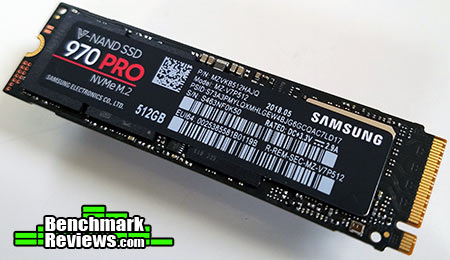
That’s because we tested it against a 960 EVO 500GB, as repeatedly pointed out in every single chart.
The 1TB benches higher than the 500GB. Not a fair comparison.
Certainly not an apples to apples comparison, I agree. Our manufacturers and product sponsors often send all media a specific capacity SSD, making it difficult to match NAND density across the board. We do the best with what we’re given, and offer the results to our visitors at the expense of our time and resources.
Got the 512GB variant, the CrystalDiskMark results are virtually identical to the 1TB, even faster, especially the 4k results, but that’s probably because it’s paired with an i7-8700 no-k, C-states were disabled and windows power options was set to high performance. It’s a great drive.
Here’s are the results: https://imgur.com/a/nl8UcqI
Thank you for sharing your results, Simon!
Our SSD test system has Windows 10 power options set to performance, and I’ll double-check the Intel Core i7-6700K 4.0 GHz Skylake CPU settings.
No power measurements.
Idle power is very important. Most NVME drives burn through power and are way less efficient compared to SATA drives. It would be great to know what power draw is like for obvious reasons.
The HP ex920 destroys the competition in terms of idle power consumption… It’s a great drive! “Stole” mine on sale for $130 (512GB)!
Comments are closed.