By Olin Coles
Manufacturer: Samsung Electronics Co., Ltd.
Product Name: SSD 970 PRO NVMe M.2 Solid State Drive
Part Number: MZVKB512HAJK
Model Number: MZ-VKB512BW (MZ-VKB512)
UPC: 887276261904 EAN: 8801643205355
Price As Tested: $229.99 (Amazon | Newegg)Full Disclosure: The product sample used in this article has been provided by Samsung.
Not so long ago Samsung debuted their third-generation NVMe client storage devices with their SSD 970 PRO M.2 solid state drive series. In this article, Benchmark Reviews tests the 512GB Samsung SSD 970 PRO, which pairs their latest 2-bit MLC V-NAND and a 512MB LPDDR4 DRAM cache buffer with their new Phoenix controller to produce up to 3500 MB/s reads at 370,000 IOPS and 2300 MB/s writes at 500,000 IOPS, and we compare performance against all the leading competition. We’ll find out if Samsung’s 970 PRO SSD is worth the money.

Over the past year motherboard manufacturers have updated the primary storage interface from SATA 6Gb/s to the M.2 2280 form factor residing on the Peripheral Component Interconnect Express (PCIe) 3.0 interface. Samsung’s SSD 970 PRO is a NVMe 1.3 solid state drive for the modern 2280 form factor M.2 interface, which is found on most current-generation desktop computers and notebook PCs.

Solid State Drive performance revolves around two dynamics: bandwidth speed (MB/s) and operational performance I/O per second (IOPS). These two metrics work together, but one may be more important than the other depending on the workload. Consider this analogy: bandwidth determines how much cargo a ship can transport in one voyage, and operational IOPS performance is how fast that ship moves back and forth. By understanding this and applying it to SSD storage, there is a clear importance set on each variable depending on the task at hand.
For casual users, especially those with laptop or desktop computers that have been upgraded to use an SSD, the naturally quick response time is enough to automatically improve the user experience. Bandwidth speed is important, but only to the extent that operational performance meets the minimum needs of the system. If an SSD has a very high bandwidth speed but a low operational performance, it will take longer to load applications and boot the computer’s Operating System than another SSD that offers higher IOPS performance.
Samsung’s SSD 970 PRO solid state drive series are available for M.2 2280 form factor motherboards, and offered in four capacities: 250GB, 500GB, 512GB, 2TB. The 512GB Samsung SSD 970 PRO solid state drive we received for testing in this review is presently available online for $229.99 (Amazon | Newegg).

Solid state storage has become standard equipment for performance-minded consumers because they work equally well in PC, Linux, or Apple computer systems. Likewise, these storage devices easily install into modern desktop and notebook platforms equipped with a M.2 2280 card slot. 970 PRO is designed for performance enthusiasts, and gives personal computers a much faster response time that can really help boost productivity and user experience.
 Samsung’s 2-bit MLC V-NAND technology is designed to sustain an 600TB Terabytes Written (TBW) for the 512GB unit we’re testing, and 1200TB for the 1TB capacity 970 PRO, coinciding with Samsung’s industry-leading 5-year limited warranty.
 SSD 970 PRO utilizes Samsung’s ‘Phoneix’ PCIe-to-NAND controller to manage 4x PCIe Gen 3 bandwidth with the host, while managing multiple NAND flash memory across 8 channels. The LPDDR4 buffer on 970 PRO varies by capacity: 512MB cache for 512GB capacities, 1GB cache for the 1TB model.
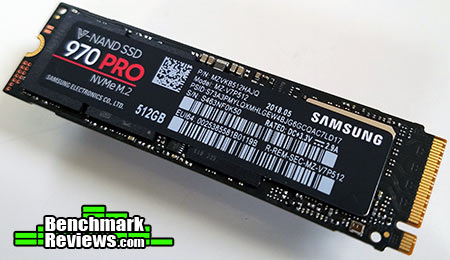
Samsung SSD 970 PRO is intended for the full-sized 80x22mm M.2 2280 form factor. Like most other M.2 SSDs, the 970 PRO does not benefit from any heatspreader device to cool the NAND or DRAM chips on the board.
 In the next few sections we’ll benchmark test the Samsung SSD 970 PRO, and compare this M.2 solid state drive to other NVMe storage products intended for notebook and desktop installations. For reference, Samsung advertises up to 3500 MB/s read and 2300 MB/s write speeds for this 512GB 970 PRO solid state drive.
Early on in our SSD coverage, Benchmark Reviews published an article which detailed Solid State Drive Benchmark Performance Testing. The research and discussion that went into producing that article changed the way we now test SSD products. Our previous perceptions of this technology were lost on one particular difference: the wear leveling algorithm that makes data a moving target. Without conclusive linear bandwidth testing or some other method of total-capacity testing, our previous performance results were rough estimates at best.
Our test results were obtained after each SSD had been prepared using DISKPART, or similar proprietary tools such as Samsung Magician. As a word of caution, applications such as these offer immediate but temporary restoration of original ‘pristine’ performance levels. SSDs attached to TRIM enabled Operating Systems will benefit from continuously refreshed performance, whereas older O/S’s will require a garbage collection (GC) tool to avoid ‘dirty NAND’ performance degradation.
It’s critically important to understand that no single software tool for the Microsoft Windows platform can accurately measure comprehensive SSD performance in a comparable fashion. Synthetic benchmark tools such as ATTO Disk Benchmark and Iometer are helpful indicators, but should not be considered the ultimate determining factor. That factor should be measured in actual user experience of real-world applications. Benchmark Reviews includes both bandwidth benchmarks and application speed tests to present a conclusive measurement of product performance.
- Motherboard: MSI Z170A GAMING M7 (Intel Socket LGA 1151 Chipset)
- Processor: Intel Core i7-6700K 4.0 GHz Skylake CPU
- System Memory: 32GB (2x 16GB) Corsair Vengeance LPX DDR4 2400MHz C14
- M.2 NVMe Storage HBA: Integrated Intel Z170 Controller
- SATA Storage HBA: Integrated Intel Z170 Controller
- Intel Rapid Storage Technology Driver 15.9.0.1015
- Operating System: Microsoft Windows 10 Pro, 64-bit
- AS SSD Benchmark 2.0.6485: Multi-purpose speed and operational performance test
- ATTO Disk Benchmark 3.05: Spot-tests static file size chunks for basic I/O bandwidth
- CrystalDiskMark 5.5.0 x64 by Crystal Dew World: Sequential speed benchmark spot-tests file size chunks
- Iometer 1.1.0 (built 08-Nov-2010) by Intel Corporation: Tests IOPS performance and I/O response time
- Finalwire AIDA64: Disk Benchmark component tests linear read and write bandwidth speeds
- Anvil Storage Benchmark 1.1.0: Sequential tests at multiple queue depths and file size chunks
This article utilizes benchmark software tools to produce operational IOPS performance and bandwidth speed results. Each test was conducted in a specific fashion, and repeated for all products. These test results are not comparable to any other benchmark application, neither on this website or another, regardless of similar IOPS or MB/s terminology in the scores. The test results in this project are only intended to be compared to the other test results conducted in identical fashion for this article.
EDITORS NOTE: Our test results have been recollected for this project, as our test system has been rebuilt and would not replicate previously recorded results.
Alex Schepeljanski developed the free AS SSD Benchmark utility for testing storage devices. AS SSD Benchmark tests sequential read and write speeds, input/output operational performance, and response times.
AS-SSD Benchmark uses compressed data, so sequential file transfer speeds are reported lower than with tools using uncompressed data. For this reason, we will concentrate on the operational IOPS performance in this section.
Beginning with sequential transfer performance, the 512GB Samsung SSD 970 PRO solid state drive produced read speeds averaging 3102 MB/s and write speeds averaging 2099 MB/s.
Single-threaded 4K IOPS performance tests delivered 55 MB/s reads and 141 MB/s writes, while the 64-thread 4K read test recorded 1291 MB/s with write speed at 1627 MB/s.

512GB Samsung 970 PRO AS-SSD Results
The chart below is sorted by total combined AS SSD 4KB 64-thread performance for each NVM Express solid state storage device, which helps illustrate which products offer the best operational input/output under load:

In the next section, Benchmark Reviews tests transfer rates using ATTO Disk Benchmark.
The ATTO Disk Benchmark program is free, and offers a comprehensive set of test variables to work with. In terms of disk performance, it measures interface transfer rates at various intervals for a user-specified length and then reports read and write speeds for these spot-tests. Please consider the results displayed by this benchmark to be basic bandwidth speed performance indicators.

512GB Samsung 970 PRO ATTO Benchmark Results
The 512GB Samsung SSD 970 PRO model provided for testing produced read speeds up to 3570 MB/s that plateaued between 64KB-12MB file chunks, which exceeds the 3500 MB/s peak specification. Write speeds also surpassed their specified peak of 2300 MB/s, producing 2336 MB/s with ATTO that plateaued from 32KB-12MB.
Below is a comparison of all recent ATTO test results, sorted by combined total:

In the next section, Benchmark Reviews tests sequential performance using the CrystalDiskMark 3.0 software tool…
CrystalDiskMark is a file transfer and operational bandwidth benchmark tool from Crystal Dew World that offers performance transfer speed results using sequential, 512KB random, and 4KB random samples. For our test results chart below, the 4KB 32-Queue Depth read and write performance was measured using a 1GiB space. Benchmark Reviews uses CrystalDiskMark to illustrate operational IOPS performance with multiple threads.
In addition to our other tests, CrystalDiskMark allows us to determine operational bandwidth under heavy load. CrystalDiskMark uses compressed data, so sequential file transfer speeds are reported lower than with other tools using uncompressed data. Note that versions prior to 6.x are obsolete, but share comparable test results.
CrystalDiskMark reports Sequential Q32T1 speeds reaching 3565 MB/s reads and 2301 MB/s writes, which exceeds the specified peak read speed and meets the specified maximum write speed for this solid state drive. 4K Q32 IOPS performance reached 402 MB/s read speeds and 292 MB/s write speeds.

512GB Samsung 970 PRO CrystalDiskMark Results
Sequential Q32T1 speeds are represented in the chart below, sorted by combined total:

In the next section, we continue our testing using Iometer to measure input/output performance…
Iometer is an I/O subsystem measurement and characterization tool for single and clustered systems. Iometer does for a computer’s I/O subsystem what a dynamometer does for an engine: it measures performance under a controlled load. Iometer was originally developed by the Intel Corporation and formerly known as “Galileo”. Intel has discontinued work on Iometer, and has gifted it to the Open Source Development Lab (OSDL). There is currently a new version of Iometer in beta form, which adds several new test dimensions for SSDs.
Iometer is both a workload generator (performs I/O operations in order to stress the system) and a measurement tool (examines and records the performance of its I/O operations and their impact on the system). It can be configured to emulate the disk or network I/O load of any program or benchmark, or can be used to generate entirely synthetic I/O loads. It can generate and measure loads on single or multiple (networked) systems.
To measure random I/O response time as well as total I/O’s per second, Iometer is set to use 4KB file size chunks over a 100% random sequential distribution at a queue depth of 32 outstanding I/O’s per target. The tests are given a 50% read and 50% write distribution. While this pattern may not match traditional ‘server’ or ‘workstation’ profiles, it illustrates a single point of reference relative to our product field.
All of our SSD tests used Iometer 1.1.0 (build 08-Nov-2010) by Intel Corporation to measure IOPS performance. Iometer is configured to use 32 outstanding I/O’s per target and random 50/50 read/write distribution configuration: 4KB 100 Random 50-50 Read and Write.icf. The chart below illustrates combined random read and write IOPS over a 120-second Iometer test phase, where highest I/O total is preferred:

512GB Samsung 970 PRO IOPS Results
The 512GB Samsung SSD 970 PRO M.2 solid state drive we received for testing produced 165,325 combined IOPS. Trailing behind it is the 1TB Samsung 970 EVO, with 161,809.
It should be noted that most modern SSDs deliver I/O far beyond the needs of multi-tasking power users and hardcore gamers, however our results indicate that the Samsung SSD 970 PRO series would also be sufficient for systems utilizing virtual machines.
In our next section, we test linear read and write bandwidth performance and compare its speed against several other top storage products using AIDA64 Disk Benchmark. Benchmark Reviews feels that linear tests are excellent for rating SSDs, however HDDs are put at a disadvantage with these tests whenever capacity is high.
The AIDA64 Disk Benchmark performs linear read and write bandwidth tests on each drive, using file chunk sizes of 1MB to speed up testing and minimizes jitter in the waveform. Because of the full sector-by-sector nature of linear testing, Benchmark Reviews endorses this method for testing SSD products, as detailed in our Solid State Drive Benchmark Performance Testing article. AIDA64 Disk Benchmark does not require a partition to be present for testing, so all of our benchmarks are completed prior to drive formatting.
Linear disk benchmarks are superior bandwidth speed tools in my opinion, because they scan from the first physical sector to the last. A side affect of many linear write-performance test tools is that the data is erased as it writes to every sector on the drive. Normally this isn’t an issue, but it has been shown that partition table alignment will occasionally play a role in overall SSD performance (HDDs don’t suffer this problem).

512GB Samsung 970 PRO Read Results
The high-performance storage products tested with Lavalys AIDA64 Disk Benchmark use a 1MB block size option. Charted above, performance on the 512GB Samsung SSD 970 PRO measured average read speeds of 2813 MB/s.
AIDA64 linear write-to tests were next…

512GB Samsung 970 PRO Write Results
The waveform chart above illustrates how this NVMe M.2 SSD managed file write transfers. The 512GB Samsung SSD 970 PRO recorded a steady linear write-to speed averaging 2144 MB/s, not far off from the 2196 MB/s max.
The chart below shows the average linear read and write bandwidth speeds for SATA devices tested with AIDA64:

Linear tests are an important tool for comparing bandwidth speed between storage products – although HDD products suffer performance degradation over the span of their areal storage capacity. Linear bandwidth certainly benefits the Solid State Drive, since there’s very little fluctuation in transfer speed. This is because Hard Disk Drive products decline in performance as the spindle reaches the inner-most sectors on the magnetic platter, away from the fast outer edge.
In the next section we compare M.2 SSDs using Anvil’s Storage Utilities Benchmark…
Released in 2014, Anvil’s Storage Utilities is a simple, yet robust, benchmark tool for easily testing the performance of nearly all types of storage devices. Utilizing 100% compressed data for its integrated SSD Benchmark, Anvil’s Storage Utilities runs 4MB sequential read and write tests along with a collection of assorted file size tests at various queue depths. The final result is a combined total from the separate read and write scores.
The 512GB Samsung SSD 970 PRO solid state drive we received for testing performed sequential 4MB reads at 3122 MB/s with a combined read score of 7059, and sequential 4MB writes at 2111 MB/s with a combined write score of 9101. Samsung’s 970 PRO produced a total Anvil SSD Benchmark score of 16,160.

512GB Samsung 970 PRO Anvil Test Results
Benchmark Reviews began using Anvil’s Storage Utilities to test with M.2 NVMe SSDs. We’ve sorted the results by highest total score, with individual read and write test scores displayed in the chart below:

In the next section, I share my review conclusion and final product rating.
IMPORTANT: Although the rating and final score mentioned in this conclusion are made to be as objective as possible, please be advised that every author perceives these factors differently. While we each do our best to ensure that all aspects of the product are considered, there are often times unforeseen market conditions and manufacturer changes occurring after publication which might render our rating obsolete. Please do not base any purchase solely on this conclusion, as it represents our rating specifically for the item tested which may differ from future versions. Benchmark Reviews begins our conclusion with a short summary for each of the areas that we rate.
Our performance rating compares how effective the 512GB Samsung SSD 970 PRO performed in benchmark operations against competing M.2 NVMe solid state drive storage solutions. For reference, Samsung specifications suggest 3500 MB/s maximum reads and 2300 MB/s maximum write speeds for the 512GB 970 PRO. In our storage benchmark tests, the 970 PRO met or exceeded these ratings. ATTO Disk Benchmark delivered 3570/2336 MBps peak read/writes speeds, dominating the competition. Sequential read/write speed tests with AS-SSD Benchmark produced 3102/2099 MBps, and 3565/2301 in CrystalDiskMark tests. Linear testing with AIDA64 Disk Benchmark produced a solid 2813 MB/s read speed while linear write performance was steady at 2144 MB/s.
Performance for Samsung 970 PRO is best summarized as incredibly fast, and ready for extreme I/O tasks.
Solid State Drives are typically only seen during installation, and then promptly forgotten. So with regard to appearance, it is truly a function over fashion proposition. Keeping in mind that M.2 SSDs are typically naked printed circuit boards with exposed chips on each side, there’s little more that can be done to improve their presentation apart from stickers or fancy metal heat spreaders. Samsung kept with the industry standard in 970 PRO’s simplicity.
Construction is probably the strongest feature credited to the entire solid state product segment, as SSDs are immune to most physical abuses. Samsung’s 64-cell layer V-NAND doubles the TBW over the previous generation. If there are ever any problems with 970 PRO during the industry leading 5-year warranty period, end-users may contact Samsung Support.
As of July 2018, the 512GB Samsung SSD 970 PRO solid state drive is available for $229.99 (Amazon | Newegg). This price tag puts Samsung’s 970 PRO series just above average for each capacity, which is impressive considering that nothing about this SSD is average. In fact, everything is considerably well above average, from its top-end I/O bandwidth and transfer speeds to write endurance and industry-leading warranty.
In conclusion, Samsung’s 970 PRO series outperformed the competition in every aspect. By comparison, the 512GB 970 PRO is approximately equal to the 1TB 970 EVO in terms of transfer speeds, but there is no comparison for NAND durability. IOPS performance with 970 PRO is ideal for VM users, and top-end transfer speeds will please hardware enthusiasts. There are plenty of SSDs on the market, but Samsung continues to lead in storage technology innovation. Based on all these factors, gamers and performance enthusiasts are well-suited to the 970 PRO series. Benchmark Reviews recognizes how well the Samsung SSD 970 PRO series delivers high-end performance at a fair value for power users, and proudly earns our Golden Tachometer Award.
+ Impressive 3570/2336 MBps read/write speed with ATTO
+ Random 4K read/writes produced 165,325 IOPS
+ Samsung Phoenix controller supports TRIM and NCQ
+ Samsung 2-bit MLC V-NAND doubles previous TBW durability
+ TCG/Opal 2.0 security automatic 256-bit AES hardware encryption
+ 5-Year Samsung product warranty support
+ Lightweight compact storage solution
+ Device sleep (DEVSLP) function extends battery life
– Expensive by comparison
- Performance: 9.75
- Appearance: 8.50
- Construction: 9.50
- Functionality: 9.25
- Value: 8.00
Excellence Achievement: Benchmark Reviews Golden Tachometer Award.
COMMENT QUESTION: Which brand of SSD do you trust most?