By Olin Coles
Manufacturer: NeocoreGames Studio
Product Name: Warhammer 40,000: Inquisitor – Martyr
Price As Tested: $49.99 (Steam)Full Disclosure: The product sample used in this article has been provided by Reverb Communications.
For more than thirty years, Warhammer 40,000 has offered gamers an exciting storyline set in a dystopian science fantasy universe. Adapted from the popular tabletop games into an action role-playing genre, Warhammer 40,000: Inquisitor – Martyr pits players against followers of the Chaos Gods set in the 41st millennium. Choose from Psyker, Crusader, or Assassin background classes to perpetually develop your character in a world where you’ll hunt down enemies and wage war against other power factions. Join me as I forge into the darkness…
Comprised of a lengthy campaign story available for single player or co-op gaming, Warhammer 40,000: Inquisitor – Martyr initiates players into a grim and secret war among the stars of the Caligari Sector in the Segmentum Tempestus of the Milky Way Galaxy as an agent of the ever-vigilant Inquisition. After completing the campaign, the Inquisitor story continues in an enormous sandboxed game set within this same secluded sector of this universe.

You begin by creating a character from backgrounds in Psyker, Crusader, or Assassin classes.
According to the game, Psykers are sanctioned mutants, disdained, yet essential to the Imperium. They channel otherworldly energies to banish Daemons, but they always risk damnation and deadly backlash from the Immaterium. Inquisitors with a Primaris Psyker background are experts in harnessing the boundless power of the Warp. In combat they rely on their psychic powers, preferring light armor and psychically attuned weapons.
The tactical Crusader, the holy warrior of the Adeptus Ministorum, is a good choice for run-and-gun style players. Crusaders display their devotion to the Emperor as honor guards or executioners, and such is the zeal of the Crusaders that it makes them ideal recruits for the Inquisition. Inquisitors with the Crusader background are fearsome warriors using heavy armor and weaponry. On the battlefield they relentlessly march through fire, like the legendary Juggernauts of the old Terran myths. They are the slowest of the three agent archetypes, trading mobility for protection and firepower.
Lastly, the Death Cult Assassin is a specialist of deceit who expresses her worship through death. Death Cults can be found on many Imperial worlds, paying their tithe to the Emperor with the culling of Heretics, Traitors and other enemies of Mankind. Inquisitors with a Death Cult background are deadly assassins, experts in hit-and-run tactics and exotic weapons. In combat they rely on their acrobatic skills and speed, preferring lighter armor and weapons.

Minimum PC:
-
- Requires a 64-bit processor and operating system
- OS: 64-bit Windows 7+ (8 / 8.1 / 10)
- Processor: Intel CPU Core i3-2120 (3.3 GHz) / AMD CPU FX-6300 (3.5 GHz)
- Memory: 4 GB RAM
- Graphics: Nvidia GeForce GTX 760 (2 GB) / AMD Radeon HD 7850 (2 GB)
- DirectX: Version 11
- Network: Broadband Internet connection
- Storage: 30 GB available space*
Recommended PC:
-
- Requires a 64-bit processor and operating system
- OS: 64-bit Windows 7+ (8 / 8.1 / 10)
- Processor: Intel CPU Core i7-2600 (3.4 GHz) / AMD CPU FX-8320 (3.5 GHz)
- Memory: 8 GB RAM
- Graphics: Nvidia GeForce GTX 1060 (3 GB) / AMD Radeon RX 480 (4 GB)
- DirectX: Version 11
- Network: Broadband Internet connection
- Storage: 30 GB available space*
Our PC Test Hardware:
-
- OS: Microsoft Windows 10 Pro, 64-bit
- Processor: Intel Core i7-6700K 4.0 GHz Skylake CPU
- Memory: 32GB (2x 16GB) Corsair Vengeance LPX DDR4 2400MHz C14
- Graphics: NVIDIA GeForce GTX 1080 (display resolution: 2560 x 1600 @ 60 Hz)
* Editor’s Note: PC installation of Warhammer 40,000: Inquisitor – Martyr requires at least 43 GB of free space.
Warhammer 40,000 games are famous for their storyline set in a dystopian science fantasy universe of the 41st millennium, and Inquisitor – Martyr continues that legacy. Once you’ve built a character from the Psyker, Crusader, or Assassin backgrounds, it’s time to begin your crusade in a single player (or cooperative multiplayer) campaign among the stars of the Caligari Sector in the Segmentum Tempestus of the Milky Way Galaxy.
As an agent of the ever-vigilant Inquisition, you’ll hunt down heretics and wage war against the Chaos Gods and other power factions, occasionally finding yourself at odds with some of your own, hence the Inquisitor – Martyr title.
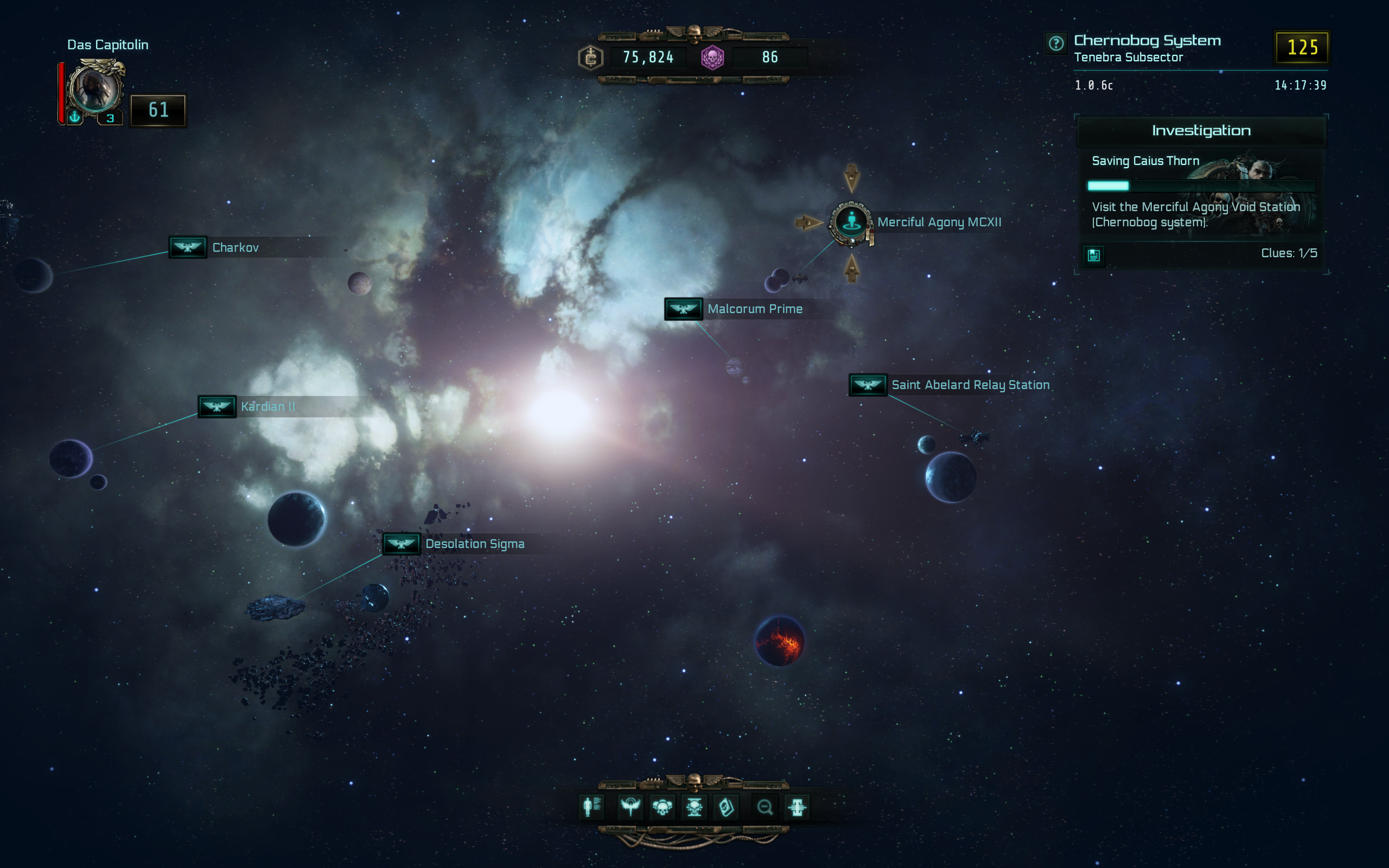
Warhammer 40,000: Inquisitor – Martyr begins each story quest with a mission briefing overview, where you’ll learn about the local threats as well as the primary (and secondary) mission objectives. You will also have the ability to set the difficulty of the mission, selecting between ‘Story mode’ for casual ARPG players, and ‘Challenge mode’ with added difficulty tiers for veteran players seeking a higher chance of loot drops and better rewards.

The Inquisitor campaign consists of investigations through priority assignments that follow the story, grand investigations that follow the plot but are more like side quests, missions of various objectives that help you grind for better gear, and tarot missions to advance your Inquisitorial Rank. There are also Weekly Glory and Influence challenges for points that unlock special rewards. Unfortunately, after completing the main campaign, Warhammer 40,000: Inquisitor – Martyr continues in the same linear-world within the same secluded sector of this universe.

While the story is complex, and the mission types are somewhat unique and varied, the grind through each map becomes quite familiar. Warhammer 40,000: Inquisitor – Martyr attempts to break the monotony with mission objectives, such as protecting VIP’s or following a particular sequence. Enemies typically fall into one of these categories: regulars, hordes, champions, commanders, and end-level elites. You’ll often find waves of each, or a cluster of them all. In spite of the varied mission objectives, your tactics will typically remain the same: kill them all.

Similar to other traditional action RPG-style games, Inquisitor – Martyr balances gameplay by using a combination of character levels comprised of Inquisitorial Rank from the campaign, power rating of all equipped items, character attributes and perks, and a Warzone Rank. Earlier versions of this game differed in how player levels were managed and gear scores affected the game, however this information is current as of patch 1.0.6c on July 6th.

In addition to the various campaign missions and side quests that work to increase your Inquisitorial Rank, Warhammer 40,000: Inquisitor – Martyr features many “Heroic Deeds” that allow players to earn points toward improving their Warfare, Toughness, and Virtue character attributes. Completing these Heroic Deeds also reveals branches on the passive skill tree, as well as unlocking special perks.

Typical of the RPG genre, loot is organized by item rarity, skill level, and item type pattern. Common loot has a single skill modifier, Mastercrafted has two, Rare and Artificer have three, and Relic loot have four modifiers. The Koschei pattern buffs critical hits and reduces damage, while the Mars pattern increases damage and deflection. The Scythe patter increase damage and HP, while Thule improves speed and damage.

In addition to a traditional loot and credit system, Inquisitor – Martyr also features a detailed crafting system that enables players to use Blueprints and Crafting Materials to build personal items. These are items not dropped as loot or awarded by mission completion, and typically offer special skill enhancements not available elsewhere.
Inquisitor – Martyr follows in some of the same footsteps of other action RPGs by weaving several layers of character progression into the game; all which keeps the player pushing toward harder missions to earn more points toward their Inquisitorial or Warzone Rank. While rank is an easy to understand metric for player capability, the level systems in Inquisitor – Martyr have received plenty of redesign, and yet still leave a lot to be desired.
Making the most of WH40K: Inquisitor – Martyr’s passive skill tree requires a commitment to certain play styles to achieve maximum effectiveness. As you apply skill points, these buffs build momentum and begin to make a small but noticeable difference in battle, especially when paired with items that further boost that skill group. Bonus perks further buff these attributes, for an overall synergistic effect.

During the first few missions movement is limited to four primary directions along linear corridors. Perhaps this is to new players from getting lost, but it persists to the point that later maps aren’t much different. While there is the occasional ramp that introduces elevation (without any benefit of holding the high ground), and there are a few ‘open’ maps where you’ll navigate by a trail of markers, most of the levels are the same painfully familiar rooms. Perhaps it’s the effect of time constraints on development, but WH40K: Inquisitor – Martyr needs much more variety.
Which brings me to the claim that “Inquisitor – Martyr is an open-world sandbox Action RPG“. Maps are either open-world, or they’re in a sandbox. They cannot be both. In the case of Inquisitor – Martyr, maps are most definitely in a sandbox, with nearly all missions taking place on a linear map spanning in four directions. On the rare occasion you do generate a mission without these linear constrains, such as Frozen Wasteland, you will still find the sandbox edges rather quickly.

Warhammer 40,000: Inquisitor – Martyr was released June 2018, with mixed reactions of a game that seemed very much a work in progress at the time. One month later, aspects of Inquisitor – Martyr have been extensively transformed, and the new narrative-based Warzone endgame game mode is welcomed, but the game still remains the same in many ways. While the current $49.99 (Steam) price tag might not have seemed worthwhile before, it might be more palatable to some anxious players now.
Had I been asked to rate this game on launch day, it would have been difficult to recommend. Here we are, dozens of updates and patches later, and Inquisitor – Martyr feels like a much more respectable title. That being said, there is still not quite enough content variety and polished features to make the full-retail price tag worthwhile. This might be one of those occasions where the fruit could still ripen after it’s left the vine, and hopefully with a sweeter price.
+ True Warhammer 40,000 plot details
+ Easy to understand player classes
+ Single-player and cooperative mission play
+ Frequent and responsive bug fixes issued
+ Regular updates with added content
+ Developers continue to refine the game
– Occasional bugs still detract from enjoyment
– All sandbox, lacking advertised “open-world” maps
– Developers have redesigned the game post-release