By Olin Coles
Manufacturer: KYE Systems Corporation
Product Name: Slim Style Wide Angle Vehicle Recorder
Model Number: DVR-FHD568
Part Number: 32300115101
UPC: 091163246251 EAN: 4710268246251
Price As Tested: $103.26 (Amazon)
Full Disclosure: The product sample used in this article has been provided by Genius.
Not all that long ago Benchmark Reviews tested the Genius DVR-FHD590, which received high marks for it’s clear picture and wide viewing angle. The minds at Genius went right back to work implementing our suggested improvements into their latest dash camera; replacing the distracting LED lamp with six-layer glass lens and high dynamic range (HDR) image sensor technology. In this article Benchmark Reviews tests the Genius DVR-FHD568 Vehicle Recorder. Featuring wide-angle 1080p video recording at 30 frames per second, the Genius DVR-FHD568 Slim Style Wide Angle Vehicle Recorder uses a large f/2.4 lens aperture paired to an 8-Megapixel 1/2.7″ CMOS image sensor to capture the sharpest details.
The streets are a dangerous place for motorists, and heavy traffic congestion adds as much risk to long trips as it does to short commutes. Defensive driving will help prevent some accidents, but the daily drive to and from work is wrought with random chance and uncertainty. It’s not a question of if you’ll be involved in an accident, it’s a question of when. You can never know when someone might run a red light as you enter the intersection, or suffer a tire failure that sends them out of control. Insurance companies tend to penalize their drivers with blame, simply because they lack solid evidence to prove otherwise. Now you can capture that proof on video whenever someone is behind the wheel, and let the camera serve as your witness should an accident ever happen.

The Genius DVR-FHD568 Full-HD 140° Wide Angle Vehicle Recorder captures crisp and clear 1920x1080p video that helps drivers protect themselves with reliable evidence in the case of an unforeseen accident.
Specifications:
- 1/2.7“ CMOS Sensor
- Fixed Focus F2.4 Four-Layer Lens
- 4” panel display
- G-Sensor
- Focus Range: Normal: 1.5m to ∞
- Car security recorder, DSC and playback modes
- Resolution: 1920 x 1080 to 30fps or 1280 x 720 at 60fps
- Supports up to 32GB micro SDHC Micro SD
- Battery : 420mAh Li-polymer
- DV mode: AVI
- Mini HDMI/USB port and DC IN
The Genius DVR-FHD568 is a 1080p dashcam video recorder kit that contains the following items: vehicle recorder, window suction mount, 12V DC car adapter to mini-USB “B” cable, and a nineteen-language quick start guide. Genius DVR-FHD568 (part number 32300110101) is available online for $103.26 (Amazon).
The core concept behind the Genius DVR-FHD568 is that it acts intuitively on your behalf, without requiring user interaction. To execute this function, the camera automatically turns on and begins recording as soon as power is provided from the vehicle at startup. An integrated 3-Axis G-Sensor in DVR-FHD568 automatically triggers the device to record an “emergency event” whenever movement crosses the sensitivity threshold, creating an audio/video file that cannot be overwritten unless you specifically delete it. Once the vehicle engine shuts down, the device continues recording for a set duration then automatically saves the file and turns off the camera.
Powered by an internal Li-Polymer 420mAh battery, the Genius DVR-FHD568 maintains a full charge with the supplied 12V DC car adapter to mini-USB cable that plugs at the bottom of the camera. This same mini-USB port allows a computer to connect to the DVR, enabling transfer of the recorded AVI files. Alternatively, a mini-C HDMI output is available to play back audio/video footage or still photos directly to any HDMI display.
The DVR-FHD568 camera body measures 3.1″ W x 2.2″ H x 0.65″ D (79W x 55 x 17 mm). At the heart of the kit is an 2.0 Megapixel camera with a large 1/2.7“ CMOS image sensor using high dynamic range for low-light recording. The video recorder is capable of 1080p full high-definition 1920×1080 resolution at 30 fps, or 720p HD 1280×720 resolution at 60 fps – both using the H.264 CODEC.
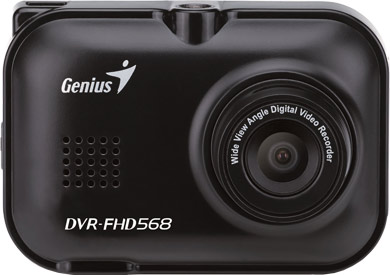
A distortion-corrected 140° wide-angle fixed focus (f/2.4) lens captures a large horizontal field of view, Nearly capturing the entire windshield view. The Genius DVR-FHD568 works well in all light conditions: bright daylight and nighttime driving. High Dynamic Range (HDR) enables video capture to remain crisp and clear in situations with high contrast.
An integrated microphone at the drivers side of the camera body picks-up sounds nearby to the camera, such as driver/passenger voices or those coming to aid victims of an accident. Audio is recorded alongside video, giving a complete account of details – including conversations or distractions.
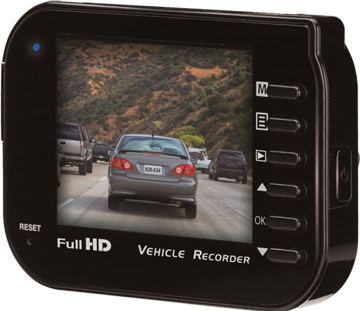
Along the right side of the camera (as it faces out the windshield) you’ll find the power button. Menu option buttons positioned beside the LCD screen offer simple UP/DOWN/OK user interface control. Most menu options are straight-forward and require no explanation. During recording operation you can also make adjustments on the fly, including resolution and frame rate settings.
The LCD screen features a large viewing angle, so the driver can easily observe playback without changing position. Recordings can be viewed in real-time, or in playback mode on the 2.4″ color LCD screen. Menu options allow you to change the Panel Off setting to remain on continually, on for 15-seconds or 1-minute, or always off.

At the bottom of the camera body is a Micro SD memory card slot. Not included with the vehicle recorder kit, DVR-FHD568 requires a Micro SD card to save recorded video and photo files. For best results, I recommend using a Class-10/UHS1 speed Micro SDHC memory card for capturing high definition video files. The DVR-FHD568 dashcam will still operate without a micro SD card installed, allowing for ‘offline’ configuration.
The Genius DVR-FHD568 vehicle recorder offers a mounting point at the top of the unit, so it can be positioned to hang down from the top the windshield. On most cars, the suction unit fits neatly behind the rear-view mirror, positioning the camera behind or beside the mirror.

Genius includes a suction-activated glass mount for attaching DVR-FHD568 to the windshield. The suction mount is extremely strong even before activating the lever, so combine this with the ultra-light weight of the camera there should be no fear that the unit might fall off while driving (the same cannot be said for very heavy units, like the Papago! dashcams). Some experimentation will be necessary for tinted or coated windows.
In the next section, I discuss my test results with the Genius DVR-FHD568 Full HD Vehicle Recorder.
Upon consideration of purchasing this vehicle recorder, the very first thing you’ll want to ensure is that you’ve got a class-6 (or faster) Micro SDHC memory card available for storage of multimedia recordings. Since 32GB is the specified maximum capacity supported, I recommend a fast (UHS1/C10 speed) Micro SDHC memory card like the Transend TS32GUSDU1E or SanDisk SDSDQU-032G-AFFP-A, both of which include adapter cards.
All testing was conducted using the Genius DVR-FHD568 Full HD Vehicle Recorder suction-mounted beside the rearview mirror inside a sports sedan, with a 32GB UHS1 (Class-10) speed Micro SDHC memory card installed.
The Snellen chart is a common eyesight test used to determine level of visual acuity. Benchmark Reviews has adapted the Snellen chart for the purpose of testing video camera clarity. This is important for reading a vehicle’s licence plate number and identifying text.
Standard license plates measures 6″ tall by 12″ wide, with 3″ block letters and numbers. Our test was conducted two car lengths away from the chart, which we’ve determined to be the edge distance away for all cameras to accurately display standard size license plate text.

Optimistic that these dash cams would clearly display plate text beyond two car lengths, our adapted Snellen chart skips the first line that would have displayed a 3″ letter simulating full-size license plates and begins with 1/2 size (1.5″) letters (“F” and “P”). Unfortunately, we later discovered that none of the cameras would read beyond 1/3 size (1″) text.
First up was the Genius DVR-FHD568, which utilizes a 2.0 megapixel camera resolution and 140-degree wide angle lens. The unit features a 1/2.7“ CMOS image sensor that yields 21.70 mm2 surface area. This dashcam offered the largest view, but sacrificed fine detail quality as result. The wide angle lens undoubtedly helps the camera ‘see’ more, which can be helpful for catching events that aren’t directly front and center of the camera lens. Additionally, the large image sensor allows more light to reach the surface to aid in low-light recording.
A standard 3″ license plate number could be read from two car lengths away, but at four car lengths away the 1/2 size (1.5″) text was very difficult to read (100% is actual size). Enhancing the image to 200% did not yield significant improvement. Depth is the inherent sacrifice any wide-angle lens will make, at the benefit of larger field of view.

Next up was the Papago! P3 dash cam, which we reviewed back in March (2014). This camera features an Aptina 3.5 megapixel camera resolution and 130-degree wide angle lens. The unit features a 1/3″ CMOS image sensor that yields 17.30 mm2 surface area identical to Apple’s iPhone 5S. Like DVR-FHD568, this camera has a large field of view and captures a large picture. Although the angle is 10° less than FHD568, the fine details are similarly lost.
Standard 3″ license plate numbers could be read from two car lengths away, but at four car lengths away the 1/2 size (1.5″) text was quite difficult to read, matching FHD568. Enhancing the image to 200% did not yield any improvement. Also note that the Papago! P3 dashcam suffered from poor color replication, producing a green hue to the picture.
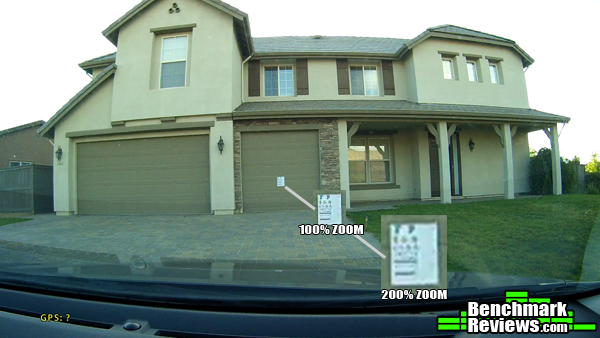
Finally, we tested the Genius DVR-FHD590, which was first reviewed back in May 2013. This dashcam features a 5-megapixel camera resolution and 128-degree wide-angle fixed focus lens (f/2.4, f=3.0mm). The unit features a 1/3.2″ CMOS image sensor that yields 15.50 mm2 surface area identical to the Apple iPhone 5. According to the specifications, FHD590 captures 12° less field of view than FHD568, also 2° less than the P3. However, according to our results it appears that FHD590 has a much smaller field of view that offers greater fine detail quality.
Both 3″ standard license plate numbers at two car lengths away and 1/2 size (1.5″) numbers four car lengths could be read, which makes this higher-priced dashcam move valuable for those looking to capture this information. While difficult to read, 1/3 size (1″) license plate numbers could still be identified. Zoomed in 200% did improve the picture, but only enough to confirm previous results. This camera favors details over field of view and light sensitivity.

There are several obvious uses for the Genius FHD Vehicle Recorder, such as recording traffic events that might defend you in an accident, but there are many others that also serve equally-important purposes. For example, the DVR-FHD568 could be used as an autonomous co-pilot for monitoring the behavior of inexperienced drivers, or as a co-witness for driving instructors. Commercial drivers, such as those who operate limousines, shuttles, taxi cabs, moving vans, and buses, could benefit from the footage DVR-FHD568 records… especially in an emergency. While less obvious, the Genius vehicle recorder could also aid drivers who use a company vehicle, or high-risk operators who transport critical cargo.
Each video clip segment (configured in 1-, 3-, or 5-minute segments) is saved to the Micro SD memory card in .AVI container format. 3-Minute clips weigh approximately 200MB each, but if you elect to save in 5-minute intervals the file size increases to 350MB each. On the 32GB memory card used for testing, over 7-hours of recordings at 1080p could be saved before the DVR-FHD568 would automatically overwrite older files.
An integrated 3-Axis G-Force sensor in DVR-FHD568 automatically triggers the device to record whenever an event forces it past the menu-selected sensitivity threshold. This creates an audio/video file that cannot be overwritten, unless you specifically delete it from the menu. At the ‘normal’ sensitivity, at least one recording was preserved as an Emergency file due to suddenly stopping.
Dash cameras are nothing new, but the lens/sensor technology and convenience features help elevate the Genius DVR-FHD568 to a level above previous offerings. There’s no doubt that vehicle recorders will ease fears when dealing with insurance claims or law enforcement, and based on my short time testing DVR-FHD568, I’m confident vehicle recorders will contribute to numerous online videos that capture road-rage and other driving un-pleasantries.
There have been several close calls recorded, and far too many times where other drivers were captured behaving dangerously to the point of nearly causing an accident. In one incident this year a driver got out of his vehicle to confront another motorist beside me, but when I pointed directly at the dash cam high on my windshield the angry driver returned to his vehicle. It’s possible he changed his mind, but it’s more likely the camera changed it for him.
The only perceivable downside to having a vehicle recorder is the minor obstruction caused by the camera. I was able to alleviate this distraction by hiding it behind the far side of my rear-view mirror, but this still exposes the USB cord that hangs below the camera. The camera’s profile is smaller (shorter) then others we’ve tested, and so is the mounting hardware. The compact size reduces the chance of this dash cam interfering with my vision.
Most consumers are not also camera experts. Manufacturer’s know this, which is why they tout the devices resolution before mentioning the image sensor size. If you’re taking photos with a camera, which typically has a flash or uses staged light sources, then resolution is very important. But if you’re recording video using the available ambient light sources, typically either sunlight in the day or street lights and headlamps at night, then the surface area of the image sensor becomes critical.
We tested three different dash cams in this review, and each utilized a different size CMOS image sensor. Making matters worse, each image sensor was classified by a misleading representation of its size. For example, the Genius DVR-FHD568 vehicle recorded featured in this article used a 1/2.7“ CMOS image sensor that yields 21.70 mm2 surface area (the largest offered) but only delivered a 2-megapixel resolution (the smallest offered). The Genius DVR-FHD590, which gave us the best detail quality due to less angle in the lens, featured a 5-megapixel camera resolution (very large) with a 1/3.2″ CMOS image sensor that yields 15.50 mm2 surface area (very small).
In a perfect world, you’d have both: high resolution effective pixel capture for sharp detail clarity, and an image sensor with large surface area to collect light in dim/dark environments.
Genius has come very close to perfection with DVR-FHD568, but I’m convinced they could do better (especially if they marketed their resolution and image sensor sizes more clearly – something none of the manufacturers do). After testing the 128° wide-angle Genius DVR-FHD590 back in May 2013, I was convinced that the lens could be wider. Later it would be compared against the Papago! P3 dashcam, which is 400% bigger and heavier, but featured a 130° wide-angle lens that seemed ideal… right up until the point where I needed to read the license plate number on a car only a few lengths away.
If I had the opportunity to design my own dash cam, it would first include on-board memory for internal storage. Memory is cheap these days, and there’s really no excuse for any of these products not to include their own 8GB integrated chip. That being said Micro SD is the format of the day, so large and obsolete SD cards should not be found on any modern camera (l’m looking at you, Papago!).
Next on my design checklist would be a high-resolution camera for capturing fine details. Something 8.0-megapixels or better would do nicely for most motorists. We’re trying to read license plates, not the frame surrounding it (although having both would be nice, if not too unreasonable).
Then we’d address the CMOS image sensor, which would need to step up to at least 2/3″ to yield either 58.10 mm2 surface area. Of course, I wouldn’t complain about a or 1″ image sensor offering 116 mm2 surface area and nearly capable of night vision. Still, size is a consideration, and I don’t want another 1-pound dash cam coming unattached from my windshield and scuffing the face on my nice new stereo receiver (a la Papago! P3).
Lastly, I want only enough battery to finish writing the file if the power source is turned off. I’ve discovered half-hour lengths of video recorded after I exit the vehicle, just because the motion sensor captures somebody walking nearby. The large battery adds to the size, cost, and heat output by the unit.
Features such as GPS are nice, if not trivial. Unless the unit is going to offer voice navigation, nobody is using an LCD display smaller than their phone’s screen to read while they drive. It’s not safe, nor reasonable. Additionally, the device should offer frequent firmware updates. This is important for proper GPS functionality, as maps are constantly being updated as changes occur.
These are not impossible requests, and they’re all using technology already presented in other products. If a smartphone can do this and much more, the next generation of dash cam certainly should be capable of my list.
IMPORTANT: Although the rating and final score mentioned in this conclusion are made to be as objective as possible, please be advised that every author perceives these factors differently at various points in time. While we each do our best to ensure that all aspects of the product are considered, there are often times unforeseen market conditions and manufacturer changes which occur after publication that could render our rating obsolete. Please do not base any purchase solely on our conclusion, as it represents our product rating specifically for the product tested which may differ from future versions. Benchmark Reviews begins our conclusion with a short summary for each of the areas that we rate.
We begin our ratings with performance, which pits the Genius DVR-FHD568 against others we’ve tested such as the previous DVR-FHD590 model and expensive Papago! P3 dashcam. All of these are limited to a 32GB memory card, which I believe should be the starting point for storage capacities and not the limit. The menu on DVR-FHD568 is the most straight-forward and refined we’ve seen on any camera yet, and does not require a manual to understand the options or their function.
For vehicle recorder cameras, image quality is paramount. On the Genius DVR-FHD568 dashboard camera, a 2.0 megapixel 1/2.7“CMOS image sensor captures 1080p video at 30 FPS. While other dashcams may offer larger resolution, they typically use a smaller image sensor that diminishes low-light recording quality. This was evident in the comparison to Papago! P3’s 8.0 megapixel 17.30 mm2 image sensor, which produced a picture with poor exposure and no better detail quality. The video captured using a 21.70 mm2 image sensor on DVR-FHD568 was clear and fluid, which is important for clean playback.
Back when the Genius DVR-FHD590 dashcam was tested I complained about wanting a slightly wider field of view, even though I understood it would reduce overall detail quality. Although everyone has different needs, mine have changed since then towards better detail sharpness. After attempting to read license plate numbers with these 130-140° wide-angle lens cameras, I’m actually most pleased with the results from the 128° lens. Image sensor technology may ultimately improve the situation, but only the 128° lens on FHD590 was able to display readable license plate numbers at distance.
Appearance is a much more subjective matter, especially since this particular rating doesn’t have any quantitative benchmark scores to fall back on. The Genius DVR-FHD568 offers a subdued flat-black finish that is imperceivable within darkened cabin interiors. This color helps hide the camera from conspicuous view, so to avoid drawing attention to itself. The camera unit measures 3.1″ wide by 2.2″ tall, so it’s easy to find a mounting spot on the windshield.
The Genius DVR-FHD568 is built solid, and offers a very durable construction. A reinforced plastic camera housing protects the lends and LCD screen, so the most likely causes for failure would be liquid submersion or electrical damage. This device is designed to endure crash damage and provide video evidence, making it far more durable than other models. The camera will easily survive falls from the windshield or being accidentally dropped.
In terms of functionality the Genius DVR-FHD568 offers everything you could want from a dashboard camera, with the small exception of GPS (a feature of their DVR-FHD660G model, which I hope to review next). GPS notwithstanding, all other functions of DVR-FHD568 worked exactly as advertised. Automatic features intuitively started and stopped when needed (without being prompted). The automatic emergency recording feature that uses the units 3-axis G-Force sensor for collision detection offered peace of mind that you’ll capture the most critical events. If desired, the unit can be detached from the bracket and used as a digital camera to take pictures.
As of October 2014, the Genius DVR-FHD568 Vehicle Recorder (model 32300115101) is available online for $103.26 (Amazon). Compared to similar dash cameras, the Genius DVR-FHD568 certainly offers a value-priced edge over the competition. This camera does not include a (required) Micro SDHC memory card, so I recommend a fast (UHS1/C10 speed) product like the Transend TS32GUSDU1E or SanDisk SDSDQU-032G-AFFP-A – which both include adapters.
The Genius DVR-FHD568 belongs to a growing genre of consumer electronics, and based on my experience with this camera I expect it to do well in the marketplace. This is truly one of the few win-win products I’ve tested in my time, where there’s no downside to having it installed in your vehicle. I plan to continue using the Genius DVR-FHD568 in my vehicle, because it’s been proven so useful with every close call and near hit. This is an outstanding product with many great features, and I highly recommend it to all drivers.
+ Outputs H.264 full-HD 1080p quality video
+ Automatic emergency recording for collision detection
+ Motion-detecting IR receiver
+ Large 1/2.7″ CMOS digital image sensor
+ Integrated microphone and speaker
+ Features 3-Axis G-Force sensor
+ Doubles as a 2MP digital camera
+ 420 mAH Li-polymer battery enables recording when car is off
– Requires Micro SDHC card (not included)
– Mounting brackets may obscure view
– 140° wide-angle lens reduces detail quality
-
Performance: 9.00
-
Appearance: 9.50
-
Construction: 9.75
-
Functionality: 8.50
-
Value: 8.00
Quality Recognition: Benchmark Reviews Silver Tachometer Award.
COMMENT QUESTION: Which is more important to you: wide-angle view or better detail clarity?


7 thoughts on “Genius DVR-FHD568 Vehicle Recorder Review”
In future reviews one of the “features” I think would be welcomed if the Dash Cam’s ability to record encounters with law enforcement personnel and the units ability and how easy it is to reorient the field of view to record same along with
I’m not sure I understand your request. These cameras will record whatever they’re focused at, so long as they have power to remain operational. As far as reorienting that focus, I think this would be subjective to the individual and their placement of the device. A camera situated under the rear-view mirror of a car is easily turned, whereas a camera set off in far corner of the windshield would not be reachable.
John, check Youtube for some great video of day and night recordings of this camera. This cam I bought for myself. I also purchased a Cobra 820 dash cam for my wife, another excellent choice. I wanted to buy the two cameras and compare them myself. They are both very good cameras. I will buy an extra one, either or and toss it in the closet encase one of them fail me.
I kept buying the cheap ones from Asia. They are garbage.
I am having problems opening the menu to set the cam, no matter what I do it will not open.
Plug it into your computer or a USB wall charger for an hour, and then try. The battery might be dead, the adapter might not be working, or the unit itself is broken.
Thanks very much for writing this review.
I’ve been looking for a camera to place in my school bus to capture vehicles that run my stop sign while kids are boarding and leaving the bus (happens way too often, sadly). Of all the features I’m looking for in a camera, being able to capture the license plate is the most important thing. This is the first review I’ve read that actually specifies that the 590 is able to do this. Thanks again.
The quick guide does not explain very well. Is there a slow guide? (Like for old farts.)
Comments are closed.