By David Shields
Manufacturer: Antec, Inc.
Product Name: ISK600
Model Number: AGI600I
UPC: 761345151658
Price As Tested: $64.99 (Amazon | Newegg)
Full Disclosure: The product sample used in this article has been provided by Antec.
Antec is no stranger to the chassis market, with well respected products such as the Nine Hundred and Twelve Hundred series chassis. However, Antec has little to offer in the Mini-ITX market, with just the ISK100 and 300 series released thus far. Last November, Antec released the newest case in their Mini-ITX lineup, the ISK600. The small form factor ISK600 is designed to provide all the features any ITX builder would need without the price tag of other cases such as the Corsair Obsidian 250D and the BitFenix Prodigy. The ISK600’s main features include the ability to mount a standard ATX power supply, long graphics cards, up to five internal hard drives, and it comes with a decorative LED strip on the front panel. With the interest in small form factor PCs continuing to rise, it is imperative that new designs offer more to builders than the competition. But does the ISK600 have the features necessary to compete? In this article, Benchmark Reviews inspects the features of the Antec ISK600 and how they compare to the other popular choices in the Mini-ITX market.

Features & Specifications
| Materials | Plastic / Aluminum |
| Color | Black |
| Dimensions (WxHxD) | 260mm x 195mm x 369mm |
| Compatibility | Mini-ITX Motherboard, ATX PSU |
| Drive Bays | 3x 3.5″ bays, 2x 2.5″ bays, 1x slim optical drive. |
| Expansion Slots | 2x |
| Cooling | 1x 120mm fluid dynamic bearing case fan (included) |
| I/O | 1x USB 2.0, 1x USB 3.0, Audio In/Out |
| Other | Graphics cards up to 317.5mm, CPU coolers up to 170mm. |
The Antec ISK600 has very basic outer design, with the only decorations being the small Antec logo and the led strip. The strip gives off a very muted blue light and is a good choice for builders who don’t want a case with an overstated decoration. The panel is plastic, and features your standard assortment of power and reset buttons, USB ports (one 2.0 and 3.0 each) and audio ports. The switches had a nice, firm feel to them and will likely stand up to repeated use quite nicely. The front panel does not appear to be removable.

The sides and top of the case are made of brushed aluminum. This brushed look is attractive, but the moment I removed the case from it’s bag it started attracting fingerprints and dust, and already had a few scratches that looked like they were incurred during shipping. As the case was packaged safely, it would seem that the brushed surfaces tend to scratch quite easily. The front panel features vents on each side, but all they provide are extra openings to let air (and dust) into the case. The grilles on each side serve as extra ventilation for the graphics card and the power supply but again, don’t feature anything to prevent dust from entering the case.

The rear of the case features the I/O plate slot for the motherboard, dual expansion slots, the power socket, and the sole case fan mount (120mm). You could technically mount this as an intake, but there is nowhere for the air to escape from the case if you do that. To remove the blanks from the expansion slot(s), remove the screw holding the blank in place then slide the blank out.
 The bottom of the case features four rubber feet for vibration reduction, another vent along the bottom of the front panel, and what seems to be a second vent along the side, but it doesn’t seem to have any clear function.

Antec chose not to create a flashy, complicated exterior, and instead concentrated on making a simple design that could fit the role of a HTPC or office PC without a large footprint or drawing attention. Even the front LED strip is designed with this is mind, providing a muted glow that is not out of place on a design such as this, or in a work / living environment. The way the aluminum tends to attract noticeable marks and dust is a bummer, but again, this case isn’t meant to be looked at.
To get access to the internals, remove all three thumbscrews from the back and lift the entire aluminum cover off the chassis. The large opening on the side of the case is where the graphics card is installed. The other side of the case features a single 3.5″ drive bay along with the ATX power supply mount. Antec did helpfully provide four pre-installled motherboard standoffs, so installing your ITX board is as simple as dropping and screwing it in place. The Antec ISK600 fits graphics cards up to 317.5mm, and CPU coolers up to 170mm.

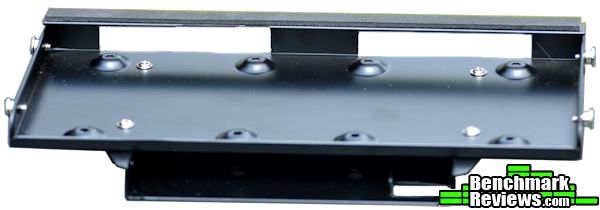
The top of the case features two fully removable drive bays slotted into place by screw heads on each side. Antec added anti-vibration rubber around the screw heads of the rear 3.5″ HDD trays, but for some reason did not do the same with the 2.5″ / ODD bay. Each bay also has a strip of foam where the aluminum chassis cover rests to further reduce the noise from vibration. The rear bay can accommodate dual 3.5″ hard drives, while the front can mount dual 2.5″ as well as the slim optical drive underneath. The case can accommodate graphics cards of up to 317.5mm and CPU coolers up to 170mm.

Taking a closer look at the front 2.5″ / ODD bay shows the mounting system for the drives. The slim optical drive slots into the bottom of the bay and is fixed in place by four screws on the bottom. To remove the bay cover on the front of the case simply push the cover from the outside into the case and it will pop right out. The 2.5″ drives are mounted facing into the case and secured with four screws in the bottom.
The rear of the case provides a mount for the sole case fan in the chassis, a 120mm fan. Antec’s online manual states that the Antec Kuhler H20 CPU cooler is compatible with this mount but does not mention any other coolers. With the upper drive caddy in place, there is exactly 76mm of clearance between it and the back plate, which should allow you to mount many different AIO liquid coolers. Removing the caddy greatly improves available room and I see no reason why it wouldn’t be possible to mount a 120mm AIO cooler in a push / pull configuration. I suggest measuring clearance with your motherboard and / or graphics card in place before installing an AIO system.

The power supply mounts on the internal bracket with the rear facing the side panel vent, and the PSU fan facing the front of the chassis. The side and bottom vents built into the front panel allow the PSU fan to draw air into the unit, but the wires and chips for the front panel connectors do obstruct airflow. Antec states that you can fit a PSU of up to 140 x 150 x 86mm inside the case, and they do provide an internal 90 degrees PSU connector that runs to the external socket in the back. There are two foam pads along the inside of the front panel, along with two on the bottom of the case which helps cut down on vibration. I strongly recommend, if not downright require, purchasing a modular PSU for the ISK600.

Antec installed four cable tie down points around the PSU area, this is literally the only location in the ISK600 where you can arrange cables, otherwise you’ll simply have to leave them loose. It seems that Antec intends for you to run the cables from the front panel through the tie points and around the PSU to the back of the motherboard. Interestingly, the small vent-like holes that are behind the motherboard (see my section on the exterior for reference) appear as though you could insert cable ties through. Given the orientation of the interior ties and the inclusion of that grille, it is quite possible this is exactly what Antec has in mind. One inch of space exists behind the motherboard, which can be used to arrange the various cables that connect to the motherboard. You’ll want a modular PSU for this case, unless you like stuffing all your unused cables into one spot and further complicating the already poor airflow.

The interior of the ISK600 uses a unique layout designed to provide more customization options than in other Mini-ITX cases. It isn’t quite as modular as the BitFenix Prodigy, but it packs a good amount in a much smaller form. All the vibration reducing features are certainly a nice touch and an attractive feature for those who want a quiet work or HTPC PC. I am slightly disappointed with the cooling options, and I think that Antec could have included mounts for at least two additional case fans in the ISK600, certainly two 80mm mounts and possibly even dual 120mm fans.
I’m going to say this; this is not a case I would recommend for anyone looking to build their next performance PC. Other ITX cases such as the BitFenix Prodigy may be more expensive, but they actually feature the ability to create some moving airflow in the case. I think Antec is looking to place this case in the office or the living room, with a more subtle, compact design that features plenty of noise reducing features. I daresay you could some parts in, add a quiet Noctua fan to the rear or an AIO system, (Corsair comes to mind with Corsair Link to control the fans) and you’ve got a quiet system that will blend in well anywhere you put it. You start dropping some high end components into the ISK600 all you will really create is a space heater for your feet.
Antec set out to create an affordable Mini-ITX case designed to appeal to the working CEO or the family looking for that media center PC in the living room. With that in mind, it succeeds nicely, boasting an overall sturdy construction and a design that is not to terribly difficult to build a system in. I could see this PC hooked up to a couple of monitors to provide a seamless workflow for the office, or perhaps connected to your Xbox via Windows 8 to provide excellent media streaming to your console and even additional screens via Microsoft SmartGlass.
Performance wise, this is a nice little case for the previously mentioned purposes. Don’t expect any good gaming performance, but slap an i3 or Phenom processor in with a nice quiet fan and a couple of SSDs, and you have a quiet, unobtrusive media center PC. Air buildup could be a problem, but if you purchase a blower type GPU such as the EVGA 660 and a water cooler for the CPU instead of a large heat sink, it likely won’t be as much of an issue for the kind of system you would most likely build in the ISK600.
The Antec ISK600 is a simple box, but it does look attractive with the muted blue led on the front and the brushed aluminum cover. My only complaint is the ease with which the brushed aluminum can get marked up or scratched, and fingerprints are very noticeable and difficult to remove.
The ISK600 is sturdy, especially the main frame of the case and the top mounted drive bays slide in and out nicely. The PSU bracket seems a little on the thin side but as it shouldn’t need to support the PSU’s weight I doubt it will be an issue. Remove the entire cover of the case to access the interior was a nice touch that makes it easier to access your internals, and the cover overall is only a little flimsy on the sides and fairly easy to replace when finished.
With the option to mount up to five internal hard drives, the ISK600 certainly isn’t short on storage. And being able to mount a standard ATX power supply provides the power necessary for the more powerful, lengthy graphics cards the ISK600 can fit. The numerous vents on the case are slightly questionable, given the fact that most of them won’t be anywhere near moving air and could currently bring more dust into the chassis.
Here’s where the ISK600 loses most of its ground to the competition: value. Currently priced for $64.99 (Amazon | Newegg), it’s closest rival, the BitFenix Prodigy, sits at a mere $5.00 higher while boasting many of the same features plus compatibility with larger graphics cards, more storage and more water cooling. Of course, the Prodigy is also much larger than the ISK600, but unless size is an absolute issue the ISK600 has some trouble competing in a head to head comparison. On the lower end of the Spectrum we have the Cooler Master Elite 110 and 130 at $15.00 less. While both are smaller and have less options for graphics and storage, it could also fill the same roles the ISK600 is intended for. I think that $55 for the ISK600 would make it a better value (At the time of this article Newegg had a rebate offer for $10.00 off to make it $55.00).
Again, Antec has come up with a good product in the ISK600. It’s a basic case that fills a niche in the market for an office or media based PC while still offering features usually found in larger, more expensive cases. I won’t go as far as to say it’s a “must buy” as there are other cases than can fulfill the same role(s), but you cannot deny that Antec has created a solid product with the ISK600.
+ Sturdy construction.
+ Simple component installation.
+ Compatible with standard ATX PSUs and long graphics cards.
+ Simple, attractive appearance.
– Cooling is pretty lousy, and heat will buildup in this chassis.
– Aluminum finish attracts marks and scratches easily.
– Price is just a tad bit high.
– Lots of unfiltered openings will likely cause high dust buildup within the case.
-
Performance: 8.25
-
Appearance: 8.75
-
Construction: 9.00
-
Functionality: 8.50
-
Value: 8.00


One thought on “Antec ISK600 Mini-ITX Case Review”
“Antec added anti-vibration rubber around the screw heads of the rear 3.5″ HDD trays, but for some reason did not do the same with the 2.5″ / ODD bay.”
…because an SSD doesn’t have any moving parts, thus no vibration. I suppose that it might be nice to have that for the optical drive, but given that it’s a slim optical drive and thus limited in its speed, I don’t see vibration being a problem.
Comments are closed.