By Olin Coles
Manufacturer: Herman Miller, Inc.
Product Name: Embody Chair
Price As Tested: $1199 (Amazon)
Is a chair’s purpose merely to furnish a place for us to sit? There are countless directions to discuss this subjective matter, but suffice it to say that a chair’s purpose goes beyond a solid foundation for resting our weight. In an ideal chair, the design would be suitable for hours of comfortable sitting. The chair would accommodate healthy posture, and relieve stress from load-bearing joints. Ideally, this chair would be attractive and feature a look as competent as its ability. There is such a chair.
Herman Miller is a company that engineers function and architects fashion. They’ve dominated the industry for decades with elite furniture, and influenced our perception of what a chair should be. Herman Miller’s Aeron chair, one of the few commercial products added into the Museum of Modern Art’s permanent collection, was introduced in 1994 and has set the bar immeasurably high for every chair that’s come thereafter. It seems fitting then, that Herman Miller, the name behind the world’s most admired chair, has returned to improve upon their prestige.
Welcome the Herman Miller Embody chair. Designed specifically for people who work for hours at their computer, Embody is the first work chair that benefits both mind and body. More than just a solution towards minimizing the negative effects of sitting, Herman Miller’s Embody chair was also designed to deliver positive effects on the body. In this article Benchmark Reviews takes you on a tour of the Herman Miller Embody ergonomic office chair, and demonstrates how much better sitting all day can feel.

Herman Miller offers a large collection of modern furniture, and if price compels comfort, these pieces are worth their weight in gold. The Aeron chair, which became de facto office equipment for the dot-com industry in the late 1990’s (for me it was 800batteries.com in 1998 and igo.com in 1999), was a huge success for Herman Miller. This popular ergonomic chair became a household name, but its price tag limited adoption to only the most affluent consumers. In the computer hardware industry, these people are also called enthusiasts. Enthusiasts love to have ‘the best’ that this world can offer. In the realm of office chairs the best is called Embody, and it’s made by Herman Miller.
Features Summary According to Herman Miller:
The Embody chair allows the body to move naturally into the most healthful seated postures. Its Pixilated Support technology creates dynamic seat and back surfaces that automatically conform to movement and evenly distribute weight. Its frameless, narrow back adapts to the curvature of the spine and allows arms and shoulders to move freely. And its new tilt technology stabilizes the pelvis and supports the spine all the time.
Embody encourages working in a reclined position, the most healthful posture for computer users. Shifting weight to the chair’s back reduces compression of the spine and helps the head and eyes stay aligned with computer display screens. Whether people lean forward or recline, their lower-back support remains constant, with no adjustments needed. This overall freedom from physical constraint and discomfort means that blood circulates better, the heart slows down, and more oxygen flows to the brain, a critical advantage in an economy where ideas and innovation drive success. Source: Herman Miller
-
Creates harmony between people and computers.
-
Enables and promotes healthful movement.
-
Lets blood and oxygen flow more freely, enhancing ability to stay focused.
-
Conforms to body’s movements in forward through reclined positions.
Designed for the Environment:
-
95% Recyclable Unit
-
Contains 0% PVCs
-
Manufactured using 42% Recyclable Materials
-
McDonough Braungart Design Chemistry (MBDC) Cradle to Cradle Silver Certified
-
GREENGUARD Environmental Institute Certified
-
GREENGUARD Children & Schools Certified
-
BIFMA International Level 2 Certified
-
Provide Credits Towards Leadership in Energy and Environmental Design (LEED) Certification

-
Warranty: 12-Year, 3-shift
-
Designers: Jeff Weber and Bill Stumpf
-
General Dimensions
-
Height: 42-Inches (min) ~ 45-Inches (max) / 106.68 CM ~ 114.30 CM
-
Seat Height: 16 ~ 20.5-Inches / 40.64 CM ~ 52.07 CM
-
Width: 29.5-Inches / 74.93 CM
-
Depth: 15-Inches (min) ~ 18-Inches (max) / 38.10 CM ~ 45.72 CM
-
Herman Miller Embody chair cloth textiles utilize spacer-and-knit constructions used in athletic footwear and geo-textiles. These materials are meant to enhance Embody, not simply cover up the chair. Contemporary colors paired with either of two frame colors and three base colors help to simplify choice and appeal to universal tastes.
Herman Miller offers the Embody chair in one of two different material styles: Rhythm (standard) or Balance (premium). Herman Miller Rhythm material is 100% polyester, and is familiar to other product lines. Balance is 100% polyester knit, created especially for the Embody Chair. Loft, or thickness, gives it a cushy feel. Air and light pass through it more easily, providing maximum cushion and breathability. As a note, Balance White material is not covered by warranty against discoloration. The Embody chair is available in one of fifteen standard material colors:

Herman Miller Embody Rhythm Standard Material
|
|
|
For an added premium (usually $200 more), the following thirteen Embody material colors are also available:

Herman Miller Embody Balance Premium Material
|
|
|
The Herman Miller Embody chair can be custom-configured with either black ‘Graphite’ or white plastic upper frame. Light colored materials receive an opaque plastic ‘Pixel matrix’ backing (illustrated below) and dark materials use a black plastic backing, regardless of frame color selection.
For an additional fee (usually $100), fully-adjustable arm supports are available in a matching upper frame color. Most people rest their arms on the desktop surface, which makes this upgrade unnecessary.

Embody Chair with Graphite Frame and Base
After the upper chair has been configured, the lower portion is customized to feed individual needs. Herman Miller offers the Embody chair with three different trim and base options: solid polished Aluminum (silver color), Titanium (light grey color), or Graphite (black color). All Embody chairs utilize a polished cast-aluminum seat frame. The Graphite base unit is available as an option whenever the upper portion is also configured with Graphite. While the Aluminum and Titanium base units are metal, the Graphite base is plastic. Some outlets charge an additional $200 for the polished aluminum base, while many offer it for free.

Embody Chair with Polished Aluminum Base and Translucent Casters
Embody can be configured with four different roller caster options: carpet casters, carpet or hard floor casters, carpet or hard floor braking casters (immobile chair when unseated), and premium translucent casters. Not all outlets offer the translucent caster option, while some offer it for free and others charge a $50 premium.
The Herman Miller Embody Chair was designed by Bill Stumpf (Aeron Chair) and Jeff Weber, who developed the Embody chair to go a step beyond being merely “heath-neutral”. According to Herman Miller, over time the Embody chair can actually improve the health of the person sitting in it. There have been several scientific studies (cited below) to have shown that Embody users can experience better circulation, reduced resting heart rates, and less tissue damage around the sitting muscles. Embody is intended to promote natural alignment in the spine, and relieve stress across the entire back.

Rounded corners make it difficult to tell where the chair’s edges are, even when you’re sitting in it, because there are no hard edges anywhere along the frame. Rigid edges running under the thighs can lead to poor circulation, and the need for frequent stretching. With the Herman Miller Embody Chair, all edges are made to flex under the sitter’s movements, allowing a ideal distribution of weight.

Through years of research and development, Bill Stumpf and Jeff Weber incorporated health-beneficial features such as the Pixelated Support System – a dynamic mesh of adjoining seat materials that Herman Miller has proven to increase circulation and reduce strain on cell tissue (detailed in the next section).

The seat edge at the thighs is fully adjustable, allowing you to find the seat depth optimal for your body’s proportions. Adjustable tilt limiter allows the user to lean back without experiencing unwanted lift in the thighs; instead, the legs remain roughly parallel to the floor, preventing stress on the knees, ankles, and thighs.

For chairs with Rhythm Black, Balance Carbon, or Balance Black upholstery and graphite frame finish, the back mat will be graphite. For all other options, the back mat is translucent (as illustrated in these images). All Herman Miller Embody chairs use a polished cast-aluminum seat frame, regardless of upper frame or base material and finish.

Hand built and custom crafted for each and every order, the Herman Miller Embody ergonomic office chair features a 12-year warranty. Herman Miller’s 12-year warranty covers the Embody chair for normal wear and tear. Fabric covers are replaceable, and the warranty does not cover fabric that is soiled, stained, or damaged due to improper cleaning. For non-warranty damage, Herman Miller resellers offer replacement parts for the Embody chair.
Herman Miller Scientific Study References:
The Herman Miller Embody chair’s Backfit adjustment and seat conform to the body’s unique shape and distribute weight evenly. Embody’s shape mimics the spine, providing subtle support along the entire back that shifts with your movements. The Backfit creates a dynamic surface that reacts to your body’s movement every time you shift.
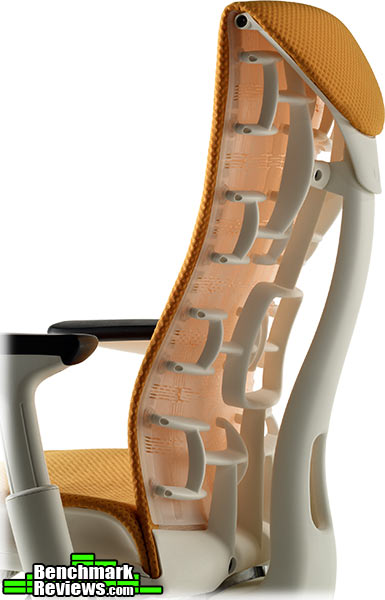
The narrow, frameless form along the back allows for freedom of movement along the neck and shoulders, which allows for a greater range of motion through the arms. Embody’s dynamic frame can shift and twist right along with your spine, making it easy to lean back and stretch, or turn without sitting forward.

To promote the flow of heat away from the body that can build up under the legs and back over time, Herman Miller developed the Pixelated Support system. This 4-layer mesh is filled with negative space which permits a much greater amount of air flow than traditional fabric and frame chairs. Every ‘pixelated’ square inch reacts under your movements. When you shift, your seat shifts. The extremely responsive nature of the Pixelated Support material means Embody users can sit for hours without experiencing uncomfortable heat-buildup.
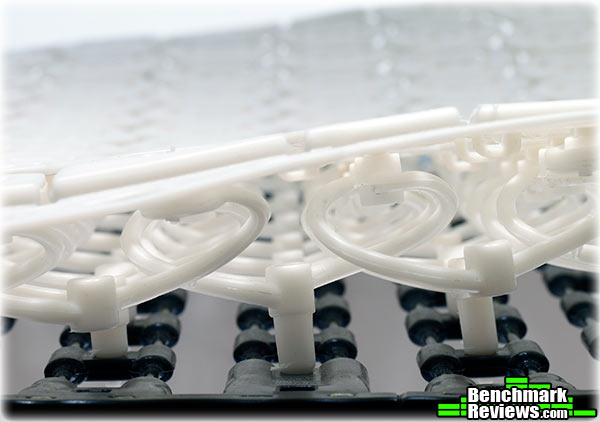
This breakthrough chair surface, combined with tilt technologies and adjustable back support, means the Embody Chair is built to provide comfort for hours of sitting. As their studies have concluded, Embody lets you be better to your body every time you take a seat. Since Embody is under warranty for 12 years, sitting in a chair that enhances blood circulation and distributes pressure at a granular level across your back, thighs, and sitting muscles can truly affect how your body feels from day to day.
While the Embody chair naturally contours to the bodies’ shape, there are still some adjustments necessary to enjoy the most comfortable seating experience. Most people, myself included, believe that they’re smarter than the chair, and don’t require any level of instruction to adjust the chair. I can’t speak for the others, but my own experience brought me back to the Herman Miller website to watch video guides and read helpful documents on how to best adjust the Embody chair.
Positioned in the left corner of the seatback is the tilt limiter. Four steps within the adjustable tilt limiter separate the Embody’s seatback from fully-reclined to the full-upright position. The most comfortable level is one step down, which allows for a six-inch free recline. The tilt limiter works in conjunction with the tilt tension knob, and can be adjusted to easily recline backward or gradually drift back.

Herman Miller Embody Chair Seatback Tilt Limiter
Located at the base of the Backfit frame is a rubber-coated Backfit adjustable knob (lower left corner in the image below), which allows the seatback unit to move forward or back without impacting the other aspects of the Embody chair. The Backfit knob turns 7.25 twists, and can adjust the seatback up to five inches forward or back.
The (optional) adjustable arm supports lift up six inches and also pull in or away from the body by three inches each. Spread to their widest and tallest position, the arm supports offer only 18-inches of separation, which could catch the hips of some sitters. Spread open and reduced to their lowest position, the arm supports offer 21-inches of separation. The Embody chair does not come with arm supports by default, which is a good thing, because most times they’ll be unnecessary or unwanted.

Herman Miller Embody Chair Backfit Adjustment Knob
Embody’s seat height joystick is one of the more sensitive adjustments on the Embody chair, primarily because the translucent plastic lever is designed to rotate within the knob. There’s a cutout in the lever, and it’s recommended to keep this notch pointing towards the floor. By lifting or depressing the lever, the Embody chair adjusts height depending on the weight applied to the seat.
Although the tilt tension knob houses the seat height joystick, it plays a completely different role to the Embody chair. Used to fine-tune the speed of recline, the tilt tension knob adjusts ten turns lock to lock, and works against the upper body weight to help determine the ideal recline resistance.

Herman Miller Embody Chair Seat Height Joystick/Tilt Tension Knob
The final adjustment is the Embody seat-bottom depth. Two locking seat depth handles are located at the edge of the Embody seat-bottom and adjust the seat up to three inches. By lifting weight off of the seats forward edge, the handles can be pulled up and adjusted in or out in locking steps. This adjustment helps remove pressure from the thighs, which can fatigue the legs.

Herman Miller Embody Chair Locking Seat Depth Handles
Pixelated support technology paired with seven different adjustment tools separate the Herman Miller Embody chair from every other office chair I’ve used in the past. These adjustments ensure that one chair fits every body size, with most shapes and postures automatically adapted for by the Embody chair. By fitting the body form and reducing seated pressure, Embody increases blood circulation and improves the flow of oxygen to help decreases heart rate.
According to the Herman Miller Embody website: “Embody is good for you. An agile chair that keeps your body and brain limber all day. Designed specifically for people who work for hours at computers, Embody is the first work chair that benefits both mind and body.” These are bold claims, and for the asking price of $1100 (twice the cost of Herman Miller’s Aeron chair) the Embody chair had better deliver on every promise. This isn’t snake oil, where the results could be real or imagined; this is a product that either makes you feel good after sitting for hours… or it doesn’t. So far, this article has detailed and demonstrated what the Herman Miller Embody chair can do as an ergonomic sitting device. With a full month of personal testing with the Embody chair, it’s time to discuss what it’s actually done.
Let’s begin with my expectations: for the best-available purchase price of $1100 ($1200 with optional arm supports), the Embody chair should remedy the poor leg circulation I feel after 10-12 hours of sitting in my $200 Realspace Pro 12000 office chair. I’m not expecting the Embody to feel as soft as my La-Z-Boy recliner, but it should be better than the $600 Aeron (also by Herman Miller), or the padded leather HON chair ($700) I’ve got in the study. I suppose I’m guilty of expecting performance to match price, but I’m an American living in a recession, and an expensive $1200 office chair had better come with three wishes.

Herman Miller Embody Backfit Frame
The Herman Miller Embody chair is too large to be shipped via UPS or FedEx, so each unit is hand-crafted and carefully boxed for freight transport directly from the Zeeland, Michigan Herman Miller factory. My first challenge with the Embody chair was actually receiving it: there’s a 21 business-day lead time on all orders. Taking weekends into consideration, that means you’ll be waiting a month for the Embody chair… which is exactly how long it took. There are several Herman Miller furniture stores online that stock a few ready-to-ship pre-configured models, but I insisted on arm supports and translucent casters. In retrospect, I could have done without both (especially the arm supports).
My first hour with the Embody chair was spent adjusting the various levers and knobs in no particular order, primarily because no form of product documentation or literature came with my chair. After visiting the Herman Miller website and watching a series of instructional videos, I was a near-expert in the art of Embody adjustments. The chair felt stiff and new at first, perhaps because the tension knob and seatback adjustment lever were both fully engaged. Overall, my initial experience left me feeling as though the Embody chair had immediately supported my back but had a lot of fine tuning left to be done.

Herman Miller Pixelated Support Embody Seat
As a business owner, I’ve become accustomed to working half-days: that means I work twelve out of twenty-four hours per day. I spend a lot too much time in front of my computer, responding to email and keyboarding articles such as this, so comfort is mandatory if I’m to have a productive work day. I work out and stay in shape, plus I’ve spent a portion of my life as a US Marine so I’ve had my own share of uncomfortable working conditions (one full year of sleeping atop dirt). Just because I can sleep on a bed of nails doesn’t mean I want to, and it’s hard to concentrate on work if your legs fall asleep or your back aches. So fine tuning the Embody chair is time well spent, as it turns out.
Since the Embody chair offers a noteworthy 12-year warranty and a premium $1100+ price tag, chances are very good the owner will be sitting in it for many years to come. With this in mind, my first week with the Herman Miller Embody chair involved minor tweaks to each of the adjusting devices, a short twist here and a half turn there, until I felt that the Embody chair ergonomically contoured to my body and lived up to its name. Once the courtship was over and I’d learned to live with Embody, there were some definitive benefits and only a few shortcomings worth noting.
Of the many things I like most about Embody, the Herman Miller Backfit seat-back support technology was at the top of my list. The Backfit frame and Pixel Matrix pad gives my upper body a feeling of floating up against the chair’s seat back, instead of leaning against it. With several give and take zones along the back, you never feel direct pressure or resistance. It’s probably still a good idea to get up and stretch every few hours, but at least now a sore back isn’t forcing me out of the chair.

Herman Miller Pixelated Support System
For all of the many things I’ve come to appreciate in Embody, I still have just one criticism: the seat bottom is not as soft as I’d like. Although pressure is evenly distributed across my entire seat, and my legs feel great, I still notice the lack of free-floating comfort. I understand how Herman Miller’s Pixelated Support system works, and that the individual cells must work independently in order to yield the appropriate suspension feedback. I’m also fully aware that too much padding would dull (or neutralize) the responsiveness, and yet somehow I still believe that a thin layer of closed-cell foam individually placed over each square pixel could go a long way. Of course, there’s the possibility that I should have spent another $200 on the fabric upgrade.
The standard Herman Miller Rhythm material is 100% polyester, and has a thin (1/8″) cushion feel to it. Herman Miller’s Balance material is a premium option created specifically for the Embody Chair, and it’s made from 100% polyester knit. This knit is advertised to give superior loft, or thickness, and delivers a cushy feel. My hands can feel a small amount of loft in the Rhythm material, but my legs can’t, and I’m regretting the decision. If I had to do it all over again, I would opt for Balance polyester knit material in place of optional arm supports.
Herman Miller is in the business of making functionally sound furniture that also happens to be fashionable. Many of the ergonomic chairs designed at Herman Miller offer extraordinary seating features, and most are given an affordable price tag. The Herman Miller Celle ($450) and Mirra ($600) chairs deliver some of the same flair as legendary Herman Miller Aeron chair ($630). But having the best comes at a cost: $1100 fetches the Herman Miller Embody chair. Even despite the premium pricing, Embody is not complete without the specially designed polyester knit Balance material for another $200.

Chairs are a primary focus, but functional furniture is a more accurate goal. If there was one Herman Miller piece that goes perfectly with Embody, it’s the Envelop desk. Equipped with adjustable features such as a tapered extending desktop with tilt support, the Envelope could be considered one half of the ideal Embody set.
As with any company driven by artistic flair, not all products that wear the Herman Miller name are worth their asking price. Like everything that costs money, the decision to purchase will come down to function and fashion over cost. Thankfully, the Embody chair is one of the few ideas that were inspired by function and worth the expense.
Although the rating and final score mentioned in this conclusion are made to be as objective as possible, please be advised that every author perceives these factors differently at various points in time. While we each do our best to ensure that all aspects of the product are considered, there are often times unforeseen market conditions and manufacturer changes which occur after publication that could render our rating obsolete. Please do not base any purchase solely on our conclusion, as it represents our product rating specifically for the product tested which may differ from future versions. Benchmark Reviews begins our conclusion with a short summary for each of the areas that we rate.
Without having a vast personal experience with every office chair available, my ratings are relative to the many chairs I do have experience with. In comparison to other premium ergonomic chairs, the Herman Miller Embody chair performs above and beyond all other seating products I’ve seen in my lifetime. Comparing the Embody against the Aeron chair is inevitable, and a little unfair. America’s favorite ergo-chair costs half as much, and so it seems fitting that it also delivers half as many functions (less, actually). The Herman Miller Backfit frame matches perfectly to the Pixel-Matrix Support pads and with seven different adjustments possible there’s barely a curve that doesn’t personally contour to your body.
Appearance is one area that Herman Miller chairs excel in, and Embody is no exception. Available in dozens of colors, two different fabric materials and frame colors, three different base finishes, and four different caster options, the Embody chair can be made to look as functional or as fashionable as your senses will allow. I’m a huge fan of the Pumpkin colored fabric with white frame and polished aluminum finish, which costs exactly the same as all-black or all-white.
Of the many stand-out features attributed to the Embody chair, above them all is superb construction. Herman Miller stands behind the quality of their hand-built Embody chairs with a twelve-year warranty. If there’s a concern with the Embody chair, or any Herman Miller product, free support is available via the customer service website or by calling 800-646-4400.
Functionality is the crowning achievement for the Herman Miller Embody chair. Pixel-Matrix support structure, seven ergonomic adjustments, various caster options (such as self-braking), and functional fabric all build upon the list of triumphant feats the Embody chair delivers. This article has already spent pages dedicated to the features and functionality of this chair and Embody easily becomes the prime example for highly-purposed chairs of the future.
There’s a tall list of highlighted Embody features, but price may not be among them. You really do get what you pay for, but the asking price is certainly not for everyone. Starting at $999 (Amazon), or up to $1400 loaded with arm supports and polyester knit Balance material, value is a propositional play for the Embody chair. Comparative to the entire market, $1100-1400 is actually respectable when you find dozens of more expensive chairs with far less function being sold at the major office supply outlets. Using our price comparison tool, there were several online retailers selling the Herman Miller Embody chair… some with added buyer incentives such as free translucent casters.
In conclusion, I spent $1200 of my own money on the Herman Miller Embody chair, and I’m very pleased with my purchase. If I had to do it again, I’d go without arm supports (-$100) and add the Balance material (+200) for a softer seat. Since there are after-market user-replaceable parts sold, perhaps I’ll still get the Balance Pumpkin-colored fabric after all. If you’re prone to long periods of sitting behind a desk, your body would be better cared for with the Herman Miller Embody chair. I’m an athletic person with no medical conditions, yet my back and legs could immediately feel a difference when supported by Embody. For anyone with heath conditions, the improvements could be much more dramatic and pain relieving.
+ Highly ergonomic design improves on Aeron legacy
+ Backfit frame perfectly contours to spine
+ Pixel Matrix technology promotes circulation
+ Pixelated Support System reduces leg fatigue
+ Seven adjustable features to fine-tune fit
+ Extremely well built with 12-year warranty
+ Available with highly-customizable options
+ Eco-Green LEED credited chair: 95% recyclable
– Expensive premium seating product
– Balance material should be standard fabric
– Lacks included product manual or adjustment instructions
– Seat bottom is not very soft or comforting


