By David Ramsey
Manufacturer: Hewlett-Packard
Product Name: Portable SSD P800 1TB
Part Number: 3SS21AA#ABC
UPC: 0192545069335
Price As Tested: $449.99 (Newegg | Amazon)Full Disclosure: Hewlett-Packard Co. provided the product sample used in this article.
USB-powered external hard drives remain the mechanism of choice for most laptop users who need to back up their systems or transfer large files. While their price is low, so is their performance, and the increasing availability of Thunderbolt 3 ports on newer laptops presents an opportunity for vendors to target high-end users who are willing to pay for the best possible data transfer rates. The Hewlett-Packard Portable SSD P800 leverages its Thunderbolt interface to provide performance that’s exceptional for any storage device, not just an external one, and today Benchmark Reviews will put this high-end new drive through its paces.

| Capacity | 1TB |
| Interface | Thunderbolt 3 |
| Form Factor | Custom, 2.85″ x 5.55″ x 0.73″ |
| Power | 0.5W idle, 6.5W maximum |
| Max transfer speed | 2.4GB/s read, 1.2GB/s write |
| MTBF | 2,000,000 hours |
No matter how fast your processor, memory, or video card is, your computer will still be limited by its slowest component: the hard disk. While hard disk speed has improved tremendously since the “early days”, with large caches and 10,000RPM spindle speeds, even the fastest hard disk’s performance is glacial compared to the rest of the computer. The situation only gets worse with modern pre-emptive multitasking operating systems, where dozens of threads are running simultaneously and competing for your disk’s limited response time and bandwidth.
Consider: the average time to move a high-performance hard disk’s read/write head to a new track will be less than 10ms, which seems pretty fast. But your CPU is galloping along at billions of cycles per second, and will spend a significant amount of its time just waiting for the hard disk to fulfill its last request. Hard disk performance has plateaued in the last few years, running up against the physical limitations of spindle speeds, magnetic media density, and head servomotor performance. At the end of the day, disks are limited by the fact that they’re comprised of physical, moving parts.
With no moving parts, Solid State Drive technology removes this bottleneck. The difference an SSD makes to operational response times and program speeds is dramatic: while a faster video card makes your games faster, and a faster processor makes compute-bound tasks faster, Solid State Drive technology makes your entire system faster, improving initial response times by more than 450x (45,000%) for applications and Operating System software, when compared to their mechanical HDD counterparts. The biggest mistake PC hardware enthusiasts make with regard to SSD technology is grading them based on bandwidth speed alone. File transfer speeds are important, but only so long as the operational I/O performance can sustain that bandwidth under load.
As we’ve explained in our SSD Benchmark Tests: SATA IDE vs AHCI Mode guide, Solid State Drive performance revolves around two dynamics: bandwidth speed (MB/s) and operational performance I/O per second (IOPS). These two metrics work together, but one may be more important than the other. Consider this analogy: bandwidth determines how much cargo a ship can transport in one voyage, and operational IOPS performance is how fast that ship moves. By understanding this and applying it to SSD storage, there is a clear importance set on each variable depending on the task at hand.
For casual users, especially those with laptop or desktop computers that have been upgraded to use an SSD, the naturally quick response time is enough to automatically improve the user experience. Bandwidth speed is important, but only to the extent that operational performance meets the minimum needs of the system. If an SSD has a very high bandwidth speed but a low operational performance, it will take longer to load applications and boot the computer into Windows than if the SSD offered a higher IOPS performance.
Presently available online for $449.99 (Newegg | Amazon), the 1TB HP Portable SSD P800 lightweight Thunderbolt 3 storage device. The HP Portable SSD P800 comprises a textured aluminum case with a wave pattern embossed across the top.

The same pattern repeats on the bottom. There’s no label or logo to be found here.

The integrated Thunderbolt 3 cable fits in a recess on the side of the case. A sliding switch will push out the cable end, or you can use the plastic pull tab.

The cable itself is quite short. While you can use this drive with a desktop computer that has a Thunderbolt 3 port, it’s really intended for laptop computers. Thunderbolt 3 extension cables are available, though.

The Hewlett-Packard drive is much larger than the 1TB version of Samsung’s Portable SSD T5.

There are no cables or other accessories included with the drive. The Quick Start manual includes this page in a few dozen languages. Yep, this is all the documentation you’ll get! But it’s really all you’ll need.

Like the Samsung, the HP P800 is a sealed unit and I couldn’t open it to see the internals. So, let’s jump right into the benchmarking…
When we test storage devices, the two main metrics to consider are access time and transfer rate. Simply put, access time is the time is takes the storage device to start delivering data once the request has been received, while transfer rate is how fast (megabytes per second) the data comes once the transfer operation begins. With a hard disk, data transfer cannot begin until the disk’s head servo physically moves the read/write head to the correct track, and the rotation of the disk brings the designated sector under the head. Although modern servos are very fast, in the best case you’re still looking at several milliseconds to do this, while an SSD’s access time is always under a millisecond. The disadvantage is even worse if the data isn’t all in a contiguous space on the disk, since the head will have to be repositioned on the fly, leading to more delays.
Early consumer SSDs actually had slower transfer rates than the best hard disks, although their instantaneous access times more than made up for it. The zenith of consumer hard disk performance was probably reached in 2012 with the release of the Western Digital Velociraptor 1 terabyte disk. Spinning at 10,000RPM, this disk could under ideal circumstances (i.e. a synthetic bandwidth test) reach a sequential transfer rate of over 230MB/s. Keep this figure in mind as you read this review.
Early on in our SSD coverage, Benchmark Reviews published an article which detailed Solid State Drive Benchmark Performance Testing. The research and discussion that went into producing that article changed the way we now test SSD products. Our previous perceptions of this technology were lost on one particular difference: the wear leveling algorithm that makes data a moving target. Without conclusive linear bandwidth testing or some other method of total-capacity testing, our previous performance results were rough estimates at best.
Our test results were obtained after each SSD had been prepared using DISKPART or Sanitary Erase tools. As a word of caution, applications such as these offer immediate but temporary restoration of original ‘pristine’ performance levels. In our tests, we discovered that the maximum performance results (charted) would decay as subsequent tests were performed. SSDs attached to TRIM enabled Operating Systems will benefit from continuously refreshed performance, whereas older O/S’s will require a garbage collection (GC) tool to avoid ‘dirty NAND’ performance degradation.
It’s critically important to understand that no software for the Microsoft Windows platform can accurately measure SSD performance in a comparable fashion. Synthetic benchmark tools such as ATTO Disk Benchmark and Iometer are helpful indicators, but should not be considered the ultimate determining factor. That factor should be measured in actual user experience of real-world applications. Benchmark Reviews includes both bandwidth benchmarks and application speed tests to present a conclusive measurement of product performance.
For this test we had to use a separate test system with Thunderbolt support, as our standard Z170-based test platform doesn’t support Thunderbolt.
- Motherboard: ASUS Prime X299 Deluxe Socket LGA 2066
- Processor: 3.3 GHz Intel Core i9-7900X
- System Memory: 32GB DDR4 2133MHz
- Operating System: Microsoft Windows 10 Pro
- AS SSD Benchmark 1.6.4067.34354: Multi-purpose speed and operational performance test
- ATTO Disk Benchmark 2.46: Spot-tests static file size chunks for basic I/O bandwidth
- CrystalDiskMark 3.0.1a by Crystal Dew World: Sequential speed benchmark spot-tests various file size chunks
- Iometer 1.1.0 (built 08-Nov-2010) by Intel Corporation: Tests IOPS performance and I/O response time
- Finalwire AIDA64: Disk Benchmark component tests linear read and write bandwidth speeds
- Futuremark PCMark Vantage: HDD Benchmark Suite tests real-world drive performance
This article utilizes benchmark software tools to produce operational IOPS performance and bandwidth speed results. Each test was conducted in a specific fashion, and repeated for all products. These test results are not comparable to any other benchmark application, neither on this website or another, regardless of similar IOPS or MB/s terminology in the scores. The test results in this project are only intended to be compared to the other test results conducted in identical fashion for this article.
Testing Notes on Thunderbolt: Thunderbolt 3 is the latest and fastest iteration of the Thunderbolt I/O standard co-developed by Apple and Intel. Thunderbolt 3 incorporates the ability to supply 100 watts of power delivery, up to 4 PCI-E lanes, and DisplayPort 1.2 all over a copper USB C connection. The maximum bandwidth is 40 Gb/s.
While Thunderbolt 3 uses USB C connectors (Thunderbolt 2 used mini-DisplayPort connectors), it’s important to remember that while it can supply USB 3 connectivity (i.e. most Thunderbolt ports will support USB 3 devices), the converse is not true: a Thunderbolt device such as this Hewlett-Packard Portable SSD P800 will not work when plugged into a non-Thunderbolt USB C port.
To test the P800, Benchmark Reviews configured a new X299-based test bed with ASUS’ “Thunderbolt 3 EX” card. While we were able to run some of our standard benchmark tests, others like AS SSD and ATTO Disk Benchmark would crash the system every time they were run. We are not sure if this represents a problem with ASUS’ Thunderbolt implementation or simply that the benchmarks weren’t designed with Thunderbolt in mind.
CrystalDiskMark 3.0 is a file transfer and operational bandwidth benchmark tool from Crystal Dew World that offers performance transfer speed results using sequential, 512KB random, and 4KB random samples. For our test results chart below, the 4KB 32-Queue Depth read and write performance was measured using a 1000MB space. CrystalDiskMark requires that an active partition be set on the drive being tested. Benchmark Reviews uses CrystalDiskMark to illustrate operational IOPS performance with multiple threads. In addition to our other tests, this benchmark allows us to determine operational bandwidth under heavy load.
CrystalDiskMark uses compressed data, so sequential file transfer speeds are reported lower than with other tools using uncompressed data. For this reason, we will concentrate on the operational IOPS performance in this section.
CrystalDiskMark 3.0 reports sequential speeds reaching 1860MB/s reads and 1139MB/s writes.

The chart below summarizes 4K random transfer speeds with a command queue depth of 32. While the P800’s straight sequential performance was exceptional, its 4K/QD32 results were less so.

In the next section, we continue our testing using Iometer to measure input/output performance…
Iometer is an I/O subsystem measurement and characterization tool for single and clustered systems. Iometer does for a computer’s I/O subsystem what a dynamometer does for an engine: it measures performance under a controlled load. Iometer was originally developed by the Intel Corporation and formerly known as “Galileo”. Intel has discontinued work on Iometer, and has gifted it to the Open Source Development Lab (OSDL). There is currently a new version of Iometer in beta form, which adds several new test dimensions for SSDs.
Iometer is both a workload generator (that is, it performs I/O operations in order to stress the system) and a measurement tool (that is, it examines and records the performance of its I/O operations and their impact on the system). It can be configured to emulate the disk or network I/O load of any program or benchmark, or can be used to generate entirely synthetic I/O loads. It can generate and measure loads on single or multiple (networked) systems.
To measure random I/O response time as well as total I/O’s per second, Iometer is set to use 4KB file size chunks over a 100% random sequential distribution at a queue depth of 32 outstanding I/O’s per target. The tests are given a 50% read and 50% write distribution. While this pattern may not match traditional ‘server’ or ‘workstation’ profiles, it illustrates a single point of reference relative to our product field.
All of our SSD tests used Iometer 1.1.0 (build 08-Nov-2010) by Intel Corporation to measure IOPS performance. Iometer is configured to use 32 outstanding I/O’s per target and random 50/50 read/write distribution configuration: 4KB 100 Random 50-50 Read and Write.icf. The chart below illustrates combined random read and write IOPS over a 120-second Iometer test phase, where highest I/O total is preferred. The HP Thunderbolt P800 returned by far the highest score we’ve ever seen for an external drive.

In our next section, we test linear read and write bandwidth performance and compare the speed of Hewlett-Packard’s external SSD against several other top storage products using the AIDA64 Disk Benchmark.
Many enthusiasts are familiar with the Finalwire AIDA64 benchmark suite, but very few are aware of the Disk Benchmark tool available inside the program. The AIDA64 Disk Benchmark performs linear read and write bandwidth tests on each drive, and can be configured to use file chunk sizes up to 1MB (which speeds up testing and minimizes jitter in the waveform). Because of the full sector-by-sector nature of linear testing, Benchmark Reviews endorses this method for testing SSD products, as detailed in our Solid State Drive Benchmark Performance Testing article. One of the advantages SSDs have over traditional spinning-platter hard disks is much more consistent bandwidth: hard disk bandwidth drops off as the capacity draws linear read/write speed down into the inner-portion of the disk platter. AIDA64 Disk Benchmark does not require a partition to be present for testing, so all of our benchmarks are completed prior to drive formatting.
Linear disk benchmarks are superior bandwidth speed tools because they scan from the first physical sector to the last. A side affect of many linear write-performance test tools is that the data is erased as it writes to every sector on the drive. Normally this isn’t an issue, but it has been shown that partition table alignment will occasionally play a role in overall SSD performance (HDDs don’t suffer this problem).

With an average linear read transfer rate of just over 2 gigabytes per second, the P800 is much faster than even internal SATA SSDs, approaching the speed of performance-oriented NvME drives.

Linear write performance was less impressive, with very broad swings in transfer rate: the maximum rate is more than triple the minimum rate. Still, with an overall average of 900 megabytes per second, it’s still pretty fast.

Even with its variable write performance, the Portable SSD P800’s overall AIDA64 performance is exceptional, with four times the read throughput and triple the write throughput of the next closest external drive.
In the next section we’ll try to other tests to make up for the lack of Vantage, ATTO, and AS-SSD.
The Hewlett-Packard Portable SSD P800 is the first Thunderbolt storage device that Benchmark Reviews has tested, and we ran into some problems with our new Thunderbolt-equipped test system. Basically, some tests would crash the entire system every time they were run. We’re unsure whether this represents a problem with ASUS’ Thunderbolt EX3 card and driver, or whether it’s an incompatibility with older benchmark software.
So I’ve added a few ad-hoc tests. First, I timed a simple file transfer, dragging a multi-gigabyte video file from the internal SATA SSD of the test system to the P800:

In contrast to the variable performance we saw in the AIDA64 linear write test, this file transfer was smooth and consistent, which is perhaps unsurprising since we’re only seeing about half of the linear write performance returned by the synthetic benchmarks.This is because this operation was limited by the read speed of the source volume, a standard SATA SSD. This is something I will discuss in my final thoughts.
Next, I ran the Anvil Pro SSD Benchmark. Note that the maximum sequential read and write rates line up rather well with what we’ve seen in other benchmarks.

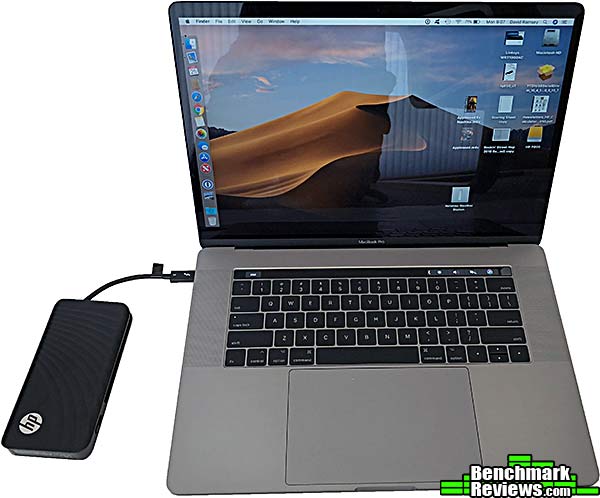
For my last test, I connected the P800 to my late 2017 Macbook Pro 15″, which has four native Thunderbolt 3 ports, to run Black Magic Design’s disk speed test.

The Black Magic Design disk speed test is oriented towards video producers and rates a disk based on its ability to handle various video bit streams. It’s interesting to see how closely the read and write figures align with the AIDA64 linear read and write figures.
In the next section, I’ll present my final thoughts and conclusion.
IMPORTANT: Although the rating and final score mentioned in this conclusion are made to be as objective as possible, please be advised that every author perceives these factors differently at various points in time. While we each do our best to ensure that all aspects of the product are considered, there are often times unforeseen market conditions and manufacturer changes which occur after publication that could render our rating obsolete. Please do not base any purchase solely on our conclusion, as it represents our product rating specifically for the product tested which may differ from future versions.
It seems only recently that a USB 2 external drive, connected to a High Speed USB 2 port at 480Mb/s, was as fast as anyone could reasonably want. Then USB 3 came along and bumped the raw bandwidth by a factor of over 10 to 5Gb/s, and USB 3.1/USB C doubled even that. As we’ve seen with our tests of USB 3 and USB 3.1 external drives like the Samsung T5 and MyDigitalSSD BOOST, these new interfaces carry significant real-world performance benefits.
Thunderbolt 3 brings a new level of performance, with synthetic benchmarks showing anywhere from 2 to 4 times the transfer rate of even USB 3.1 drives. But synthetic benchmarks don’t always reflect real-world performance, and in this case there’s a “gotcha”: if you’re transferring data to or from this drive, your performance is going to be limited by the rest of your system. It doesn’t matter how fast the P800 is if the drive you’re moving data to or from is slower. We saw this limitation when I copied a large video file from the SATA SSD on the desktop test system to the P800: an average write speed of 420MB/s is less than half what the benchmarks reported, but was as fast as the internal drive could deliver the data. So if your computer’s not rocking the latest NvME internal drive, you’re not going to get the full performance the P800 can deliver.

The impressive performance of the 1-terabyte P800 comes at a cost, though: when you can buy a 1TB USB external hard drive in a blister pack for $50 at any office supply store, you must really need (or want) the performance to pay nine times as much for the P800. And this era of the ultra-thin Macbook, HP Spectre, and Dell XPS 13, the P800’s considerable size and heft will add a noticeable load to your laptop carry bag.
As of July 2018, the HP Portable SSD P800 is available online for $449.99 (Newegg | Amazon), and is a premium product aimed at the very top niche of busy content creators and other professionals who need this level of power and whose hardware can make use of it. For them, there’s simply no other game in town.
+ Highest performing external drive money can buy
+ Sleek metal enclosure
+ Integrated Thunderbolt 3 cable
– Very expensive
– Transfer performance may be limited by your system
– No backup or utility software
– Will not work on USB C ports; requires Thunderbolt
- Performance: 9.75
- Appearance: 9.00
- Construction: 9.50
- Functionality: 8.00
- Value: 7.50

One thought on “HP Portable SSD P800 Review”
While clean, or reformatted drives certainly show their stuff WRT transfer speeds, etc, it is interesting that throughout the article you stressed real-world results will likely be worse and degrade over time with usage. It’s too bad there isn’t a test for those conditions, or is there?
I contend that factor alone virtually nullifies the clean drive performance figures because nobody continues to use their drive (regardless of type) in just-formatted condition.It would be terrific if they could, but it doesn’t happen.
I don’t know the answer to this dilemma, nevertheless the performance of SSDs will undoubtedly make them the fastest gun in town, unless and until something better comes along.
Comments are closed.