By David Ramsey
Manufacturer: Micron Technology, Inc.
Product Name: Ballistix Elite DDR4 32GB Kit
Model Number: BLE4K8G4D34AEEAK
UPC: 649528782762
Price As Tested: $371.99 (Crucial | B&H)Full Disclosure: Micron Technology provided the product sample used in this article.
We’re in the middle of a transition from the DDR3 memory standard that has served us well for a decade to the new DDR4 standard. With higher bandwidth at lower voltage, DDR4 seems a perfect match for our compute-intensive multi-core CPU world. In this article Benchmark Reviews examines Crucial’s Ballistix Elite DDR4 enthusiast memory, which runs at an eye-watering 3466Mhz. We’ll test it against “standard” DDR4 to see what difference this extra performance makes.

I’ll test this memory in my Z170 / Core i7-6700K test system with a variety of benchmarks.
Courtesy of Crucial. Full product sheet.
- 4x8GB DDR4-3466 (32GB kit)
- UDIMM form factor
- Non-ECC
- 1.35V
- DDR4 PC4-27700 • 16-18-18
Let’s take a look at this advanced performance memory in the next section…
Test Platform
- MSI Z170 Gaming 5 motherboard
- Intel Core i7-6700K CPU, non-overclocked
Some years ago, Intel defined the “Extreme Memory Profile” (XMP) protocol, wherein a memory vendor could indicate, via a special chip on a memory module, the fastest timings the memory could run at. Modern motherboards allow you to enable or disable XMP in the BIOS, or sometimes via a physical switch on the motherboard. The Crucial Ballistic Elite DDR4 we receive has XMP settings of 16-18-18-36 at 3,466MHz, while the “standard” DDR4 I tested against is running at 2,133MHz. It’s important to note that if you install performance memory in your computer, you must enable the XMP setting in your computer’s BIOS to realize the extra performance. Well, that or overclock it manually.
Starting off with AIDA64’s built-in memory benchmark, we see substantial gains in both sequential reads and sequential writes, with a 48.3% increase in read throughput and 61% increase in write throughput. The increase in write throughput virtually equals the 62% increase in memory clock speed over stock.

Next, I ran Passmark 9’s memory benchmark. Uncached read results were modest, with a 14% increase; cached reads were virtually the same (which is to be expected here), while writes showed a more substantial 38% increase.

The last synthetic test, the memory benchmark built into SiSoft’s Sandra Lite utility, shows substantial gains: 55% overall, with a 55% increase in integer bandwidth and a 54% increase in floating point bandwidth. This is very close to the 62% increase in clock speed.

In the next section I’ll run some real-world applications.
I like the Handbrake video encoder as a good general test of a system’s computer performance. It scales gracefully across multiple CPU cores and depending on the encoding format, can present a very heavy computational load. In this test I encoded a half-hour episode of “Family Guy” using Handbraker’s built-in 1080p30 “very fast” setting.
The performance improvement was slight, but real, with 38 seconds cut from the total encoding time. This represents a performance improvement of just over 8%.

Next, I tested another compute-intensive program, the 3D modeling and rendering application Blender. Here again the performance improvement was real and repeatable, but also small: less than two seconds separates the times to render a 25-frame animation of a rotating, translucent chunk of ice. This is about a 3.5% improvement.

I’ll present my final thoughts and conclusions in the next section.
Building a high performance system requires some knowledge of and consideration for the way the various components interact. For example, you won’t get the full performance of an expensive, high end graphics card if it’s paired with a slow, lower-end CPU. The components that have the greatest effect on system performance are, in order of importance:
- Storage (SSD vs. hard disk)
- Processor
- Graphics card
- Memory
Of course, individual use patterns can rearrange this list. A dedicated gaming system would place more importance on a high-performance graphics card than an SSD, for example; while a video transcoding workstation would benefit more from a faster CPU.
But regardless of the use cases, the truth is that your memory performance is almost never going to be a limiting factor. The reason for this is simple: modern processors have megabytes of on-chip cache. The Core i7-6700K used in this test system has 8M of cache. This might not sound like much when put up against the 32GB Crucial memory kit, but it’s enough to satisfy 90% or more of all memory requests during normal use. This means that even infinitely fast memory with 1-clock latencies will still not have that much of an effect on system performance.
Synthetic benchmarks like AIDA64 that read large sequential blocks of memory show the true performance it’s capable of since caching isn’t involved. However, most real-world workloads don’t read or write large sequential chunks of memory, so you’ll see little noticeable performance increase.
The situation here is similar to that in the storage world: going from a hard disk to a SATA SSD yields dramatic and tangible performance improvements, but going from a SATA SSD to an PCI-E based m.2 SSD shows virtually no real-world improvement, even though benchmarks show the latter is much faster.
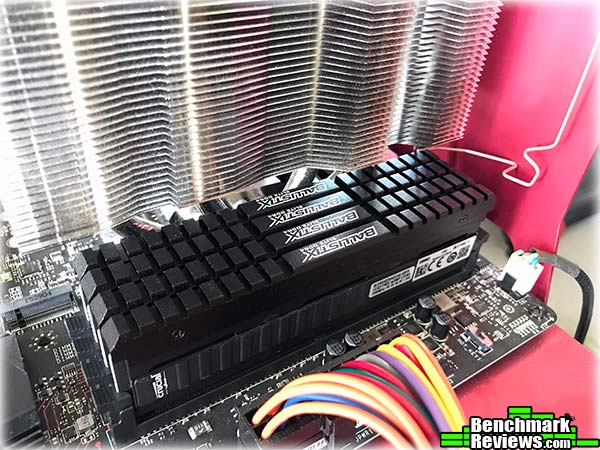
Crucial’s Ballistix Elite DDR4-3466 32GB memory kit provides a substantial step up in performance compared to standard DDR4-2133. The appearance, quality of construction, and synthetic benchmark results are all that we’ve come to expect from Crucial’s enthusiast-level products.
But at the end of the day, high-performance memory is really a niche product. For $371.99 (Crucial | B&H), the Ballistix Elite 32GB kit costs substantially more than a standard DDR4-2133 kit, which currently sells for about $220-$250. And the significant added cost will not translate into extra performance for most users, whose performance dollars would be better spent elsewhere.
But for those looking to add that last increment of system performance, whether for bragging rights or the rare workloads that can fully exploit the added bandwidth, will be thrilled with the Ballistix Elite DDR4-3466 32GB kit.

+ Quality construction
+ Impressive appearance
+ Amazing throughput on synthetic benchmarks
– Expensive
– Real-world performance gains minimal for most users
-
Performance: 9.50
-
Appearance: 9.00
-
Construction: 9.25
-
Functionality: 8.00
-
Value: 7.00


