By Olin Coles
Manufacturer: Samsung Electronics Co., Ltd.
Product Name: Samsung SSD 950 PRO
Part Numbers: MZ-V5P256BW (256GB) MZ-V5P512BW (512GB)
Price As Tested: $199.99 (256GB) or $349.99 (512GB)Full Disclosure: The product sample used in this article has been provided by Samsung.
Depending on your age, you might remember back to when storage drives connected to the motherboard by an IDE ribbon cable, ultimately capable of PATA transfers up to 133 MB/s. Later came the SATA interface capable of up to 6 Gb/s transfers, and which also introduced the feature-rich AHCI interface protocol. Today we have M.2, a next-generation connector designed specifically for solid state drives and capable of interfacing through the PCI Express bus. Along with this new connector arrives NVMe, a non-volatile memory protocol that outperforms AHCI for SSD transfers by enabling much higher input/output operations (IOPS) and nearly 400% faster performance.
In this article Benchmark Reviews tests the Samsung SSD 950 PRO, an M.2 solid state drive among the first to utilize the ultra-fast NVMe protocol, on both Intel X99 and Z170 platforms. Featuring Samsung’s second generation 32-layer MLC V-NAND, SSD 950 PRO M.2 is available in 256 GB and 512 GB storage capacities. The SSD 950 PRO utilizes Samsung’s UDX controller to deliver sequential read speeds up to 2500 MB/s and writes up to 1500 MB/s, while random read performance reaches up to 300,000 IOPS and write speeds up to 110,000 IOPS. Performance is further optimized with Samsung Magician software, and durability enhanced by the drive’s Dynamic Thermal Guard and AES 256-bit Full Disk Encryption. 950 PRO includes a 5-year limited warranty, and promises up to 400 terabytes written (TBW) for 512GB model.
There are a few things worth noting with the launch of SSD 950 PRO, beginning with the form factor. For obvious reasons Samsung sees a bright future in M.2, and namely NVMe, so you won’t see a SATA version of the SSD 950 PRO. You also won’t see Samsung using the term 3D V-NAND anymore, as they’ve re-branded the technology as simply V-NAND. Finally, Samsung’s 32-layer MLC V-NAND 128GB die will remain the flash technology used in 950 PRO until they reveal their 3rd-generation 48-layer technology later in 2016.

Solid State Drive performance revolves around two dynamics: bandwidth speed (MB/s) and operational performance I/O per second (IOPS). These two metrics work together, but one may be more important than the other depending on the workload. Consider this analogy: bandwidth determines how much cargo a ship can transport in one voyage, and operational IOPS performance is how fast that ship moves back and forth. By understanding this and applying it to SSD storage, there is a clear importance set on each variable depending on the task at hand.
For casual users, especially those with laptop or desktop computers that have been upgraded to use an SSD, the naturally quick response time is enough to automatically improve the user experience. Bandwidth speed is important, but only to the extent that operational performance meets the minimum needs of the system. If an SSD has a very high bandwidth speed but a low operational performance, it will take longer to load applications and boot the computer’s Operating System than another SSD that offers higher IOPS performance.
Courtesy Samsung (click to enlarge)

Solid State Drive technology has been revolutionary, as it immediately delivers a very noticeable performance boost that surpasses upgrades to other system components. Samsung’s SSD 950 PRO is designed for the M.2 2280 form factor using Non-Volatile Memory Express (NVMe), which means that performance enthusiasts with computers as small as ultra-slim notebooks all the way up to large desktop workstation PCs can benefit from the incredible speeds available across the Peripheral Component Interconnect Express (PCIe) 3.0 interface.

With the compact M.2 form factor now widely available on most devices and motherboards, users can take advantage of the SSD-optimized NVMe protocol implemented into Intel’s X99 and Skylake Z170 platforms to unleash incredible PCIe bandwidth and lower latency from Samsung 950 PRO. Portable systems will benefit from the added power savings, which translates into an increased battery life and potentially reduce operating costs.

Samsung Magician 4.8 software, which will debut with this launch, allows the Windows computer to further enhance performance by processing data on a system level using unallocated PC memory (DRAM) as a storage cache. Samsung Magician features a DRAM usage algorithm optimized for maximum memory available for RAPID mode. This algorithm utilizes up to 25% of system memory for RAPID mode, so a system with 16GB memory will use up to 4GB for Samsung RAPID storage cache.

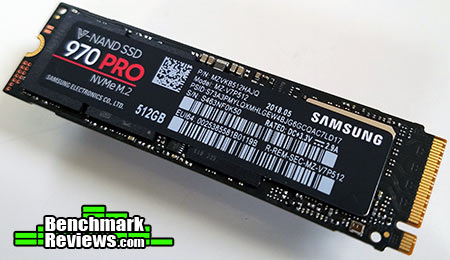
Unlike SATA-based SSDs that use a metal enclosure to protect the sensitive electronics inside, M.2 SSDs lack the footprint to dress up the product with decals. There’s just enough room for product labels to be placed over the NAND, although with high-density components the entire backside of the PCB is completely bare (see above).
For those desktop computer systems without a native M.2 port, you’ll need an M.2-to-PCIe adapter for a 4x or better slot and a motherboard with NVMe support. The NVMe protocol improves upon random and sequential performance over 3rd-generation SATA 6 GB/s interfaces utilizing the now-legacy Advanced Host Controller Interface (AHCI).
 Samsung SSD 950 PRO is available in 512GB and 256GB storage capacities, with the 512GB version delivering sequential read/write speeds of up to 2,500 MB/s and 1,500 MB/s. Using the well-known Samsung UBX controller, random read performance reaches 300,000 IOPS, with write speeds up to 110,000 IOPS. Samsung provides the 512GB SSD 950 PRO with a lengthy five-year product warranty, or 400 TBW (Total Bytes Written).
In the next few sections we’ll test benchmark performance with the Samsung SSD 950 PRO…
Early on in our SSD coverage, Benchmark Reviews published an article which detailed Solid State Drive Benchmark Performance Testing. The research and discussion that went into producing that article changed the way we now test SSD products. Our previous perceptions of this technology were lost on one particular difference: the wear leveling algorithm that makes data a moving target. Without conclusive linear bandwidth testing or some other method of total-capacity testing, our previous performance results were rough estimates at best.
Our test results were obtained after each SSD had been prepared using DISKPART, or similar proprietary tools such as Samsung Magician. As a word of caution, applications such as these offer immediate but temporary restoration of original ‘pristine’ performance levels. SSDs attached to TRIM enabled Operating Systems will benefit from continuously refreshed performance, whereas older O/S’s will require a garbage collection (GC) tool to avoid ‘dirty NAND’ performance degradation.
It’s critically important to understand that no single software tool for the Microsoft Windows platform can accurately measure comprehensive SSD performance in a comparable fashion. Synthetic benchmark tools such as ATTO Disk Benchmark and Iometer are helpful indicators, but should not be considered the ultimate determining factor. That factor should be measured in actual user experience of real-world applications. Benchmark Reviews includes both bandwidth benchmarks and application speed tests to present a conclusive measurement of product performance.
This article utilizes benchmark software tools to produce operational IOPS performance and bandwidth speed results. Each test was conducted in a specific fashion, and repeated for all products. These test results are not comparable to any other benchmark application, neither on this website or another, regardless of similar IOPS or MB/s terminology in the scores. The test results in this project are only intended to be compared to the other test results conducted in identical fashion for this article.

- Motherboard: ASUS X99-DELUXE/U3.1 LGA 2011-v3
- M.2 Adapter: ASUS Hyper M.2 X4
- Processor: 3.0GHz Intel Core i7-5960X Haswell-E CPU
- System Memory: 16GB DDR4 2133MHz
- Operating System: Microsoft Windows 10 Pro

- Motherboard: MSI Z170A GAMING M7 Socket LGA 1151
- Processor: 4.0 GHz Intel Core i7-6700K Skylake CPU
- System Memory: 16GB DDR4 2133MHz
- Operating System: Microsoft Windows 10 Pro
The following storage hardware has been used in our benchmark performance testing, and may be included in portions of this article:
- Samsung SSD 950 PRO 512GB M.2 NVMe MZ-V5P512BW
- AS SSD Benchmark 1.8.5636.37293: Multi-purpose speed and operational performance test
- ATTO Disk Benchmark 2.46: Spot-tests static file size chunks for basic I/O bandwidth
- CrystalDiskMark 5.0.2 x64: Sequential speed benchmark spot-tests various file size chunks
- Iometer 1.1.0 (built 08-Nov-2010) by Intel Corporation: Tests IOPS performance and I/O response time
- Finalwire AIDA64 Extreme v5.50: Disk Benchmark component tests linear read and write bandwidth speeds
- Futuremark PCMark Vantage 1.2.0.0 (x64): HDD Benchmark Suite tests real-world drive performance
CrystalDiskMark is a file transfer and operational bandwidth benchmark tool from Crystal Dew World that offers performance transfer speed results using sequential, 512KB random, and 4KB random samples. For our test results below, the default 4KB 32-Queue Depth read and write performance was measured using a 1GB file size.
Benchmark Reviews utilizes CrystalDiskMark to illustrate operational IOPS performance with multiple work threads. In addition to our other tests, this benchmark allows us to determine operational bandwidth under heavy load. CrystalDiskMark uses compressed data, so sequential file transfer speeds are reported lower than with other tools using uncompressed data.

CrystalDiskMarkTests: Intel X99 Platform
Using a NTFS-formatted 512GB Samsung SSD 950 PRO, CrystalDiskMark utilized 32-queries working on 1-thread to produce 2600 MB/s sequential read speeds for both the X99 and Z170 test systems. Q32T1 Sequential write speeds were also very similar, achieving 1547 MB/s on X99 and 1540 for Z170.
Random 4K transfer using 32-queries and 1-thread delivered 525 MB/s read and 392 MB/s write performance for X99, while Z170 produced much higher speeds with 777 MB/s reads and 426 MB/s writes.

CrystalDiskMarkTests: Intel Z170 Platform
Utilizing 1MB blocks for sequential single-thread transfers, 950 RPO delivered read speeds reaching 2158 MB/s with X99 and 1925 MB/s with the Z170 test system. Write speeds were very different between the two, with X99 producing 1033 MB/s while Z170 generated a remarkable 1536 MB/s.
Random 4KB IOPS performance utilizing a single queue and thread produced 49 MB/s reads from X99 and 42 MB/s on Z170, while write IOPS reached 223 MB/s with X99 and 179 MB/s on Z170.
In the next section, Benchmark Reviews tests transfer rates using ATTO Disk Benchmark.
The ATTO Disk Benchmark program is free, and offers a comprehensive set of test variables to work with. In terms of disk performance, it measures interface transfer rates at various intervals for a user-specified length and then reports read and write speeds for these spot-tests. There are some minor improvements made to the 2.46 version of the program that allow for test lengths up to 2GB, but all of our benchmarks are conducted with 256MB total length. ATTO Disk Benchmark requires that an active partition be set on the drive being tested. Please consider the results displayed by this benchmark to be basic bandwidth speed performance indicators.

ATTO Disk Benchmark: Intel X99 Platform
ATTO Disk Benchmark tests transfers speeds for file sizes ranging from 0.5 KB to 8192 KB. Our Intel X99 test system produced 2591 MB/s maximum read speeds, which plateaued around 64-1024 KB file chunks. Maximum write speeds reached 1558 MB/s, and plateaued between 64-1024 KB.

ATTO Disk Benchmark: Intel Z170 Platform
Tested next with the Intel Z170 platform, Samsung’s SSD 950 PRO produced 2511 MB/s maximum read speeds that plateaued around 32-8192 KB file chunks. Maximum write speeds reached 1565 MB/s, and also plateaued between 32-8192 KB. There appears to be a remarkable performance difference in the file sizes for each test system.
In the next section, Benchmark Reviews tests performance using the AS SSD Benchmark tool…
Alex Schepeljanski of Alex Intelligent Software develops the free AS SSD Benchmark utility for testing storage devices. The AS SSD Benchmark tests sequential read and write speeds, input/output operational performance, and response times. AS-SSD Benchmark uses compressed data, so sequential file transfer speeds are reported lower than with other tools using uncompressed data.

AS SSD Benchmark: Intel X99 Platform
Beginning with sequential transfer performance, the 512GB Samsung SSD 950 PRO M.2 solid state drive produced speeds up to 1940 MB/s for reads on the X99 test system, and 1953 MB/s on Z170. Write speeds reached 1433 MB/s on X99, and 1444 MB/s on the Z170 platform.

AS SSD Benchmark: Intel Z170 Platform
Single-threaded 4K IOPS performance tests delivered 32 MB/s reads with 950 PRO on X99, and 44 MB/s reads on Z170. 4K IOPS writes measured 67 MB/s on X99, and a remarkable 167 MB/s on Z170.
64-thread 4K IOPS reads recorded 1125 MB/s on X99 and 1175 on Z170, while write performance reached 361 MB/s on X99 and 374 on the Z170 test system.
In the next section, we continue our testing with Iometer to measure input/output performance…
Iometer is an I/O subsystem measurement and characterization tool for single and clustered systems. Iometer does for a computer’s I/O subsystem what a dynamometer does for an engine: it measures performance under a controlled load. Iometer was originally developed by the Intel Corporation and formerly known as “Galileo”. Intel has discontinued work on Iometer, and has gifted it to the Open Source Development Lab (OSDL). There is currently a new version of Iometer in beta form, which adds several new test dimensions for SSDs.
Iometer is both a workload generator (that is, it performs I/O operations in order to stress the system) and a measurement tool (that is, it examines and records the performance of its I/O operations and their impact on the system). It can be configured to emulate the disk or network I/O load of any program or benchmark, or can be used to generate entirely synthetic I/O loads. It can generate and measure loads on single or multiple (networked) systems.
All of our SSD tests used 64-bit Iometer 1.1.0 by Intel Corporation to measure IOPS performance. To measure random I/O response time as well as total I/O’s per second, Iometer is set to utilize 4KB file transfers over 100% random sequential distribution at a queue depth of 32 outstanding I/O’s on each of four worker targets. The results below illustrate total read and write IOPS over a 120-second test phase, where highest I/O total is preferred: 
Iometer Random 4K Reads: Intel X99 Platform

Iometer Random 4K Reads: Intel Z170 Platform
The 512GB Samsung SSD 950 PRO M.2 solid state drive produced 258,752 read IOPS with the X99 test system, while the Z170 platform generated a substantially higher 253,313 read IOPS in our tests.
Iometer write I/O tests are up next:

Iometer Random 4K Writes: Intel X99 Platform

Iometer Random 4K Writes: Intel Z170 Platform
The 512GB Samsung SSD 950 PRO M.2 solid state drive produced 93,835 write IOPS installed in the X99 test system, while the Z170 platform generated 94,191 IOPS in our tests.
Familiar readers will notice that bandwidth has scaled with the transition from SATA to PCIe, and as a result IOPS performance grows with it. Although the device’s storage controller determines output rate, performance is enhanced by the incredibly fast transfer speeds made possible by the PCIe bus M.2 interface.
In our next section, we test continuous linear sequential read and write bandwidth performance with AIDA64…
Many enthusiasts are familiar with the Finalwire AIDA64 benchmark suite (formerly Lavalys EVEREST), but very few are aware of the Disk Benchmark tool available inside the program. The AIDA64 Disk Benchmark performs linear sequential tests on each drive, and does not require a partition to be present for testing so all of our benchmarks are completed prior to drive formatting.
Linear sequential disk tests scan from the first physical sector to the last, and could be considered the best measure of storage performance. A side effect of many linear write-performance test tools is that the data is erased as it writes to every sector on the drive. Normally this isn’t an issue, but it has been shown that partition table alignment will occasionally play a role in overall SSD performance (HDDs don’t suffer this problem).

AIDA64 Sequential Reads: Intel X99 Platform

AIDA64 Sequential Reads: Intel Z170 Platform
Lavalys AIDA64 Disk Benchmark utilized a 1MB block size to test the 512GB Samsung SSD 950 PRO. As illustrated in results above, read performance with 950 PRO on the X99 test system measured average speeds of 2310 MB/s while the Z170 platform produced 2166 MB/s.
Tests on the X99 system delivered consistent flat-line wave form results, allowing for an average read speed virtually identical to this drive’s maximum peak speed across the full capacity. Z170 results delivered rather inconsistent sequential performance, with the average and maximum speeds separated by 110 MB/s.
AIDA64 continuous sequential write-to tests were next…

AIDA64 Sequential Writes: Intel X99 Platform (DISKPART Clean)

AIDA64 Sequential Writes: Intel X99 Platform (Magician Secure Erase)

AIDA64 Sequential Writes: Intel Z170 Platform
The waveform charts above illustrate buffered data writes on 950 PRO, indicating linear write performance speeds saturated the transfer cache. The 512GB Samsung SSD 950 PRO solid state drive recorded an average linear write-to speed of 916 MB/s on X99 using DISKPART clean -all NAND prep and 978 MB/s using Magician Secure Erase. This is a remarkable deviation, as maximum performance reached 1492 MB/s for a difference of 576 MB/s.
Test performance on the Z170 system appeared less volatile as the write speeds averaged 1349 MB/s while maximum speed reached 1507 MB/s, for a difference of 158 MB/s.
In the next section we use PCMark Vantage to test real-world SSD performance…
PCMark Vantage is an objective hardware performance benchmark tool for Windows computer systems. The HDD test inside PCMark Vantage is well suited for testing all types of connected storage devices. Benchmark Reviews has decided to use the HDD Test Suite to demonstrate simulated real-world application performance on the drive. PCMark Vantage runs eight different storage benchmarks, each with a specific purpose. Once testing is complete, results are given a PCMark score while and detailed results indicate actual transaction speeds.
The 512GB Samsung SSD 950 PRO produced a total PCMark Vantage (secondary) HDD Test Suite score of 211,873 on the X99 platform, while the Z170 system scored 210,264 PCMarks.
 PCMark Vantage Score: Intel X99 Platform

PCMark Vantage Score: Intel Z170 Platform
Test-specific results for each PCMark Vantage HDD benchmark suite are reported below:

PCMark Vantage Results: Intel X99 Platform

PCMark Vantage Results: Intel Z170 Platform
In the next section, I conclude this review and give my final product rating…
IMPORTANT: Although the rating and final score mentioned in this conclusion are made to be as objective as possible, please be advised that every author perceives these factors differently. While we each do our best to ensure that all aspects of the product are considered, there are often times unforeseen market conditions and manufacturer changes occurring after publication which might render our rating obsolete. Please do not base any purchase solely on this conclusion, as it represents our rating specifically for the item tested which may differ from future versions. Benchmark Reviews begins our conclusion with a short summary for each of the areas that we rate.
Our first rating is performance, which compares how effective the Samsung SSD 950 PRO performs in benchmark operations against storage solutions. For reference, Samsung specifications suggest 2500 MB/s maximum reads and 1500 MB/s write speeds for this model. In our storage benchmark testing with 950 PRO, this M.2 solid state drive performed beyond the advertised maximum speeds and produced results 400% faster than the best SATA SSD’s previously tested. ATTO Disk Benchmark tests proved the 512GB Samsung SSD 950 PRO was good for delivering 2591 MB/s read speeds, and 1595 MB/s write speeds. CrystalDiskMark reported 2600 MB/s average sequential read speeds and 1547 MB/s writes using 32-queries working on 1-thread. Linear sequential testing with AIDA64 Disk Benchmark produced 2310 MB/s average read bandwidth, while continuous sequential writes averaged 1349 MB/s. AS-SSD Benchmark produced 1953 MB/s sequential reads, and 1444 MBps writes.
The 512GB Samsung SSD 950 PRO solid state drive features their 3-core UBX controller advertised to deliver up to 300,000 random 4KB read IOPS and 110,000 write IOPS. Using Iometer operational performance tests configured to a queue depth of 32 outstanding I/O’s per each of four targets, our benchmarks produced 258,752 read IOPS and 94,110 write IOPS. These results give credibility to Samsung’s specifications for SSD 950 PRO. Obviously the PCIe bus plays a critical role in delivering impressive transfer speeds, but Samsung’s UBX controller last seen in the Enterprise-class SM953 SSD helps establish 950 PRO as a truly dominant consumer product.

As to the question of whether Intel’s Z170 Skylake platform is a better choice over X99 Haswell computers, there are some subtle indicators to discuss. Z170 tests didn’t always generate the highest benchmark results, but typically performed to the same level as X99. The difference was so small, it would not be perceivable to even the most sensitive power user. Beyond the synthetic scores, we did see improved consistency from our Z170 tests. Taken together with the benefits of Intel’s Skylake architecture, Z170 is our favored choice of desktop platform.
950 PRO isn’t much to look at. Solid State Drives are typically low-visibility products; seen just long enough to install before they’re forgotten. With the introduction of the diminutive M.2 2280 form factor, now these highly-functional SSDs will become even less visible (and likely less fashionable). To Samsung’s credit, they’ve given the 950 PRO enough color to stand apart from the rest of the motherboard, but just barely. The only remaining visually appealing change they could possibly make is the addition of colorful anodized aluminum heat spreaders.
While construction is typically the strongest feature credited to the entire solid state product segment, M.2 SSDs don’t feature the same protective housing their SATA counterparts enjoy. Apart from the exposed components, Samsung does emphasizes quality with a generous product warranty. If there are ever any problems with Samsung SSD 950 PRO during the 5-year warranty period, end-users may visit Samsung Support or create a Service Request. As with other Samsung products such as 850 PRO, this warranty might later be increased to 10-years as yields improve.
As of October 2015, the Samsung SSD 950 PRO series launches in the following capacities and retail prices:
| Description | Capacity | Model | MSRP |
| 950 Pro M.2 NVMe | 256GB | MZ-V5P256BW | $199.99 |
| 512GB | MZ-V5P512BW | $349.99 |
The new Samsung SSD 950 PRO starts what will become a large movement towards the M.2 form factor, and will be the first of many more to support the soon-to-be standard NVMe protocol. More and more performance enthusiasts will undoubtedly leave SATA to move their primary storage to the PCIe bus, taking advantage of four times the bandwidth along with faster and more productive SSD controllers. The SSD 950 PRO is another pleasant surprise from Samsung, as they once again offer substantial improvements over previous offerings.
In conclusion, Samsung SSD 950 PRO delivers unparalleled performance for its price and ushers in a new generation of solid state drive products sure to become standard equipment on high-end computer systems and portable devices. While 950 PRO may not offer the industry’s least expensive price per gigabyte compared to other solid state storage devices, it’s still very much a value-driven product with very competitive pricing. Considering that no other SSD in this market segment can deliver sustained transfer speeds or operational performance anywhere near the same level, it’s nice to see prices are reasonable. Benchmark Reviews recognizes how well the Samsung SSD 950 PRO delivers top-end performance at a fair price, thus earning our Golden Tachometer Award.
+ Unbelievable 2591 MB/s reads and 1595 MB/s writes!
+ Produced 258,752 IOPS random reads and 94,110 writes!
+ 32-layer V-NAND Flash delivers 400TB written endurance
+ Native write acceleration – no compression used
+ Samsung 3-core UBX controller designed for NVMe protocol
+ 5-Year Samsung product warranty support
+ Low power consumption may extend battery life
– NVMe is not widely available… yet.
- Performance: 9.75
- Appearance: 8.50
- Construction: 9.00
- Functionality: 9.50
- Value: 8.25
Excellence Achievement: Benchmark Reviews Golden Tachometer Award.
COMMENT QUESTION: Which brand of SSD do you trust most?

6 thoughts on “Samsung SSD 950 PRO Solid State Drive Review”
Hi. Why u used the adapter for the x99 deluxe and not the integrated M.2 Socket?
I buught one of those but i couldn’t make it works on my x99 deluxe.
It is not compatible with the M.2 X4 socket?
Looking at their website, it doesn’t appear that the ASUS X99-DELUXE has an integrated M.2 socket. See for yourself: https://www.asus.com/us/Motherboards/X99DELUXE/
The x99 Deluxe very much does have an integrated m.2 socket, and it even ships with a secondary extended pci-e x4 m.2 bracket.
I’m having the same issue of it not being recognized in the BIOS, but the device seems to be recognized in Windows (running Windows 10).
Did you ever get the 950 pro to appear in your bios. I have the similar problem with the X99 Deluxe (1st edition).. Also nothing appears under NVME in the bios. Does boot into windows 10.
The intel 750 series NVME does appear in both the boot section as well as the NVME section although the latter has no configurable settings.
Why does Crystalmark show such low 4K read speeds vs some of the other benchmarks? I have the 950 pro installed on a z170 Asus Hero VIII and I have that same issue. In fact, Samsung’s magician also reports about 208K with 4K IOPS read.
That is an excellent question, and the only answer I have is “I dunno.”
Hard disk drive performance is extremely repeatable: the platters have defined sectors, the drive may have a few megabytes of cache, but in general I can run various read and write tests all day long and see very little variance in the results.
SSDs are something else entirely. They’re little “storage computers”, with multi-core processors, varying amounts of cache, and different strategies and internal protocols striving to balance performance with NAND durability. When I send a command to a hard disk, about all the controller does after a cache check is figure out which platter, track, and sector I want to deal with; when I send a command to an SSD, well, who knows what’s going on? It’s an evolving system and the various vendors don’t disclose the operational details for competitive reasons. Samsung doesn’t publish any details on the “UBX” controller they use on this drive, so all I can do is speculate.
What this boils down to is:
A. Running the same test multiple times can yield different results. Simple example: run a linear write test on a “clean” SSD, followed immediately by another run of the same test. The second iteration will show significantly reduced performance since the controller will have to erase each “sector” before writing to it the second time.
B. Performance during a test can vary. Look at the AIDA64 linear read test on the Z170 and X99 platforms. Why are the results “smoother” on the X99? Again, who knows?
Complicating the issue is the fact that this is our first NVMe SSD. Is this a factor? Will all NVMe SSDs show this relative to AHCI SSDs? Stay tuned! In the meantime all we can do is run the tests and report the results.
Comments are closed.