By Julian Duque
Manufacturer: Scythe Co. LTD
Product Name: Mugen Max CPU Cooler
Model Number: SCMGD-1000
UPC: 894092005247
Price As Tested: $69.99 (Amazon)
Full Disclosure: The product sample used in this article has been provided by Scythe.
If there was a list of the 10 most underrated manufacturers in the DIY PC market industry Scythe would definitely be in it. Scythe’s first release was back in 2002, and since then they have continued to push forward advancements that with time have become standard to the rest of the many cooling companies out there. Last week we reviewed the Scythe Ashura which was undoubtedly impressive, but today’s contestant has promised even more. The Scythe Mugen Max is another massive heatsink that is looking to become the top CPU cooler of 2015.
If there’s a single reason for Scythe’s success, it’s their operating philosophy. Instead of spending money in expensive ad campaigns, Scythe builds upon quality and design by investing in their research and development department unlike many modern manufacturers on the market. In turn, Scythe continues to amaze their small fan base globally by bringing advancements in the field and sustaining the outstanding quality they are most frequently known for.
The Scythe Mugen Max is compatible with most modern desktop motherboards coming from both AMD and Intel with the exception of the AM1 platform, which you will most likely not need this cooler for. Included with the Mugen Max is a 140 mm Scythe GlideStream fan that has been adapted to have 120 mm hole spacing. Unfortunately it only comes with one and a second one of that same model can not be easily purchased inside the US, but we have managed to get one for our noise tests.

There are several misconceptions when it comes to the ordeal of choosing a cooler for your processor. It is true that Water-Cooling may yield better cooling results, mostly due to water’s higher thermal conductivity when compared to the ethanol and ammonia mixture found in most heat-pipes based coolers. But that does not mean that air coolers should not be considered as an option for enthusiasts. Unlike water-coolers, air-coolers do not need a pump, and can be “Passively Cooled” for quieter operation. Although pumps have become more silent and reliable, they should still be considered as another moving part inside your system that may be subject to failure, as well as being a source of noise. Another important factor to take into consideration when choosing the right CPU cooler is compatibility, Most heatsinks require certain parameters to be met including the CPU cooler height limit of your case, and motherboard clearance compatibility. In contrast, water-coolers only require a place to mount the radiator inside your case, as most CPU blocks are small enough to not interfere with important components near the CPU socket.
Courtesy of Scytheus.com
Model Name:
Mugen MAX CPU Cooler
Model Number:
SCASR-1000
Compatibility:
Intel®:
Socket LGA2011 / 2011-v3 (Square ILM)
Socket T / LGA775
Socket LGA1150
Socket LGA1155
Socket LGA1156
Socket LGA1366
AMD®:
Socket AM2
Socket AM2+
Socket AM3
Socket AM3+
Socket FM1
Socket FM2
Socket FM2+
Dimensions:
145 x 65 x 161 mm / 5.71 x 2.56 x 6.34 inch
Weight:
720 g / 25.40 oz (heatsink only)
Accessories:
Mounting plate x2 (Intel), mounting plate x2 (AMD), mounting bar x1, screws for clips x4, mainboard screws x8, mounting screws x2, back plate spacer (Socket 775) x1, washers x4, wrench x1, fan clips x4, thermal grease, backplate, installation manual
Base Plate Material:
Nickel plated copper
Fan Model Name:
GlideStream 140 PWM (adapted Model)
Again, like with most CPU coolers, the packaging is far from exciting, mostly made from cardboard which not only protects the heatsink, but keeps the accessories organized. I always stay away from non exciting stuff so lets get moving. In this section, we will go over the external characteristics of the Scythe Mugen Max.
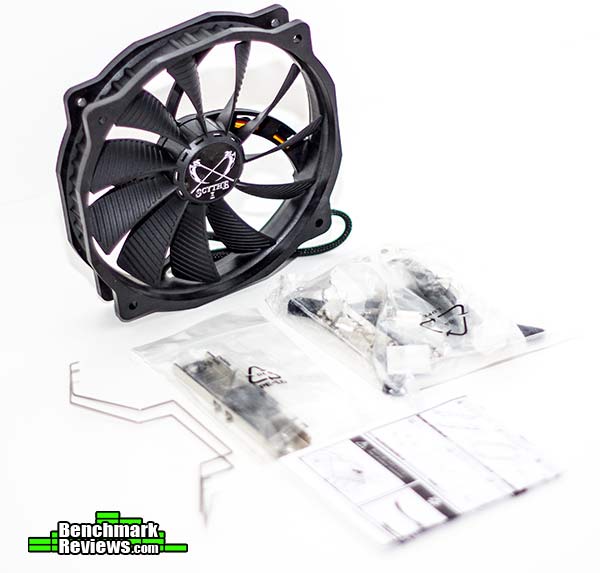
Included with the Scythe Mugen Max is a multi-lingual installation guide with very detailed instructions that will come readily handy when installing the cooler. There is also one back plate for Intel systems, as well as all the necessary hardware to mount the heatsink into any modern AMD or Intel motherboard. Scythe has also included a small plastic bag filled with thermal interface material and two fan brackets to install two 120 mm fans on the heatsink although only one is included. For easier installation of the heatsink, Scythe has also included a small wrench to get to the hard to reach screws that sustain the Scythe Mugen Max in place.
Unlike most heatsinks, the Scythe Mugen Max does not have a very dense fin array. This was probably done by Scythe to keep costs down, and it was compensated by making each fin have a larger surface area.. Yes, the Mugen Max is a complete behemoth measuring 145(W) x 86(D) x 161(H) mm without any fan installed, but like we saw with the Scythe Ashura, a dense fin array can make temperatures drop quickly with the appropriate fan. Let’s hope that the Mugen Max lives up it’s name by showing the performance we expect from such a large heatsink.

I usually rant a lot about not perfectly machined base plates on high-end CPU coolers, after all this is not a cheap product. Our sample of the Scythe Mugen Max has no notorious mistakes on it’s overall finish of the base plate and was absolutely flawless as we expect from any Scythe cooler. Having a perfectly machined base plate with no errors should yield better performance as there will be no place for air pockets to form between the TIM and the base of the cooler.

Compatibility has been a major issue ever since big heatsinks appeared, but manufacturers keep trying to fight their way around it. Like other heavyweight heatsinks, the Scythe Mugen Max is shifted slightly backwards in order for the fan to not even come close to the ram. This can cause issues with things like really large heat-spreaders for the power delivery system located to the left of most motherboards specially when using a second fan such as with our Asus Gryphon Z87 with the thermal armor installed.
Before we inspect each member of our new CPU cooler collection, let’s establish that our tests consist of methods we have determined to be the best for our one singular purpose. Our methodology isn’t written in stone, and could very likely be changed or modified as we receive justification (and feedback from the community). Our scope is limited to stand-alone products only, meaning those products which can be installed and operated without additional critical components needed or kit construction. This is the reason for this first test, in which the mounting system for each cooler is tested. Since this is not an apple to apples comparison, but rather a subjective description of each of the kits available without any form of quantitative data, it does not affect the numerical scores we give for each product. The purpose of this test is to inform our readers on how the mounting system of each processor cooler can affect the buying experience.
As usual, we will mount the cooler in one of our Intel test platforms. This time, we will be using an XFX MB-N780-ISH9 LGA 775 motherboard to test the mounting system included with the Scythe Mugen Max, which Scythe lists as one of the supported sockets.

Installing the Scythe Mugen Max starts with locating the four silver nuts, the back-plate, and the LGA 775 spacer to prevent the back-plate to make contact with the contacts located behind the motherboard’s socket. Scythe does not clearly package each component in an individual bag which can confusion. For AMD sockets you will have to remove the top fan bracket, however you will still need the back-plate included with all AMD motherboards.

With the back-plate and thumb nuts in place it is just a matter of seconds to get the two mounting brackets installed. Once the back-plate is held snug it is time to decide which way to install the Scythe Mugen Max in order to install the two brackets. The scythe manual instructs users to install it vertically, which is a smart choice as you will have less compatibility issues this way due to the heatsinks shape.

So far the Scythe Mugen Max has been an easy installation, but it is still a bulky heatsink. Unlike the Scythe Ashura, the Mugen Max is a lot thicker, meaning that reaching those two bottom screws will require some skill with the screwdriver, specially since they are not permanently attached to the metal bracket that holds the Mugen Max in place. The small wrench that Scythe includes might be useful in some cases, however the tall heatsinks in our test motherboard did not allow us to use the tool to reach the screws, instead we used a long screw driver through the canals that can be seen through the top of the heatsink to tighten down the screws. This does mean that you will probably need to remove the motherboard from the case in order to install the Mugen Max in place.
Benchmark Reviews is always looking to improve our testing methodology over the past few years. We have always solicited suggestions from the enthusiast community, and received guidance from the experts in this field. This particular time we will be using a fresh testing methodology. Benchmark Reviews continues to test CPU coolers using the stock included fan and thermal interface material (whenever applicable), and then replace it with a high-output fan and aftermarket TIM.
Manufacturers are not expected to enjoy this sort of comparison, since we level the playing field for all coolers by replacing their included fan and TIM with common units which are then used for every CPU cooler tested. Many manufacturers include fans with their heatsink products, but most ‘stock’ fans are high-RPM units that offer great airflow at the expense of obnoxiously loud noise levels. By using the same model of cooling fan and TIM throughout our second test, we can assure our results are comparable across the board. This is one of the more significant changes we have made to our test methodology, since many of the benchmark tests we have conducted in the past have compared the total package. Ultimately we’re more interested in the discovering the best possible cooler, and we believe that you’ll feel the same way.
-
Motherboard: Asus Gryphon Z87 Motherboard
-
Processor: Intel Core I5 4670k
-
Enclosure: Phanteks Enthoo Mini XL
-
Operating System: Windows 7 Professional.
Testing was conducted in a loosely scientific manner. Ambient room temperature levels were maintained within one degree of fluctuation, and measured at all times throughout testing. The processor received the same amount of thermal paste in every test, which covered the ICH with a thin nearly-transparent layer. The cooler being tested was then laid down flat onto the CPU, and compressed to the motherboard using the supplied retaining mechanism. If the mounting mechanism used only two point of force, they were tightened in alternation; standard clip-style mounting with four securing points were compressed using the cross-over method. Once installed, the system was tested for a baseline reading prior to testing.
At the start of each test, the ambient room temperature was measured to track any fluctuation throughout the testing period using Asus AI Suite and two of the included temperature sensors located at the front intake of our test system. Aida 64 Engineer was utilized to create 100% CPU-core loads and measure each individual processor core temperatures. It’s important to note that software-based temperature reading reflects the thermal output as reported from the CPU to the BIOS. For this reason, it is critically important (for us) to use the exact same software and BIOS versions throughout the entire test cycle, or the results will be incomparable. All of the units compared in our results were tested on the same motherboard using the same BIOS and software, with only the CPU-cooler product changing in each test. These readings are neither absolute nor calibrated, since every BIOS is programmed differently. Nevertheless, all results are still comparable and relative to each products in our test bed (see The Accuracy Myth section below).
All test results utilize Aida 64 Engineer to report core temperature averages (within the statistics panel), which gives us more precise readings. To further compensate for this, our tests were conducted several times after complete power down thermal cycles. Conversely, the ambient room temperature levels were all recorded and accurate to one-tenth of a degree Celsius at the time of data collection.
All modern processors incorporate an internal thermal diode that can be read by the motherboards’ BIOS. While this diode and the motherboard are not calibrated and therefore may not display the actual true temperature, the degree of accuracy is constant. This means that if the diode reports 40°C when it’s actually 43°C, then it will also report 60°C when it’s truly 63°C. Since the design goal of any thermal solution is to keep the CPU core within allowable temperatures, a processor’s internal diode is the most valid means of comparison between different heatsinks, or thermal compounds. The diode and motherboard may be incorrect by a small margin in relation to an actual calibrated temperature sensor, but they will be consistent in their margin of error every time.
Our first CPU Cooler Performance Test takes use of the included TIM and fans included with each CPU cooler. The Scythe Mugen Max includes only one fan for a push setup and a small bag of Scythe branded TIM which can be reused for one installation. The purpose of this test is NOT to prove which cooler is better, but rather to give our readers an expectation of what to expect from each cooler using the stock fans and TIM.

Courtesy of ScytheUs.com
| Scythe GlideStream 140 PWM Fan Specifications | |
|---|---|
| Dimension | 140 x 140 x 25 mm / 5.51 x 5.51 x 0.98 inch |
| Rated Speed | 500 ± 300 rpm to 1300 rpm ± 10% |
| Noise Level | 13 – 30.7 dBA |
| Air Flow | 63 – 165 m³/h or 37.37 – 97.18 CFM |
| Static Pressure | 1.47 – 10.0 Pa / 0.15 – 1.02 mmH²O |
The Scythe Glidestream fans have a measured RPM rating from 500 to 1300 making them reasonably quiet when compared to the high RPM fans that companies such as Raijintek and Silverstone include with their CPU coolers. Although the Scythe Mugen Max tralls behind other coolers in this section, it is still one of the quietest ones. Both the Scythe Mugen Max and the Cryorig R1 Ultimate are the obvious winners here, as they manage to be at the bottom left of the table.

Heating things up always turns to run in favor of air coolers as they are more resilient when exposed to higher temperatures. Take a look at the Raijintek Triton, which managed to beat the Scythe Mugen Max in part 1 of this test. On part 2, the Scythe Mugen Max manages to close the gap between it and the bottom of the table which holds the likes of the Silverstone TD02-E, a dual 120 mm AIO water cooler which features high RPM fans.
It’s time for our second and most important test. In this test we look to compare each cooler side by side by eliminating all the variables that may hamper our results. This means using our choice of fans and TIM throughout the entirety of this test. Buyers may benefit from buying custom fans and TIM by gaining performance, as well as by reducing the noise coming from the high RPM fans included with most cooling units. Our choice of TIM is Prolimatech PRO-PK3-5G which is an aluminum based solution that does not require any burn in time to reach peak performance.
Our choice of fans include the Yate-Loon D12SM-12 120 mm and D14SM-12 140 mm fans. Yate-Loons are mostly known for their quiet operation, and very low price. They are also very common among power supply fans, and are frequently found in the market as there are many re branded versions available from different companies.
| Model #: | D12SM-12 | D14SM-12 |
|---|---|---|
| Dimensions: | 120 x 120 x 20 mm | 140 x 140 x 20 mm |
| Air Flow Max.: | 70.5 CFM | 62.0 CFM |
| Noise Level Max.: | 33 dBA | 29 dBA |
| Fan Speed: | 1650 RPM ± 10% | 1400 RPM ± 10% |
| Rated Voltage: | 12 V DC | 12 V DC |
| Input current Max.: | 0.30 Amps | 0.70 Amps |

In part 1 of this test, the output heat generated by our Intel Core I5 4670k at stock settings gives the Scythe Mugen Max no struggles in terms of cooling capabilities. It manages to beat a vast majority of the other coolers, but surprisingly not it’s smaller brother the Scythe Ashura. Only the Raijintek Triton manages to beat both of them, making the Scythe Mugen Max the runner up for the best heatsink in part 1 of our test 2.

Our overclocked temperature measurements close the gap between the Scythe Mugen Max and other coolers in this section. It is almost quite surprising that both the Mugen Max and the Ashura follow the same path throughout our most important test. It is clear that they are both the winners of our test 2. beating even the best water coolers in our tests, as well as maintaining the most stable temperatures even at lower RPMs.
As per request from many members of the enthusiast community, Benchmark Reviews has added noise measurements to our CPU cooler testing methodology. Each test is conducted in a noise isolated room, during the night time to avoid any minor disturbances caused by normal daytime activities near our location. Our base ambient temperature was measured at 15 dB for each of our tests. Noise was measured using a Brüel & Kjær type 2225 sound level meter located at 1 meter from the fan/fans. Fans were placed so that the axis of rotation of the fan is perpendicular to our line of measurement. For our dual fan noise measurements, fans were placed in series (facing each other) with a 10 cm gap between them. All fans were tested at 12 Volts.
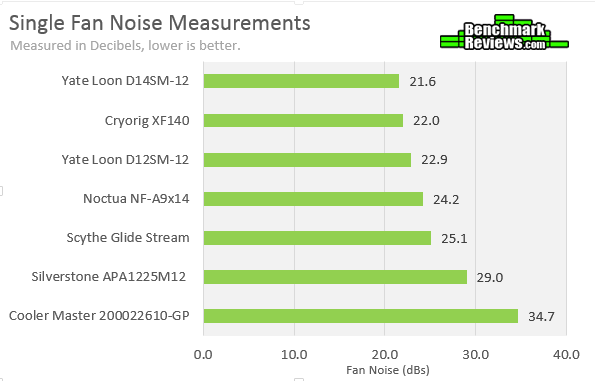
The fan included with the Scythe Mugen Max has the model name Scythe Glide Stream 140. Having 140 mm fans allows the Scythe Mugen Max to gain the lead in terms of noise, however it is still beaten by even the 120 mm Yate Loon which is surprising. Unfortunately, the included fan has the same hole spacing as a 120 mm fan, meaning that the only 140 mm fan you will be able to install on the Mugen Max is the included fans, or any 120 mm fan.
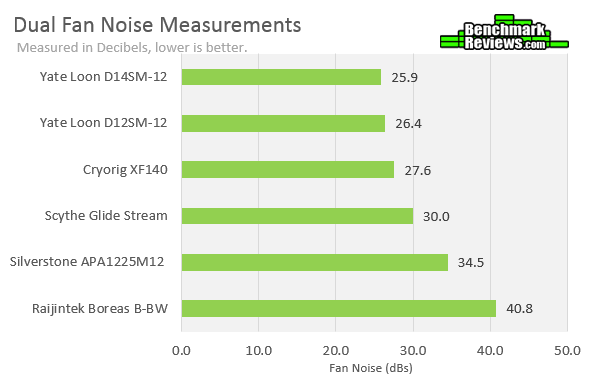
Introducing a second fan causes Scythe Glide Stream fans to stay in place place behind both the Yate Loon and Cryorig contenders in this test. Although only fan is included, we had another Scythe Glide Stream 140 in the office from one of our other reviews, but we could not find any information on were these fans are available online from a trusted retailer so that makes our second test not that important as to obtain a second Scythe Glide Stream fan you will probably have to buy two coolers.
By now it should be clear that Scythe’s claims were more than correct. The Scythe Mugen Max passed all of our tests with flying colors. It is stylish, simple to install, and it out-performs any other cooler in part 2 of our second test. If there is something bad that could be said about this cooler is the lack of a second fan for the price, after all this is not a cheap product, otherwise Scythe’s long experience in the heatsink market is clearly shown in every detail from the Scythe Ashura and the Mugen Max, both gaining the lead over any other heatsink in our 2015 heatsink performance numbers.

The performance of the Scythe Mugen Max is only disappointing when compared to it’s smaller brother the Ashura. Otherwise it gains the lead over most coolers in all of our tests. Using the included fans and TIM it managed to stay in the bottom left of the table with the most quiet and best performing coolers of test 1. In test 2 the Scythe Mugen Max was tied along it’s smaller brother the Scythe Ashura as the coolers to beat. Overall the Scythe Mugen Max manages to keep our overclocked core i5-4670k under control.
Beauty is subjective, but making a bold design that gets your point across is not. Scythe is not aiming for one or the other but they do try to make all of their products elegant. The Mugen Max does not look fancy, but rather practical. The only detail shown to it’s overall design is the Scythe logo at the top, otherwise it is just a shiny, bright piece of machinery ready to cool any modern processor.
Unfortunately, it is impossible for us to test the reliability of most of the products we review. However, the Scythe Ashura shows some very positive signs when it comes to it’s overall construction. The mounting mechanism is sturdy and showed no signs of flex. The fins on the heatsink were not easily bent, and are protected by an aluminum shroud at the top. There were also no flaws on the base plate of our sample, which should result in better performance. .
Scythe was clever enough to give the Mugen Max a very thoughtful layout. There are no ram clearance issues, which can be attributed to the cooler being offset backwards, although if your motherboard has very tall heat spreaders you might want to consider choosing a water cooler. Installation is not as hard as with some of the coolers we have seen this year. Considering how big the Mugen Max is, it is quite easy to install compared to other behemoths like Cryorig R1.
Our last score pertains to the value of the product at hand. The Scythe Mugen Max is priced online for $69.99 (Amazon) at the time of this review which is above average for a performance air cooler. This is a premium over the already cheaper Scythe Ashura, but it is still a great cooler which beats most of the competition on a performance per price ratio. If Scythe would have included a second fan, the price would definitely be justifiable.
+ Extreme performance for the money.
+ Simple design.
+ 2-Year warranty.
+ Smart design with no ram clearance issues.
– Only one fan is included.
-
Performance: 9.75
-
Appearance: 8.75
-
Construction: 9.50
-
Functionality: 9.00
-
Value: 8.0