By Bruce Normann
Manufacturer: QNAP Systems, Inc.
Product Name: QNAP TVS-863+ Turbo vNAS Server
Model Number: TVS-863+-16G-US
UPC: 885022008254
Price As Tested: $1499 (Newegg | B&H | Amazon)
Full Disclosure: The product sample used in this article has been provided by QNAP Systems, Inc.
The QNAP TVS-863+ Turbo vNAS is part of a new hardware platform for QNAP that brings a high level of performance to the small tower-based format, at a lower cost than was possible before. That’s not an uncommon theme for NAS product announcements, but this is. The TVS-x63 series is based on a System-On-Chip (SOC) offering from AMD. Stunned…? I know I was when I first heard it. After years of suffering with multiple generations of Intel Atom-based NAS devices with lackluster performance, from every NAS manufacturer in the market, finally we have a low power replacement that rocks the world. The Intel Bay Trail-D CPU is a great little replacement for the Atom, but the new AMD GX-424CC is in another league altogether. The Radeon graphics section inside, plus four CPU cores running at 2.4 GHz, and a well-developed APU architecture that marries the two together for challenging loads, provides a sea change in computing performance for the low-power, low-cost NAS segment.
The four new TVS-x63 towers (4,5,6, or 8 bays) are being promoted as small-medium business NAS servers, based on their high performance, low cost, and a bunch of software functionality that is ideal for the modern business. Recent QNAP launches have leveraged the tremendous potential of 10GbE networking for the business user, and the TVS-863+ comes standard with a 10GbE network card in a PCI Express expansion slot. The home and the SOHO market aren’t quite there yet, in terms of 10GbE adoption, so all four form factors in the TVS-x63 family are available with just a pair of integrated GbE network interfaces if that’s all you need. The home market is very sensitive to pricing, and QNAP has leveraged the work they did last year to re-engineer the daylights out of the surrounding infrastructure, and pumped even more juice into the system controller, courtesy of AMD. More power, new features – lower price? Another winner, possibly….?
With eight 3.5″ drive bays available, there is a potential for 48TB of storage, using readily available NAS-specific drives, plus the ability to link up an expansion chassis through the USB 3.0 ports. If both capacity and redundancy are needed, RAID 5 is usually the minimum configuration. If you want to go to RAID 6 or RAID 10, you need a minimum of four disks, with two spindles completely occupied by providing multiple levels of redundancy for your data. A four-bay device is really the bare minimum for a high availability NAS appliance, and that’s why I think the 8-bay unit in this series makes a lot of sense for a most SMB users. Plus, you might want to dedicate one of those bays to the new SSD cache option. More about that later.

Benchmark Reviews has tested a wide array of QNAP NAS products, ranging from the QNAP TS-119 NAS single-disk unit made for home users, to the Goliath QNAP TS-870U-RP 8-Bay NAS for the storage needs of large businesses. Most recently we tested the 4-bay TS-470 powerhouse. Let’s see how this latest Turbo vNAS compares to those corporate animals, and to a variety of other siblings and competitors.

Virtualization has taken the IT universe by storm in the last 5-7 years. I can vouch for the fact that there are even large deployments of virtual servers in Antarctica. While the concept has spread somewhat to other devices, it’s primary application is in large, multi CPU, multi-core servers. When you look below the surface of a NAS, you might be tempted to think that the natural evolution of the device is to become a Storage Area Network (SAN). That’s certainly a valid growth pattern, but QNAP also recognized that the basic architecture of a NAS is not that far off from a typical server. With that info in mind, they made the leap to bring the same virtualization concepts and techniques that are in wide spread use on enterprise servers to a NAS platform. Ultimately, it’s largely a function of software, more than anything else. Let’s take a closer look at what virtualization brings to the NAS ecosystem.
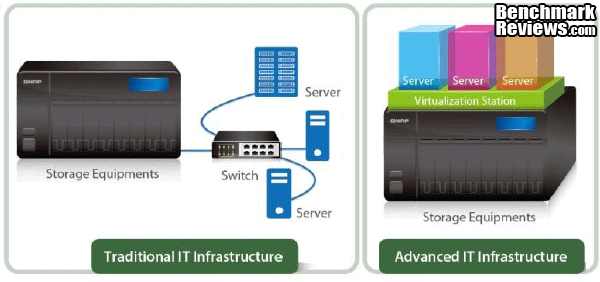
The old IT infrastructure used the NAS strictly as a storage device, connected to the rest of the network devices through a switch. Just as virtualization was driven by Moore’s law and the fact that 16 CPU cores now fit easily into a 2U rack slot, the use of multi-core CPUs in a NAS server opens up brand new opportunities for expanding the functional footprint of the device. I’m a whole lot more excited about deploying virtualization on this new QNAP TVS-x63 series, with a quad core AMD CPU inside, than I was for the TS-x51 series that I tested last time. The home user may be able to get by with only one VM running the operating system of their choice, but a small business probably has a wider variety of needs. They may also have most of them covered by garden-variety servers. Just like VMware in the data center eight years ago, you have to start somewhere. Let’s take a look at where that might be.
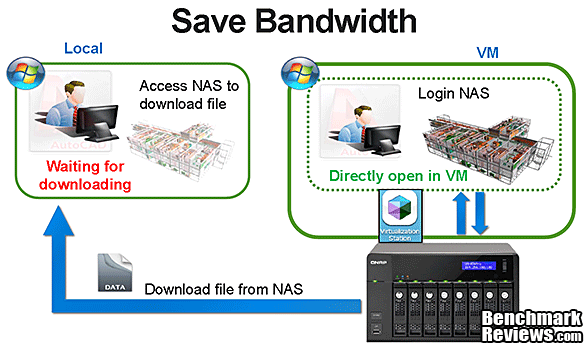
The illustration above uses CADD data as an example, but it could easily be any kind of data. Let’s say you are a professional photographer or a graphics designer, and you are working out in the field or interfacing with a client. Instead of downloading a 24 Megapixel image to your 10” tablet, and using the local application to open it and display it, why not let the NAS server do all the hard work, and just download the 1080p image to your HD screen. It will happen a whole lot faster, especially if you are relying on a 4G network for access. The same will be true if you’re sitting at home browsing any kind of hi-res media – music, video, photos over 802.11n Wi-Fi.

One other advantage in the scenario we just discussed is that the source data for the file you are accessing never gets transmitted to your mobile device or remote PC. Data tapping is becoming more prevalent, especially outside the US, and it’s not unrealistic to be worried that your proprietary or secret information might be intercepted by the person with the notebook computer sitting in the corner of the café. Maybe there’s a permanently installed antenna in the coffee shop that just sucks everything into a big storage array in the apartment two floors up. The fact is, data protection has evolved since the early days of BYOD and keeping the ‘real’ data behind the firewall instead of sending byte-perfect copies of it all over the world is a strategy you need to embrace. Once again, you might ask why the average home user should care about this, and I can only say that more and more people are carrying around and accessing more of their personal, legal, and financial data than we could have imagined ten years ago. Why would I carry around a copy of my tax returns on a notebook HDD or flash drive that is easily lost or stolen, when I can simply display it in a browser window, without leaving a trace of the original data on a network that I don’t really trust?

Building on the idea that your NAS is really a server in disguise, and it can and should be, processing data instead of just serving it up to the user base; video transcoding shoots to the top of the list of things I think it should be capable of. Unfortunately, the CPU component of almost all the consumer-focused NAS units sold in the last few years has been completely incapable of performing this task in any meaningful way. This is not so much a question of software availability, but an issue with the hardware. Part of the blame has to be assigned to the NAS manufacturers, who all said to themselves, “Hey, our NAS runs perfectly well with this new Intel Atom CPU.” That was a good line, back in the days of wired networks, and low-res media. Throw a few tablets and notebooks onto a crowded Wi-Fi network, and watch the lag times pile up as everyone is streaming 1080p video in real-time access mode. That’s still based on the assumption that all the NAS users are located in the house, and not surfing their multimedia files from a remote location. At least the typical gaming PC is still sitting on a GbE connection, over Cat5. Everybody else is lucky if they’re on a multi-stream 802.11n connection.

The QNAP TVS-863+, combined with the QTS v4.1 and higher operating system, allows on-the-fly video transcoding and background transcoding as another option. This lets you convert video that’s stored on the NAS and content that’s streaming from the net into any of the myriad of screen resolutions that your portable devices support natively. It will be a long time before every screen gets upgrades to 1080p, and by then 4k video will be more common. That’s something you don’t want to try and send over the typical 802.11n channel of your two year old Wi-Fi router. While Intel’s Celeron is hardly the ne plus ultra of CPUs, at least if you look at desktops, the simple comparison in the image above should be enough to convince you that the Intel Atom was a major stumbling block to implementing this technology on earlier platforms. Now substitute an AMD APU with Radeon R5e graphics cores for the Celeron and you have even more graphics processing power at your fingertips. When we get to the Video benchmarks in the NASPT test suite, you will see the difference for yourself.

QvPC is an offshoot from the introduction of virtualization to the NAS platform. Bringing together several recently implemented technologies, such as virtualization, hardware-accelerated transcoding, cloud integration, unified & tiered storage, RAID protection, SSD cache acceleration, video output, and peripheral integration provides synergies that go beyond the basic functions that each of these technologies deliver on their own. Let’s walk through a couple capabilities that are part of QvPC.
- QVM Desk directly accesses multiple virtual machines, along with data storage on the NAS. You switch VMs as if using multiple PCs connected to the same keyboard, mouse, and monitor. Compared with remote desktop access through a web browser, QVM improves efficiency and minimizes network issues.
- QvPC Technology makes it possible to run an Android-based VM, play Android games on a big screen, and if you have a touchscreen, use them like an Android-based PC. In a mixed mode world, you can use Google Chrome to access the Internet, plus download and directly save online content.
- QvPC Technology also allows you to create virtual household PC for each member of the family. With independent VMs, you have complete control over file access and user permissions. Functions like Snapshot can restore files and data if any of the VMs crash. Screen sharing allows parents to seamlessly monitor their children’s Internet usage.
That’s the newest set of features available in QTS 4.1. Now, let’s look at the Turbo NAS Server that hosts all those new capabilities.
Before we dig into the real innards of the QNAP TVS-863+, here’s the “drive’s eye” view of the NAS. Twenty pins worth of DC power enter from the upper left, because eight NAS HDDs can demand a lot of power. Higher capacity drives tend to have more platters, and take more current to get them spun up to operating speed. The eight power and signal connectors for the SATA interfaces are located towards the bottom of the board, and although the backplane looks like it’s just a passive connector board, there are three Marvell SATA controller chips located just to the left of drive slots 3-4, 5-6, and 7-8. One of the main cooling fans is partially visible from here, and the fins from the CPU cooler are too, although they’re tougher to see when viewed on edge. The CPU cooler fins are partially blocked by the power connector, which should probably be located in the center anyways.

The top cover is easily removed once a number of small screws on the back panel are removed. Disassembly of the unit to this level does not void the warranty. Going further, as I did for this review will eventually disturb a number of screws that are marked to indicate tampering. I do have to thank our friends at TechPowerUp for the clue on how to fully disassemble the device. The front cover has to be removed in order to access the final screw that holds the main system board in place. The modular layout is quite evident; the main board takes up the whole left side of the unit, and the integral PSU is sitting right on top of the drive bays. The two 120mm cooling fans are mounted on the rear panel, right in line with the drive bay. The two SO-DIMM memory modules dominate the back surface of the controller board, evidence that this device has more power on tap than usual. It’s very easy to upgrade the DRAM once the top cover is removed, and QNAP supports a number of memory upgrade options for all the various models in the TVS-x63 series. This particular unit came fully populated with the maximum supported configuration, 16GB of DDR3L-1600.

Looking straight down from the top, you can see the installed expansion card better, as well as the power supply wiring to the main board and the backplane. The wiring from the PSU to these two PCBs is very straightforward and short. The backplane PCB gets its own dedicated power connector direct from the PSU, for all those power-hungry HDDs. If you think about how much current it takes to spin up large capacity drives, with three or four heavy platters inside each one of them, it’s clearly a good idea to have substantial power cables feeding the backplane PCB directly. The blue expansion card in the upper left-hand corner with the big silver heat spreader, is a QNAP single-port 10 Gigabit 10GBASE-T network expansion card for tower models; model LAN-10G1T-D, with an x4 PCIe 2.0 interface. The PCIe interface is standard, but the physical format of the cards is unique to NAS applications. The vNAS server firmware instantly recognizes the 10GbE NIC and there is never any manual configuration required to get any of the NICs up and running. Several models from Intel and Emulex are also supported, with options for fiber optic cabling and SFP+ ports, too. I’ve personally tested the Intel X520-T2 (E10G42BT) adapter on an enterprise-class QNAP Turbo NAS and also had a solid, carefree experience with that combo. Similar to the memory upgrade process, all that is required to access the expansion slot, where the optional network cards plug in, is to remove the top cover.

It’s plain to see that this main controller board is pretty much a one-chip show. The GX-424CC AMD Embedded G-Series System-on-Chip (SOC) sitting under the aluminum block has almost all of the necessary functions built in already. It’s built with four very efficient and low-power 28nm Jaguar+ CPU cores, and its architecture is aimed directly at systems just like this. There are two SODIMM slots located on the back side of the board, and we’ll look at those later. Low power systems that feature a SOC solution typically feature a CPU cooler that’s an insignificant part of the overall landscape. When that SOC is a quad-core running all four CPU cores at 2.4GHz, that changes everything. The CPU is the only thing that really needs any cooling on this board, as even the power supply circuits are optimized for low power dissipation. All the switches, rear panel connectors and the front panel SuperSpeed USB 3.0 port are contained on this board, reducing cost and increasing reliability. Because it has to accommodate all those rear panel connectors, and span the distance from the front of the NAS all the way to the back, the board is bigger than it really needs to be and it’s not that densely populated. The two black edge connectors mounted at right angles to one another are both PCI Express x4 sockets. One is used for the SATA backplane and the other is for the expansion slot that holds the network interface card. The two 4-pin PWM fan controllers are also integrated on this board, as is the Disk-On-Module (DOM) that holds the operating system for the NAS.

Speaking of the SATA backplane, here it is, in its entirety. The edge connector on the far right transfers the PCIe signals to this board that serves as the backplane for all the SATA HDD connectors. It’s not just a passive board, as there are three drive controller ICs located on the backplane. This is consistent with how QNAP builds most of their larger tower models, putting the controllers closer to the drives they are responsible for. Each Marvell 88SE9215 controller chip handles two drives, so the board isn’t littered with active ICs, but they are easy enough to spot. All the other larger components mounted on the board are power supply and monitoring chips. The steel mounting plate that it is bolted to is very rigid, and offers a very stable and rugged support foundation for the board itself and the eight SATA connectors that it contains. A soggy SATA connection makes me cringe and the TVS-863+ was having none of that!

The SO-DIMM memory slots are located on the back side of the main system board, for easy access once the outer sheet metal cover is removed. This is one of many NAS servers in the QNAP line that provide an easy upgrade path for the system memory. In the early days of the NAS industry, memory was not a significant factor in system performance. With the increased sophistication of the operating systems, the hundreds of apps that can be loaded on a modern NAS to provide a broad array of services, and the introduction of virtualization capabilities to large portions of the product line, memory capacity is now a big deal. The memory controller is integrated on the AMD GX-424CC SOC, and it’s designed to handle up to 16GB of DDR3-1866 memory modules in single-channel mode. The specs for the TVS-863+ call out two retail versions; one with a memory capacity of 8GB installed, and another with 16GB. In the first case, only one of the SO-DIMM slots is loaded, with an 8GB memory module. Based on my testing, straight data transfers use very little of the NAS memory capacity. There are dozens of more challenging apps that you can run on a QNAP NAS though, and the extra memory will have a bigger impact on some of those. Certainly, the new virtualization option that is available with the latest operating system will also benefit from the extra memory.

So far we’ve had a good look at what there is to observe as far as hardware goes, but let’s dig down one more layer, down to the chip level where the technology really starts to get interesting. I love my hardware just as much as the next person, but it’s only half the story…..
The biggest chip on the board is the AMD GX-424CC CPU, a quad-core member of the 28nm Jaguar family. It’s architected as a System-On-Chip (SOC) in this iteration, so most of the peripheral interfaces like USB, SATA, Video, Audio, etc. are built right into the die from the start. NAS devices are a perfect application for this sort of chip, as smaller, lighter, cheaper, easy to integrate are what every NAS designer wants. It consumes a little more power than some of the smallest SOC chips on the market, with a max TDP of 25W. Part of the reason for that is the high clock frequency of 2.4GHZ, for this particular version. Critical to this marketplace is the presence of a 497MHz Radeon R5E GPU, integrated on the SOC. That’s the other reason the TDP of the chip is slightly higher than some. If you don’t think graphics processing power is important in the NAS market, you haven’t been paying attention to the consistent move towards putting NAS servers at the center of the multimedia experience. There’s lots of work to do, transcoding video streams to fit on the myriad screen resolutions that are connected to a typical network, usually on portable devices. The AMD GX-424CC is the only chip on the main board that needs a heatsink, and the modern heatpipe and fin construction is used to good effect here, pulling the heat out of the main system board and into the airstream that flows through the TVS-863+ from front to back.

As much work as the CPU does in its usual role of counting digits, it also has to communicate and control most of the subsystems that would normally be handled by an Intel Platform Controller Hub (PCH) in a normal PC, notebook, or NAS. The PCH is usually the second hardest working chip on the main board, and integrating all those interfaces into the AMD SOC also increases the TDP of the overall package somewhat. The GPU section of the AMD GX-424CC is based on a Radeon R5E Graphics engine, and it supports DirectX 11.1, OpenGL 4.2 and OpenCL1.23 (on Windows). This isn’t exactly a gaming-ready GPU, but it’s perfectly suitable for handling hi-res streaming video for multiple clients. The quantity and arrangement of PCI Express connections is well suited for this application, although a packet switching chip is needed to combine four of the single x1 PCIe lanes into an x4 signal that gets routed to one of the x4 PCIe connectors on the system board. The integral SATA connections from the SOC are used for drive bays #1 and #2, where QNAP suggests you place any SSDs you want to use as cache devices.

Asmedia supplies two key ICs that complement the integrated interfaces available on the AMD G-Series SOC. The ASM1182 packet switching chip takes four of the PCIe x1 lanes and turns them into one of two PCIe x4 interfaces that are present on the main board. One of them is used for communicating with the SATA chips on the backplane where the drives plug in. The other is used for the expansion port that typically houses the network interface card. With the option of supporting dual 10GbE interfaces from this port, bandwidth is important, and the full PCIe x4 throughput is needed to keep up with requirements. The second Asmedia chip is the ASM1074, which provides additional SuperSpeed USB (AKA USB 3.0) connections for the TVS-863+, which has a total of five available USB 3.0 ports spread between the front and back panels. The AMD SOC handles all the display requirements with a Radeon R5E GPU running at 497MHz, feeding dual HDMI output connections.

Marvell supplies the three SATA interface chips, which are used for drive bays 3-8. The 88SE9215 chip is actually capable of handling four SATA drives on its own, but for maximum throughput QNAP uses just one of the ICs to supports the three pairs of drives. There is a potential for a bottleneck on the PCIe side of the chip, and the TVS-x63 architecture ensures that the bandwidth of a single x1 PCIe lane is only split across two drives, not four. Bays #1 and #2 are directly supported by the SATA interface on the GX-424CC SOC. For that reason, QNAP suggests that users who want to take advantage of the SSD cache feature put their SSD devices in drive bays 1 and 2. Intel provides two identical ICs for driving the dual GbE ports that are integrated onto the main system board, which are standard for every model in the TVS-x63 product line. With a launch date of 4Q12, this is a full-featured NIC, with all the latest technologies for increasing application-specific throughput and reducing overall power requirements. For obvious reasons, almost all of my review is focused on the capabilities that are unleashed with the 10GbE NIC that comes standard on the TVS-863+ model, but it’s always useful to have high quality network interfaces. There are subtle compatibility and performance advantages that come with the better chips, and QNAP knows that better than most.

Let’s take a deeper look at the 10GbE Network Interface Card that is included as a standard feature with the TVS-863+ Turbo vNAS server. The biggest chip on the NIC is the Marvell Alaska X 88X3110 – a fourth generation PHY transceiver that performs physical layer functions for 10Gbps signals over 10GBASE-T copper wiring. That’s a key capability, because it means you can run 10GbE connections over CAT5e wiring, for reasonably short runs. Full 100 meter capability needs CAT 6 cabling, but that’s also a garden variety component these days. The 88X3110 features a small footprint and low power consumption – only 2.5W per port for full 100m drive capability.

The smaller chip on the NIC is Tehuti’s new 3rd generation TN4010 controller, an optimized 10 Gigabit Ethernet MAC designed for low-power, low-cost, single-port connectivity. I believe the entire board is produced by Tehuti, as a private label model for multiple manufacturers. I’ve seen similar boards, supplied for Thecus for example. The TN4010 MAC, paired with the Marvell Alaska 88×3110 transceiver, provides 10GBase-T, 1000Base-T, and 100Base-TX compatibility over low-cost standard CAT-6a Ethernet cabling, up to 100m. This combination creates a new choice for cost-conscious consumer applications, as well as to embedded applications like this. 10GbE hardware has been a challenge, in terms of cost, for a while now, and it’s good to see some new players in the game that are offering lower cost options.

As a wrap up to this technology section, Benchmark Reviews looks at the total NAS package and measures the overall power consumption that is needed to operate all these components. Benchmark Reviews uses the Kill-A-Watt EZ (model P4460) power meter made by P3 International for testing purposes, and we are able to measure not just power, but voltage, frequency, power factor, and the raw VA product. Obviously, power consumption is going to depend heavily on the number and type of drives that are installed. The power draw also depends on the fan speed that’s required to keep the unit, and the drives, cool. When the device first started up it briefly pulled a max of 80W when all four HDDs were spinning up, the SSDs were initializing, and the system fans were running open loop, before the temperature sensors were able to let the fan controllers know that everything was cool. Once the system completed its boot process, it then went into normal operating mode, where it consumed between 55-60W. During heavy file transfer operations, it drew a maximum of 75W during some of our more challenging benchmarking tests. After a period of time, which is configurable in the system software, the Turbo vNAS server goes into an idle mode that consumed just 35W. Further cuts in power consumption are possible, down to the single digits, via special sleep settings. I didn’t test those, because I don’t believe the test equipment is all that accurate once it gets down to the 1W level.
We’ve seen the ins and outs of the hardware, the new software, and the technology under the hood; now let’s take a detailed look through the extensive list of features that you get with most every QNAP Turbo NAS. I know the next couple of sections are overly long, but it’s critical to understand just how much these units can do. You don’t want to be fooled into thinking it’s just a big box full of drives. It’s capable of so much more than that.
As the volume of personal digital data continue to rise, individuals and families need higher-capacity storage solutions which are secure, reliable, and easy to manage. Most households have several different tiers of data that they need to manage. Financial records need the highest level of redundancy and security. Less critical personal data, like the family recipe archive, and the kid’s homework from last year, can get by with slightly lower redundancy and a whole lot less security controls. The combined family archive of multimedia files, videos and music for the most part probably warrants the lowest priority, as it is the easiest data to replace if it’s lost due to failure of a storage system. I’m not saying that you don’t want to back up your music library, but you may not want to pay a yearly or monthly fee to store it in the cloud.
NAS + iSCSI/IP-SAN Solution for Server Virtualization
The QNAP TVS-863+, which serves as both IP-SAN (iSCSI) and NAS, can also be easily utilized in different business and enterprise applications such as backup center, disaster recovery, file sharing, virtualization, and video editing storage. The TVS-863+ offers class-leading system architecture matched with a wide range of configuration options and native apps. There is precious little that the modern NAS box cannot do, in either the home or business environment. The ability to run an independent virtual machine on the second core of the CPU also brings new capability and performance options to the table.
The Feature-rich and Integrated Applications for Business
The NAS supports file sharing across Windows, Mac, Linux, and UNIX platforms. Versatile business applications such as file server, FTP server, printer server, web server, and Windows AD support are provided. The dominant features, such as WebDAV, Share Folder Aggregation (also known as DFS), IPv6 and IPv4 dual-stack, Wake on LAN, schedule power on/ off, HDD S.M.A.R.T, comprehensive log systems, and policy-based unauthorized IP blocking are all included features of a QNAP NAS server.
Secure – Data might seem insecure being open in a network, but the QNAP TVS-863+ offers a variety of security options such as encrypted access, IP filtering, policy-based automatic IP blocking, and more. In addition, full control of the NAS is offered down to the user and folder access rights to determine who can access the NAS and what can or cannot be accessed. The TVS-863+ is packed with security features to stop all unauthorized data access such as AES-256 volume-based encryption. The AES-256 volume-based encryption prevents sensitive data from unauthorized access and data-breach even if the hard drives or the device is stolen. This feature is finally a usable reality with the new AMD-based hardware platform that is being introduced with the TVS-x63 series.
Reliable – The TVS-863+ is reliable with built-in safety precautions to safeguard all data from any unforeseen problems. With multiple built-in features to guarantee no interruption to the work flow of a business, the TVS-863+ is an efficient asset. The advanced RAID configurations and hot-swap capabilities are included to give RAID performance, protection and reduced rebuilding time. Moreover, the dual OS embedded on the DOM architecture ensures the system will boot up. If one of the two operating systems fails, the healthy operating system will boot up and operate normally while repairing the failed operating system. The two Gigabit LAN ports can also be configured for failover which allows the NAS server to sustain the failure of one network ports and still provide continuous services.
Simple – Setting up local or remote access with the TVS-863+ is painless and does not require any IT skills in order to get the basics right. All setup processes have been simplified so that most of the process is either automatic or can be completed by an installation wizard. The user-friendly web GUI allows administrators to easily manage the NAS so there is no need for an extensive knowledge of complex commands. Simple management tools such as instant SMS/Email alert, the hard drive S.M.A.R.T. (Self-Monitoring, Analysis and Reporting Technology) feature, and system resource monitor are provided to keep administrators up-to-date on their NAS at all times.
High Network Bandwidth – The TVS-863+ comes with a 10GbE network expansion card already installed, and includes dual-port 1 GbE network ports, all of which can be aggregated to boost network performance.
Blazing Fast Data Backup via USB 3.0 – The TVS-863+ features USB 3.0 ports for high speed backup to external hard drives. EXT3, EXT4, NTFS, and HFS+ file systems are supported to ensure compatibility with Windows, Mac® OS X, and Linux operating systems.
Cross-platform Sharing with Antivirus – The TVS-863+ supports SMB/CIFS, NFS, and AFP protocols for file sharing across Windows, Mac, Linux/UNIX networks. User accounts and shared folders can be created via the user-friendly web-based interface without IT expertise. The integrated antivirus solution for the Turbo NAS ensures business continuity by offering detection against the latest viruses, malware, worms, and Trojan horses.
iSCSI for Virtualization Deployments The Turbo NAS provides flexible and secure storage server deployment with the following enhanced iSCSI features:
NAS + iSCSI storage solution The Turbo NAS can serve as a NAS for file sharing and iSCSI storage concurrently.
Flexible multiple LUNs management The NAS supports multiple LUNs (Logical Unit Numbers) and iSCSI targets. The LUNs can be flexibly mapped to, unmapped from, and switched among different iSCSI targets.
Secure IP SAN environment deployment Designed with CHAP authentication and LUN masking, the advanced ACL (Access Control List) offers you the capability to block unauthorized access from the initiators.
Advanced RAID Management with Hot-swap Design The TVS-863+ NAS offers advanced RAID 0, 1, 5, 6, 10, Single, and JBOD disk configurations. It also supports hot-swap design that a failed drive can be replaced by hot swapping without turning off the server.
Online RAID Capacity Expansion The storage capacity of a RAID configuration can be expanded by replacing the hard drives with larger ones. All the data will be kept and seamlessly moved to the newly installed hard drives. There is no need to turn off the server during the process.
Online RAID Level Migration You can upgrade the disk configuration to higher RAID level with the data retained. There is no need to turn off the server during the process.
Virtual Disk Drive (VDD) adds flexibility to storage expansion along with ease of management The unique “Virtual Disk Drive” adds flexibility to expand the capacity of NAS. By using the built-in iSCSI initiator, the NAS can connect to other iSCSI targets on the network and turn them into virtual disks, which become multiple single volumes on the NAS. The NAS serves as the storage stack chaining master. The user only needs to connect to this single entry (QNAP NAS) and is able to reach and use all the iSCSI target storages on the network.
S.M.A.R.T & Advanced HDD Health Scanning (HHS) The NAS supports Hard Disk Drive S.M.A.R.T (Self-Monitoring Analysis and Reporting Technology) for monitoring the hard drive status. Moreover, the NAS is embedded with HHS Technology which supports disk checking and bad blocks scanning.
UPS Support The NAS supports the majority of USB UPS devices which enables the users to store the data in time and avoid critical data loss when power outage occurs during data transfer.
QNAP Backup Software – NetBak Replicator The backup software, NetBak Replicator, is provided for the NAS users to perform real-time synchronization or schedule backup from multiple PCs to the NAS.
3rd Party Backup Software Ready The NAS works well with other backup software, e.g. Acronis True Image, CA BrightStor ARCserve Backup, EMC Retrospect, Symantec Backup Exec, and LaCie Silverkeeper.
Encrypted Remote Replication The data on the NAS can be backed up to or from another Turbo NAS over the network securely.
Sharing Files across Windows, Mac, Linux, and UNIX The NAS is designed for users to share the files across Windows, Mac, Linux, and UNIX environment.
Windows Active Directory (AD) and LDAP Directory Service The Windows AD and LDAP (Lightweight Directory Access Protocol) directory service features enable the system administrator to retrieve user accounts from Windows AD or Linux LDAP server to the TVS-863+ reducing time and effort in account setup. Users can use the same login name and password to access the TVS-863+.
Web File Manager The NAS provides Web File Manager for you to easily download, upload, and manage the files on the server by web browser.
Ease of User and Share Folder Management The NAS supports batch creation of users and share folders to save the time and effort of the server manager in account and folder creation. For the security of Windows network environment, server managers can hide or show network share folders.
Hard Disk Standby You can configure the hard disks to enter standby mode if there is no disk access within the specified period.
Schedule Power on/ off The flexible schedule power on/off feature is now provided on the NAS for IT administrators to manage the NAS server’s up time according to the working hours. You can set the time for automatic system power on, power off, or restart on any days of the week.
Secure data storage, access, and sharing
- Comprehensive event logs: Detailed logs of file-level data access to the NAS via samba, FTP, AFP, HTTP, HTTPS, Telnet, and SSH, and networking services accessed by online users are all recorded.
- SSL security (HTTPS): The NAS can be accessed and configured by web browser securely.
- Remote login to the NAS by SSH (secure shell) or Telnet connection is supported.
- Secure FTP: The data can be transmitted with SSL/TLS (explicit) encryption. Passive FTP port range setup is also supported.
- Write-only access right on FTP server: The third party partners are allowed to upload data to the NAS but not able to read or edit the data on FTP server.
Policy-based Automatic IP Blocking To prevent the NAS from malicious attacks, the server manager can create an IP filter policy to allow, deny, or auto-block the IP address or network domain which attempts to connect to the NAS via SSH/ Telnet/ HTTP(S)/ FTP/ samba/ AFP.
The most comprehensive support for numerous brands of IP cameras The Surveillance Station of QNAP NAS supports over 1400 models from all the leading network camera brands such as AXIS, D-Link, IPUX, LevelOne, Linksys, Panasonic and Vivotek etc. Each of the supported cameras has been put through stringent tests with the NAS series in QNAP’s laboratory to guarantee 100% compatibility and reliability with all these camera brands.
The first thing you need to do with most NAS devices is discover them on your network and set them up. Most NAS vendors bundle a small, lightweight “finder” application with their products that has some system utilities included. Most of these functions are very similar to what has been available since v4.0 became available last year. The QNAP Qfinder 5.0.1 application provides device discovery, login to the main admin app, access to the folders on the NAS, multiple connection choices, device configuration, a report of device details, a resource monitor widget, a bookmark command, drive mapping, firmware update utility, and Startup/Shutdown functions, all before you log in to the full monitoring & control applications via the web browser. There are a number of sub-menus that you go through during initial setup; once you do that, the same setup wizard is still available, from the Configuration button, in case you get forget your password or need to reconfigure the NAS. Otherwise, just use your browser and login to the IP address that the NAS is configured to; the factory default is 169.254.100.100.
The setup process is flexible, in that there are several ways to do it: online at https://start.qnap.com and click “Start Now”, a “Cloud” version of the online setup, which is easily accessed with a QR code that is printed on a label attached to the NAS top cover, and the full manual setup, which is easy enough, once you know which files to download from the QNAP support website. No matter which way you choose, it’s going to be a series of screens that guide you through the basics. The first three are easy; name of the NAS server, choose an Admin password, and set the clock. Then you need to establish the basic network settings of IP address, subnet, default gateway, and DNS server. The default settings are mostly designed around simple network structures, but the LAN techs will have no problem setting them to match a more complex corporate environment. Then comes network services, which offer the choices of Microsoft, Apple, NFS Service, FTP Service, Telnet/SSH, SNMP, Web Server, and Network Service Discovery. Again, the defaults will work for novices and the extensive options will keep the tyros happy. Finally, the disk or disks are initialized. You can start with one disk and migrate to the desired configuration later, or you can fill all your drive bays at once and configure the array from the start. Synchronizing a large array can take 8-10 hours, so if you want to do all the setup work at the beginning and then let the NAS server build the array overnight, that’s not a bad strategy.

Once the initial setup is complete, you need to log in to the main admin application, which QNAP calls QTS 4.1. The default main screen presents you with several large icons:
- Control Panel
- Video Station
- HybridDesk Station
- Download Station
- File Station
- Backup Station
- myQNAPcloud
- Qsync
- Surveillance Station Pro
- Antivirus
- APP Center
Each of these icons spawns a new window, much like any app would do. The old Administration icon has been renamed to “Control Panel”, and that is where experienced users will probably head first, in order to complete the customization process.

Let’s look at the Storage Management process a little. The Storage Manager screen is used to configure the individual disk volumes, storage pools, and the disk arrays. Storage Pools are a new addition to the QNAP range, and they increase storage capacity allocation flexibility quite a lot. This is the first time I’ve seen them on a Linux-based NAS server, but they’re a mainstay in the Solaris operating system, with its ZFS file system. Our testing protocol at Benchmark Reviews normally uses both single disk and RAID 5 storage configurations. Besides the raw test scores we get from those setups, it also allows us to go through the RAID Migration process to see how well that works. Plenty of people start small when they get a new NAS, and expand the capacity later. After adding the next three disks to the system, choose RAID 5 from the pick list and the new volume only takes a couple of minutes to initialize. The TVS-863+ migrates from no RAID to RAID 5 in one easy step. However, the system then starts ‘synchronizing’ the disks. This process took a long to complete; my four HDD setup took eight hours to complete with all four drives running non-stop.

The next setup task, after I had run a set of baseline benchmarks, was to enable the SSD cache feature. I had already installed two 120GB OCZ SSD units in the first two drive bays, per QNAP’s recommendation, and setting up the cache was a simple four-step process. The manuals give good background information on which caching algorithm to select, and for general purpose use, the LRU option was recommended.

It’s very easy to turn the cache on and off, once it is enabled, which was useful during my testing, but I don’t think this feature will get a lot of use over the lifespan of a typical NAS device. If you want to reconfigure the drives, to trade additional storage capacity for the cache acceleration at some future time, it is nice to know that the cache drives are easy to ‘remove’ from the operating environment, freeing up one or two additional bays. I managed to catch two screen captures as the cache acceleration option was initializing, which was a short, automated process.

Ok, if you’ve been following along this far, there’s not much more I can show you except how fast it is. So let’s get down to some benchmarking, and compare it to a variety of other NAS products that we’ve looked at recently.
Benchmark Reviews primarily uses metric data measurement for testing storage products, for anyone who is interested in learning the relevant history of this sore spot in the industry, I’ve included a small explanation below:
The basic unit data measurement is called a bit (one single binary digit). Computers use these bits, which are composed of ones and zeros, to communicate their contents. All files are stored as binary files, and translated into working files by the Operating System. This two number system is called a “binary number system”. In comparison, the decimal number system has ten unique digits consisting of zero through nine. Essentially it boils down to differences between binary and metric measurements, because testing is deeply impacted without carefully separating the two. For example, the difference between the transfer time of a one-Gigabyte (1000 Megabytes) file is going to be significantly better than a true binary Gigabyte (referred to as a Gibibyte) that contains 1024 Megabytes. The larger the file used for data transfer, the bigger the difference will be.
Have you ever wondered why your 500 GB hard drive only has about 488 GB once it has been formatted? Most Operating Systems utilize the binary number system to express file data size, however the prefixes for the multiples are based on the metric system. So even though a metric “Kilo” equals 1,000, a binary “Kilo” equals 1,024. Are you confused yet? Don’t be surprised, because even the most tech savvy people often mistake the two. Plainly put, the Kilobyte is expressed as 1000 bytes, but it is really comprised of 1,024 bytes.
Most network engineers are not fully aware that the IEC changed the way we calculate and name data chunks when they published the new International Standards back in December 1998. The International Electrotechnical Commission (IEC) removed the old metric prefixes for multiples in binary code with new prefixes for binary multiples made up of only the first two letters of the metric prefixes and adding the first two letters of the word “binary”. For example, instead of Megabyte (MB) or Gigabyte (GB), the new terms would be Mebibyte (MiB) or Gibibyte (GiB). While this is the new official IEC International Standard, it has not been widely adopted yet because it is either still unknown by institutions or not commonly used.
All the NAS devices we test cannot accommodate all the different disk configurations, so our current test protocol has typically been based on two of the most popular setups: a basic (single) disk and RAID-5 configurations. Most NAS products that can support RAID 5 go beyond the minimum number of drive bays, to a total of four, so that is the number of drives that I typically use to test with, even though I could get by with only three. During initial setup, I checked the NAS firmware by looking at the binary files from QNAP’s website. The installed firmware was only one version behind the latest, and was approximately two months old. The release notes indicated very minor changes between the two versions, but I decided to upgrade anyway. QNAP makes the firmware update process quite painless and foolproof, and they have always provided honest and comprehensive release notes. If something was wrong or is wrong, they list it. I connected the TVS-863+ NAS directly to an Intel X520-T2 10Gbps Ethernet NIC in the test-bench system, with a ten-foot CAT6 patch cable. I set up a static IP address on the host PC, consistent with the default address of the Turbo NAS unit, and we were in business.
With the networking taken care of, the next potential bottleneck that needed attention is the disk system on the host PC. In previous tests, I relied on the third generation OCZ Agility SSD, which is good for at least 500 MB/s, input or output, on the appropriate Intel Platform Controller Hub. I decided it was time to bypass the SSD on the test rig and install a RAM Disk. There are at least a dozen products on the market that will create and manage a RAM Disk on Windows systems; I chose RAMDisk v3.5.1 from Dataram based on performance tests in several reviews (we read ’em, too….) and its reasonable cost structure. I assigned 10GB of space to the RAM Disk, in order to replicate the test protocol I’ve been using for all my NAS testing. One other trick was necessary to get the RAM Disk to transfer files larger than 2GB. I had to use the “Convert” utility in Windows to make the RAM Disk into an NTFS volume. Then I was able to perform the file transfers with 10GB files, no problem. If you want to avoid this extra step, be sure to look for a RAM Disk product that directly supports the NTFS file system.

For basic throughput evaluation, the NAS product received one test transfer followed by at least three timed transfers. Each test file was sent to the Seagate 4TB NAS HDD (ST4000VN000) hard drives installed in the NAS for a timed NAS write test, and that same file was sent back to the RAM Disk in the test system to perform a NAS read test. Each test was repeated several times, the high and low values were discarded and the average of the remaining results was recorded and charted. I used these new Seagate NAS drives in my last test, with the QNAP TS-451 Turbo NAS, as they were supplied and installed by the manufacturer. They worked well, and I saw no difference in test results that I could attribute to the slower spindle speed of these drives. They run at 5900 RPM, vs. the 7200 RPM of the WD Black drives that I used to use. With the higher areal density of the 4TB NAS drives, I suspect the RPM difference is completely neutralized in use. Any minor variation in speed of the HDDs will probably be dwarfed once the SSD Cache is in operation anyway.
The Read and Write transfer tests were conducted on each NAS appliance using the 1 GB file and then a 10 GB file. A second set of tests are conducted with Jumbo Frame enabled, i.e. the MTU value for all the Ethernet controllers is increased from 1500 to 9000. Most of the NAS products tested to date in the Windows 7 environment have supported the Jumbo Frame configuration. Over the course of several years of testing, the Jumbo Frame configuration has slowly become the dominant performer. In the early days there was some inconsistency, but that’s all been cleared up with improvements in the firmware for the Ethernet chips used by the NAS manufacturers. I used a single Ethernet connection for all tests; I have not been able to achieve consistent results with various units using the IEEE 802.3ad Link Aggregation Control Protocol (LACP) mode, and I didn’t need the fail-over redundant connection for my testing. The TVS-863+ comes standard with two GbE ports and one 10GbE port carried on a factory-installed adapter card. My test bench PCs use consumer operating systems (Win7), which lacks full support for LACP, but they all run 10GbE like a champ.
I also run the Intel NAS Performance Toolkit (NASPT) version 1.7.1, which was originally designed to run on a Windows XP client. People smarter than me have figured out how to run it under Windows 7, including the 64-bit version that is used more often than the 32-bit version these days. NASPT brings an important perspective to our test protocol, as it is designed to measure the performance of a NAS system as viewed from the end user’s perspective. Benchmarks like ATTO use Direct I/O Access to accurately measure disk performance with minimal influence from the OS and the host platform. This provides important, objective data that can be used to measure raw, physical performance. While it’s critical to measure the base performance, it’s also important to quantify what you can expect using real-world applications, and that’s exactly what NASPT does. One of the disadvantages of NASPT is that it is influenced by the amount of memory installed on the client, and it was designed for systems that had 2-4 GB of RAM. Consequently, two of the tests give unrealistic results, because they are measuring the speed of the buffer on the client, instead of the actual NAS performance. For that reason, we will ignore the results for “HD Video Record” and “File Copy to NAS”. I’m also not going to pay too much attention to the “Content Creation” test, as it is too heavily focused on computing tasks that aren’t typically handled by the NAS.

Benchmark Reviews also measures NAS performance using some throughput tests that are traditionally used for internal drives. The ATTO Disk Benchmark program is widely recognized and offers a comprehensive set of test variables to work with. In terms of disk performance, it measures transfer rates at various intervals for a user-specified length and then reports read and write speeds for these spot-tests. CrystalDiskMark 3.0 is another file transfer and operational bandwidth benchmark tool from Crystal Dew World that offers performance transfer speed results using sequential, 512KB random, and 4KB random samples. Benchmark Reviews uses CrystalDiskMark to illustrate operational IOPS performance with multiple threads, which allows us to determine operational bandwidth under heavy load. The sequential file transfer test is the most relevant one for NAS products, and that’s the one we report on, although I tend to run the full test suite just in case I need the data at a later date. I was also very interested to see how well the SSD Cache could improve on the random access test components.

We are continuing our NAS testing with the exclusive use of Windows 7 as the testing platform for the host system. The performance differences between Win7 and XP are huge, as we documented early on in our QNAP TS-259 Pro review. The adoption rate for Win 7 has been very high, and Benchmark Reviews has been using Win 7 in all of our other testing for some time now. I know there are some XP holdouts, and I admit to using it for select applications, but the modern household has caught up with the 21st century, and any PC connected to the network will be running Win7 at a minimum.
NAS Comparison Products
- QNAP TS-451 Gigabit 4-Bay SATA NAS Server
- QNAP TS-470 Gigabit 4-Bay SATA NAS Server
- QNAP TS-870U-RP Gigabit 8-bay SATA NAS Server
- EonNAS 1100 NAS Network Storage Server
- ASUSTOR AS-604T NAS Network Storage Server
- EonNAS 850X NAS Network Storage Server
- Thecus N5550 4-Bay SATA NAS Server
- QNAP TS-879U-RP Gigabit 8-bay SATA NAS Server
- QNAP TS-659 Pro II Gigabit 6-Bay SATA NAS server
- QNAP TS-419P II Gigabit 4-bay SATA NAS Server
Support Equipment
- (4) Seagate NAS HDD, ST4000VN000, 4 TB, 5900 RPM, 64MB Cache, SATA 6.0Gb/s, 3.5″
- (4) Western Digital Caviar Black WD7502AAEX 750GB 7200 RPM 64MB Cache SATA 6.0Gb/s 3.5″
- (2) OCZ Agility3 SSD 120GB (AGT3-25SAT3-120G)
- Intel E10G42BT, X520-T2, 10Gbps Ethernet NIC, PCIe 2.0 x8, 2x CAT6a
- Dataram RAMDisk v3.5.1.130R22
- Intel NAS Performance Toolkit (NASPT) version 1.7.1
- ATTO Disk Benchmark v2.47
- CrystalDiskMark 3.0
- 10-Foot Category-6 Solid Copper Shielded Twisted Pair Patch Cable
- 1 metric Gigabyte Test File (1 GB = 1,000,000,000 bytes)
- 10 metric Gigabyte Test File (10 GB = 10,000,000,000 bytes
Test System
- Motherboard: MSI Z68-Express Z68A-GD80 (1.23.1108 BIOS)
- System Memory: 4x 4GB Corsair Vengeance LP DDR3 1600MHz (9-9-9-24)
- Processor: Intel Core i5-2500K Sandy Bridge 3.3GHz (BX80623I52500K)
- CPU Cooler: Thermalright Venomous-X (Delta AFB1212SHE PWM Fan)
- Video: Intel HD Graphics 3000
- Drive 1: OCZ Agility3 SSD 120GB (AGT3-25SAT3-120G)
- Drive 2: OCZ Agility3 SSD 120GB (AGT3-25SAT3-120G)
- Optical Drive: Sony NEC Optiarc DVD (AD-7190A-OB 20X)
- Enclosure: Lian Li Armorsuit PC-P50R
- PSU: Corsair CMPSU-750TX ATX12V V2.2 750Watt
- Monitor: HP Pavilion 27xi IPS LED Backlit Monitor 1920X1080
- Operating System: Windows 7 Ultimate Version 6.1 (Build 7600)
If you’ve got more than three HDD spindle to put in play, it makes sense to use one of the more advanced RAID configurations. RAID 5 is one of the most popular setups, primarily due to the balance it exhibits between capacity and redundancy. Not surprisingly, most NAS units that can support more than three HDDs also support RAID 5, so it makes sense to use it for test purposes. Most NAS products that can support RAID 5 go beyond the minimum number of drive bays, to a total of four, so that is the number of drives that I typically use to test with, even though I could get by with only three.
The unit that’s the subject of this review is shown as the first set of results, right on top where they’re easier to find. All these results are based on a single workstation interfacing with the NAS, and the larger models in this group are designed to handle data requests from multiple servers at one time. That doesn’t invalidate these results, because it’s still important to know what level of performance is available for a single user, as well as the overall aggregate. Before we look at the benchmark results, I want to show you the typical NAS CPU and Memory loading that occurred during these timed file transfer tests. As you can see they are both quite low, particularly the memory, and they stayed that way throughout the whole test. This chart is from a new widget that’s been included since the QTS 4.0 application, which you can put on your desktop to monitor system resources, network activity, etc. The old resource monitor screens are still available in the main software, and offer run charts instead of real-time “meters”.

Given all the behind-the-scenes processing that goes on to calculate parity bits for RAID 5, these results show that the QNAP TVS-863+ Turbo NAS has more than enough power under the hood to keep the drives performing at their potential during read and write operations. All of the NAS models I’ve tested with a 10GbE interface had results that easily tripled the performance available with the GbE interface. CPU and memory utilization on the TVS-863+ were always quite low during READ tests. Read performance is very strong with this system, which is a real bonus if you plan to use it as frontline storage. You can have network storage performance that’s almost on par with the local SSD in a high-end PC, in the range of 900 MB/s. That is very fast, and it leaves the competition in the dust. If you’re going to use it primarily as a backup system, you also want top-notch write performance, and we’ll test that next.

The 1 GB RAID 5 disk write test shows strong results as well, but not in the same league as the read benchmarks. The TVS-863+ still puts in a chart-topping result at 359 MB/s without the SSD cache and 357 MB/s with it enabled. It’s well known that RAID 5 write performance can be a weak point, with all the computation overhead involved and the extra parity bits that need to be calculated and written to each of the drives. The primary way to overcome that is with raw computational horsepower, and there may have been concerns that the AMD GX424CC SOC in the TVS-863+ wouldn’t be up to the task. These results clearly show that AMD has no reason to take a back seat to Intel in the NAS market. All those years when we were waiting for a powerful replacement for the Atom in low-power NAS devices, who would have thought that AMD would fill the gap?

Next up is 10 GB (1000 metric megabytes / 10,000,000,000 bytes) file transfer testing. Using the 4-disk RAID 5 configuration in each NAS, and a single 10 Gigabit connection, network throughput will be put to the test, and the effect of any system or hardware caches will be minimized. This is almost pure sequential disk access testing, combined with a real-world application that gets repeated millions of times a day – file transfer.
Looking at Read tests with a single 10GB file, the TVS-863+ crushes the competition and wins top place in Read performance with an average Read speed of over 1,000 MB/s, with or without the SSD cache. No worries about the new AMD CPU in the TVS-x63 series not having enough performance, that’s for sure. The performance of most of these NAS products is still constrained by their GbE connections. This chart looks a whole lot different, because some of the devices are equipped with 10GbE network interfaces. For 99% of home scenarios though, Gigabit Ethernet is the top transfer speed that will be supported by the rest of the networking equipment. This NAS makes a good case for getting a network switch with at least one 10GbE port on it.

Looking at write tests with a single 10GB file, the TVS-863+ comes out on top again, by a smaller margin, with an average Write speed of more than 372 MB/s. I used to say that if you’re writing large files to a NAS running RAID 5, you can’t afford to scrimp on system hardware; you need the biggest, baddest CPU you can afford. This AMD SOC-based NAS has made me re-think that a bit, in favor of a more optimized systems approach. In this case, the SOC approach eliminates the Platform Controller Hub from the mix, and the direct connection of the CPU/SOC to the SATA 6Gb/s controllers works very well. The TVS-x63 series has a unique blend of internal components to maximize the performance v. cost equation. Kudos to QNAP for fighting conventional wisdom and trying a new approach based on an AMD platform. The lower cost of the tower configuration hardware, compared to a rack mount form factor, helps improve the cost-benefit ration even further. This definitely helps if you need the additional capacity of one of the larger models in the TVS-x63 lineup, with six or eight bays.

All in all, after these series of file transfer benchmarks, I have to give a lot of credit to QNAP for delivering even more performance than some of their high-end business class tower models, in a lower cost format. Yes, the chassis is cheaper, and the CPU is a new breed of animal, but that’s still a smashing recipe for NAS success. Once again, the cost barrier to overwhelming performance with a 10GbE interface has been lowered. I realize most homes are going to remain in a GbE network environment for the next five years or so, but if you are ready to make that leap, this new family of storage servers will provide more usable throughput than any GbE system can hope to achieve. With half a dozen network devices now pretty much the lower limit for most homes, it might make sense to plan for effectively delivering higher performance to a larger number of users on the rest of the network.
Next, let’s take a look at test results from a benchmark suite that’s specifically designed to measure NAS performance, using test scenarios that cover a wide range of use cases. I’m talking about the NASPT tool from Intel.
NAS Comparison Products
- QNAP TS-451 Gigabit 4-Bay SATA NAS Server
- QNAP TS-470 Gigabit 4-Bay SATA NAS Server
- QNAP TS-870U-RP Gigabit 8-bay SATA NAS Server
- EonNAS 1100 NAS Network Storage Server
- ASUSTOR AS-604T NAS Network Storage Server
- EonNAS 850X NAS Network Storage Server
- Thecus N5550 4-Bay SATA NAS Server
- QNAP TS-879U-RP Gigabit 8-bay SATA NAS Server
- QNAP TS-659 Pro II Gigabit 6-Bay SATA NAS server
- QNAP TS-419P II Gigabit 4-bay SATA NAS Server
NASPT brings an important perspective to our test protocol, as it is designed to measure the performance of a NAS system, as viewed from the end user’s perspective. Benchmarks like ATTO use Direct I/O Access to accurately measure disk performance with minimal influence from the OS and the host platform. This provides important, objective data that can be used to measure raw, physical performance. While it’s critical to measure the base performance, it’s also important to quantify what you can expect using real-world applications, and that’s exactly what NASPT does. In keeping with the real-world scenario, I only run these tests on the RAID 5 configurations, since that is what most users with a large or mid-size NAS are going to use. It just doesn’t make sense to run realistic test scenarios on unrealistic hardware configurations.
One of the disadvantages of NASPT is that it is influenced by the amount of memory installed on the client, and it was designed for systems that had 2-4 GB of RAM. Consequently, two of the tests give unrealistic results with modern systems, because they are measuring the speed of the buffer on the client, instead of the actual NAS performance. For that reason, we will completely ignore the results for “HD Video Record” and “File Copy to NAS”. Shown here is a batch run of 5 cycles through the tests, which turned out to be a bit slower than the individual runs. There seemed to be some wrinkles in the batch testing that don’t show up on individual test runs, which is a bit of a pain, to be honest. The numbers in the chart below are an average of five separate runs, which I believe are more accurate than results from a consolidated batch run.
With a single, 1 GbE interface in place, the results for the tests that are more sequential in nature are capped at somewhere south of 120 MB/s. With a 10GbE connection, higher speeds are achievable, and you will definitely see some of those in this test group. Some of the tests have very low transfer rates, and that’s due to the nature of the data being transferred during the test. The Content Creation test for example, simulates a user creating a web page, accessing multiple sources for the content. The Directory Copy tests use several hundred directories and several thousand files to test a typical backup and restore scenario. That’s one of the most real-world types of test, and it’s useful for all of us to have a standard set of test data to use, because my directory of 1,000 random small files is never, ever going to be the same as your directory of 1,000 random small files.

To summarize things, here are consolidated charts of the “Fast” NASPT tests, the “Medium-Speed” tests, and finally the two “Slow” ones. I’ve regrouped these into four charts this time, in order to make them more legible. As the number of entries grows, the text gets too small to read, at some point. I’ve highlighted the text for the QNAP TVS-863+ by using red italic text for those test results. The TVS-863 comes out way on top for both the HD Video Playback trials and the 4X playback test. It’s a big margin between this device and the others, and it’s not hard to reason why. Anyone who has compared AMD integrated video GPU performance against even Intel’s latest offerings won’t be surprised that the AMD chip offers better video playback. Game goes to AMD every time… With 1X Video Playback, the TVS-863+ hits an average rate of 659 MB/s without the SSD cache, and 723 MB/s with it. In 4x Video Playback, the TVS-463+ hits an astounding rate of 1151 MB/s; with or without the cache, there was no difference. These results handily beat an enterprise-class server with all eight bays filled, once again proving the importance of good GPU cores for this benchmark.

The Medium-Speed tests show the QNAP TVS-863+ Turbo NAS putting in another very strong performance, relative to several comparable units. The HD Playback & Record test is an outright win with a result of 352 and 463 MB/s, with the SSD cache offering a significant boost in performance here. The QNAP TVS-863 also nabs first place in the File Copy From NAS test, with results of 505 and 561 MB/s. This time the SSD cache offered a modest 10% performance boost The mixture of Reads and Writes makes this set of charts a little topsy-turvy for the rest of the pack, but the TVS-863+ is a clear winner in both of these benchmarks. Once again, this stellar performance, from a low-cost solution in the product line, is only challenged by one other device – a high-end enterprise-class server, the QNAP TS-879U-RP with a full load of eight HDDs. All the performance is not magically gained from the available SSD cache either, as the results without it, and only four drives installed in RAID5, are still class-leading.

The “Slow” tests generally are slow because the file transfers are done with data sets that contain a bunch of small files of irregular size. In addition, the Directory Copy tests are accessing the file system index much more heavily than in the other tests. This adds a unique component that could be critically important for some users. These Directory Copy benchmark results show up one weak spot for the QNAP TVS-863+, where it falls behind, albeit against some pretty stiff competition. The DIR Copy to NAS results are only 25.3 and 28.3 MB/s, while the Intel-based TS-470 manages to pull far ahead with a result of 67 MB/s. The TVS-863 gets a little closer to par in the Directory Copy From NAS benchmark, where it manages 33 MB/s against the high-end Intel machines which achieve throughputs in the 40-50 MB/s range. The EonNAS 850X, with its Solaris-based OS and ZFS file system is the surprise champ here. It is a very robust and scalable file system which also offers the advantage of protection from data rot. Most of the other NAS devices in this grouping are using the EXT file system, which does not offer that feature, and is less than ideal for large-scale data storage.

The Office Productivity and Content Creation are my least favorite tests in the NASPT suite for two reasons. One, I don’t see most NAS products being used in this fashion. Maybe I’m behind the times, and desktop virtualization will make this a very important benchmark in the near future. Second, the results never seemed to scale very well with the system performance that I was seeing on other tests. The Content Creation results, in particular make no sense to me, so I’ve stopped reporting them. This time, the TVS-863 puts in a class-winning performance in the Office Productivity test, in a close fought battle where the total spread between best and worst is only 50%. The TVS-863+ also puts in a very strong performance in the Photo Album benchmark, where two other NAS devices basically equal its performance. This test is a bunch of small files again, of varying sizes, arranged in a complex directory structure. This is a very common type of data set, and these results have always seemed more relevant than the Content Creation benchmark.

The NASPT benchmark has showed some real world anomalies over time, some of which I wasn’t expecting. Beyond the simple sequential results that are easy to measure and very consistent, is a world of data that is immeasurably complex in its variations. The Intel NASPT suite is one of the few that challenges NAS devices with realistic data sets. The results can be a bit messy to interpret, like they were in this case, but they’ve also provided the greatest potential insight into NAS performance of any commonly used benchmark. Stay tuned to see if we have similar challenges on some non-traditional NAS tests, in the next section.
NAS Comparison Products
- QNAP TS-451 Gigabit 4-Bay SATA NAS Server
- QNAP TS-470 Gigabit 4-Bay SATA NAS Server
- QNAP TS-870U-RP Gigabit 8-bay SATA NAS Server
- EonNAS 1100 NAS Network Storage Server
- ASUSTOR AS-604T NAS Network Storage Server
- EonNAS 850X NAS Network Storage Server
- Thecus N5550 4-Bay SATA NAS Server
- QNAP TS-879U-RP Gigabit 8-bay SATA NAS Server
- QNAP TS-659 Pro II Gigabit 6-Bay SATA NAS server
- QNAP TS-419P II Gigabit 4-bay SATA NAS Server
In addition to measuring simple timed transfers, to determine how fast it will read and write contiguous blocks of data, Benchmark Reviews was also able to measures NAS performance using some tests that are traditionally used for internal drives. By mapping the QNAP TVS-863+ as a local drive, some of our favorite HDD/SSD benchmarking tools worked just fine. Just like the NASPT test suite, I only run these tests on the RAID 5 configuration, as that is the most realistic scenario for a system like this. Some NAS products don’t work too well with this type of test program; even though they may have the ability to map the NAS device to a drive letter, they’re still not treated like local drives by the Operating System. I didn’t have that problem with the TVS-863+ or any of the QNAP units I’ve tested, so let’s look at some results…
ATTO Disk Benchmark Results
The ATTO Disk Benchmark program is free, and offers a comprehensive set of test variables to work with. In terms of disk performance, it measures interface transfer rates at various intervals for a user-specified length and then reports read and write speeds for these spot-tests. There are some minor improvements made to the 2.46 version of the program that allow for test lengths up to 2GB, but all of our benchmarks are conducted with 256MB total length. ATTO Disk Benchmark requires that an active partition be set on the drive being tested. Please consider the results displayed by this benchmark to be basic bandwidth speed performance indicators.

The QNAP TVS-863+ turned in a huge performance on ATTO, reaching an average peak Read speed of 1235 MB/s with four disks in RAID 5. These results are in the very top tier of NAS performance, and the best Read results were actually achieved without the SSD cache installed. All the rest of the 10GbE models have benchmark results that are mostly in the 550-650 MB/s range, and then along comes this AMD-based box with double the throughput. I honestly don’t know how or why AMD has been locked out of the NAS Server market for so long; this is such a compelling performance improvement over everything else available on the market that you have to shake your head and ask “Why?” Let’s take a look at Write performance next.

The TVS-863+ pulls ahead of the pack again in the ATTO Write benchmark, but only by about 25% this time. The SSD cache does help here, but only marginally. To be honest, the hit rate on the cache was minimal during my testing, so it’s no surprise that the results show only marginally improved performance for some of the benchmarks. The TVS-863+ still wins this benchmark convincingly, but it doesn’t crush the competition like it did in the Read test. See how jaded we’ve become already? Second place is 25% slower, and third place is 50% slower, and we’re underwhelmed by this? Shame on us! Once again, all the competing units with the old standard GbE network connection are in a close group centered around 120 MB/s. With maximum Read and Write speeds both well over 600 MB/s, I think we’ve entered a new realm for low cost NAS servers. This is the sort of performance that used to only be available on large rack mount NAS systems, designed for enterprise use with a commensurate price tag.

It’s good to keep in mind that these ATTO tests are not always indicative of real-world performance, due to the sequential access mode used. In most cases, the results are going to be close to the numbers achieved in timed Read and Write tests, but these TVS-863+ benchmark results were still a bit of a surprise. It’s not every day that you see 1200+ MB/s for a NAS server. Let’s take another look at performance, this time with a mixed load, in our next benchmark – CrystalDiskMark 3.0.
CrystalDiskMark 3.0 is a file transfer and operational bandwidth benchmark tool from Crystal Dew World that offers performance transfer speed results using sequential, 512KB random, and 4KB random samples. For our test results chart below, the 4KB 32-Queue Depth read and write performance was measured using a 1000MB space. CrystalDiskMark requires that an active partition be set on the drive being tested. Benchmark Reviews uses CrystalDiskMark to illustrate operational IOPS performance with multiple threads. In addition to our other tests, this benchmark allows us to determine operational bandwidth under heavy load. In this case, the TVS-863+ pulls excellent numbers for the 512k random tests, especially the Write test, where other units frequently fall down. There are relatively lower numbers for the 4k random tests, which is not uncommon.

The results in the chart below are for the first test, which is Sequential Read. Once again, the QNAP TVS-863+ comes out well ahead of the pack, beating all of the 10GbE competitors, and completely destroying all of the GbE systems. The result for the TVS-863+, 489 MB/s for Sequential Read without the SSD cache and 492 MB/s with two 120GB SSDs in the cache position, is the best result we’ve seen so far, for four bays and a 10GbE network connection.

The results in the chart below are for the second CrystalDiskMark 3.0 test, which is Sequential Write. The TVS-863 still comes out way on top, with an average Sequential Write result of 356 MB/s without the SSD cache and 352 MB/s with it enabled. That’s more than enough to secure first place, by a margin of almost 25% over the closest competitor. The NAS servers with GbE network connections are down in the weeds again, with results that barely top 100 MB/s for the best performers.

All in all, these are an incredible set of results for Network Attached Storage, and remarkable for a unit that is designed for a good cost/performance ratio. Intel-based units with the same capacity are typically hundreds of dollars more, and they can’t match the performance of this AMD unit. In some cases this NAS server can pump data to and from a workstation as fast or faster, than a local SSD driven directly from the SATA controller on the motherboard. This is much better performance than we’ve been getting from mainstream hardware in the recent past. I’m so glad the Atom is finally retired from service, and that the replacement CPUs are better in every way. The level of NAS performance that a home or small business can afford just jumped up several steps with the release of the QNAP TVS-x63 series.
NAS Comparison Products
- QNAP TS-451 Gigabit 4-Bay SATA NAS Server
- QNAP TS-470 Gigabit 4-Bay SATA NAS Server
- QNAP TS-870U-RP Gigabit 8-bay SATA NAS Server
- EonNAS 1100 NAS Network Storage Server
- ASUSTOR AS-604T NAS Network Storage Server
- EonNAS 850X NAS Network Storage Server
- Thecus N5550 4-Bay SATA NAS Server
- QNAP TS-879U-RP Gigabit 8-bay SATA NAS Server
- QNAP TS-659 Pro II Gigabit 6-Bay SATA NAS server
- QNAP TS-419P II Gigabit 4-bay SATA NAS Server
I repeated most of the testing protocol with a fully encrypted data volume. The size of the volume was unchanged, as was the RAID configuration. The SSD cache was enabled for all the benchmarks in this round of testing. This is the first time I’ve done a full set of benchmarks on an encrypted volume, primarily because I never saw it as a viable option for the units I had on the test bench. None of the NAS servers I’ve tested had a CPU that supported the Advanced Encryption Standard New Instructions (AES-NI), not even the QNAP TS-870U-RP or QNAP TS-879U-RP Turbo NAS servers that were designed for enterprise use. One had an i3-2120 and the other a Celeron G540, neither having support for AES-NI. I briefly flirted with encryption on a number of occasions, yes I admit it, but it was so slow that I quickly gave up and wrote it off as a loss. At the time, I noticed that all modern AMD CPUs did have support for AES-NI, and wondered why no one had taken advantage of that fact yet. Well, someone at QNAP must have noticed….
In case you’re wondering what the actual impact was on CPU load (and you should), this is the overall loading during one of the 10GB timed file transfer tests. Those tests, particularly the WRITE test tend to drive the CPU the hardest. Without encryption, the load was about 37%, so an increase to 55% seems very reasonable.

RAID 5 Basic File Transfer Test Results-Encrypted
The bottom line for any storage device is the combination of capacity and transfer speed. Since capacity is something that’s easy to define and measure, the real question for any NAS product is how fast will it Read and Write data. Benchmark Reviews measures NAS performance as the bandwidth achieved during a file transfer test. The first tests we perform utilize 1GB (1000 megabytes / 1,000,000,000 bytes) and 10GB files in timed transfers to and from the NAS. The chart below gives results for timed transfers, CrystalDiskMark and ATTO. We’ll discuss the latter two in a moment.

Read and Write performance were very similar for the 1GB and 10GB files, with Read results in the 320-340MB/s range, and Write results in a slightly tighter range of 184-189 MB/s. Sure, this is way down on the 1,000 and 600 MB/s results that we achieved without encryption, but they still represent usable performance. NAS units without native CPU support for AES-NI don’t even come close to this level of performance, and were in my opinion, unusable in modern applications. So far, so good. Let’s take another look at performance, this time with a mixed load, in our next benchmark – CrystalDiskMark 3.0.
CrystalDiskMark Results-Encrypted
CrystalDiskMark 3.0 is a file transfer and operational bandwidth benchmark tool from Crystal Dew World that offers performance transfer speed results using sequential, 512KB random, and 4KB random samples. Benchmark Reviews uses CrystalDiskMark to illustrate operational IOPS performance with multiple threads. This benchmark allows us to determine operational bandwidth under heavy load.

The results in the chart above are an average of five runs, for the two sequential tests that are shown in the top two blocks of the results table. The average throughputs were 353 MB/s for Read and 229 MB/s for Write. Those are the two results we’ve been tracking to date, but I always keep a record of the random access results in the following three sets of blocks. All of the results for CrystalDiskBenchmark, using full volume encryption are closer to the non-encrypted results than for any of the other benchmarks. The encrypted results are at least 75% as fast as the non-encrypted ones, with performance getting closer and closer as the tests progress. Adding random access, and then reducing the file size, and then finally increasing the Queue depth to 32, all bring the encrypted performance closer to the unencrypted baseline. Depending on the type of data you need to manage, that could be significant benefit. Let’s take a look at a test suite that’s more indicative of sequential behavior, ATTO Disk Benchmark.
ATTO Disk Benchmark Results-Encrypted
The ATTO Disk Benchmark program measures interface transfer rates at various intervals for a user-specified length and then reports read and write speeds for these spot-tests. Please consider the results displayed by this benchmark to be basic bandwidth speed performance indicators.

The QNAP TVS-863+ turned in another good performance on ATTO with full volume encryption, reaching an average peak Read speed of 365 MB/s and an average peak Write speed of 296 MB/s. These results are in the very top tier of NAS performance, with full volume encryption. I honestly don’t know how or why AMD has been locked out of the NAS Server market for so long; this is such a compelling performance improvement over everything else available on the market that you have to shake your head and ask “Why?”
Intel NASPT Benchmark Results-Encrypted
NASPT brings an important perspective to our test protocol, as it is designed to measure the performance of a NAS system, as viewed from the end user’s perspective. Benchmarks like ATTO use Direct I/O Access to accurately measure disk performance with minimal influence from the OS and the host platform. This provides important, objective data that can be used to measure raw, physical performance. While it’s critical to measure the base performance, it’s also important to quantify what you can expect using real-world applications, and that’s exactly what NASPT does.

The video playback and file transfer tests take the biggest hit from full volume encryption in the NASPT benchmark. The bars with the smallest results were already smallish for the unencrypted test scenario, because they involve a lot of computational activity that doesn’t contribute to transfer speeds. That’s good news for those who are planning to take advantage of the virtualization capabilities that QNAP rolled out in the last year or so. Having four cores to work with is a real benefit of the AMD GX-424CC CPU that is standard here.
The bottom line for this entire section has to be that FINALLY someone has brought the capability to use full volume encryption down to earth, where it can be used by people without defense contractor-sized budgets. I have highlighted the general increase in performance that this new AMD-based architecture has brought, throughout this article. It also helps that this performance boost comes with a lower price tag, compared to similar units with Intel Inside. We’re used to this – performance increases, costs go down; it’s the natural order of things that compute. The ability to use encryption, with reasonable performance is a sea change, though. Its can v. can’t…. I’ll be waiting to see what impact this has on the NAS marketplace, but I can’t imagine that this newfound capability will go unanswered for long.
NAS Comparison Products
- QNAP TS-451 Gigabit 4-Bay SATA NAS Server
- QNAP TS-470 Gigabit 4-Bay SATA NAS Server
- QNAP TS-870U-RP Gigabit 8-bay SATA NAS Server
- EonNAS 1100 NAS Network Storage Server
- ASUSTOR AS-604T NAS Network Storage Server
- EonNAS 850X NAS Network Storage Server
- Thecus N5550 4-Bay SATA NAS Server
- QNAP TS-879U-RP Gigabit 8-bay SATA NAS Server
- QNAP TS-659 Pro II Gigabit 6-Bay SATA NAS server
- QNAP TS-419P II Gigabit 4-bay SATA NAS Server
My first and solemn duty is to remind everyone that relying on a collection of drives in any RAID configuration for data backup purposes is a huge and potentially costly error. RAID systems provide protection against loss of services, not loss of data. Several examples will illustrate the problem, I hope:
- the drive controller goes bad and corrupts the data on all the drives in the array
- the entire storage device is physically or electrically damaged by external forces
- the entire storage device is lost, stolen, or destroyed
- a single drive in a RAID 5 cluster dies and during the rebuild process, which puts higher stress on the remaining drives, a second drive fails
- floods, earthquakes, tornadoes, etc. (AKA El Niño)
All these points lead to the inescapable conclusion that multiple drives in a common system, in a single location do not provide effective and reliable data backup. Occasionally throughout this review I’ve talked about high-availability systems and the QNAP TVS-863+ clearly fits into that category, especially when employed in a RAID 6 configuration. Even with two concurrent drive failures, your data is still available and accessible. The NAS device stays online the entire time while the failed drives are replaced and the array is rebuilt. That’s what RAID systems are designed to do. The inherent redundancy is not meant to serve as a backup file set. Remember, we’re not talking about losing data here, we’re only talking about the ability to keep working uninterrupted, if one or two drives should fail, and Time is Money; always. The side benefit is that you never have to do a recovery from one of your backup sets. OTOH, I recommend you try that process every now and then, just so you can see for yourself how many potholes and pitfalls there are in the typical data restoration plan.

The QNAP TVS-863+ may not be a product that individual readers of Benchmark Reviews would contemplate purchasing. Maybe you don’t have a real justification for spending the kind of money that it takes to put eight HDD spindles in play, but four, five, or six bays and a strong CPU makes for an interesting proposition. For you, there are smaller versions available in the TVS-x63 product line. As hi-res audio and video become the norm, it makes sense to invest in this level of performance. Also, if you’ve gone “network happy” in your house, have structured wiring to most every room, and have everything running through a 24 port business class switch, then this might be the NAS for you. At the moment, it looks like 10GBASE-T is taking the dominant position in the 10GbE business-class market, but it’s still several years away for the typical home or SOHO user. For the small business owner, this is a slam dunk, IMHO. It’s by far the most cost-effective way to get full volume encryption with usable performance. If your business doesn’t need encryption, and I challenge you to explain why, then enjoy the full transfer speeds available from the TVS-x63 series. Gigabyte read speeds are in your near future!
So, what conclusions can we draw, particularly about this high performance, eight-bay TVS-863+ Turbo vNAS server? Click NEXT to find out, and discuss…
Although the rating and final score mentioned in this conclusion are made to be as objective as possible, please be advised that every author perceives these factors differently at various points in time. As Albert Einstein said, “Not everything that can be counted counts, and not everything that counts can be counted.” While we each do our best to ensure that all aspects of the product are considered, there are often times unforeseen market conditions and manufacturer changes which occur after publication that could render our rating obsolete. Please do not base any purchase solely on our conclusions, as they represent our product rating for the sample received which may differ from retail versions.
The performance of the QNAP TVS-863+ Turbo vNAS server was eye-opening for me. The AMD GX-424CC CPU and the system architecture that surrounds it makes a huge difference here, and one that I wasn’t really prepared for. The quad-core member of the 28nm “Jaguar” APU family, architected as a System-On-A-Chip (SOC) with the peripheral interfaces like USB and SATA built right into the die, leapfrogs the performance of any device built on the old Intel Atom platform and many others. Although my benchmarks are heavily weighted towards file transfer, the AMD G-Series APU typically has a 5x advantage over Intel Atom when running graphics-intensive benchmarks. There is a similar performance advantage when handling AES-256 bit full volume encryption, again courtesy of AMD. This is a breakthrough for NAS users who have wanted to use encryption, but couldn’t afford the high-dollar enterprise boxes that featured Intel’s hardware acceleration for the AES-NI instruction set. If there’s a downside to all this performance that the AMD platform brings to the table, I don’t see it. I’ve wondered for a long time why no one built a NAS around an AMD CPU, I mean it’s all x86 code after all. Now that QNAP has let the genie out of the bottle, I guarantee the TVS-x63 series won’t be the last!
The front panel of this new AMD-based has a new face, with a golden glow that is very easy on the eyes if you have it out in the open. Color schemes come and go, and in 10 years, champagne and gold will be out of style, but in 2015 it makes a nice change from the black and white options that dominate the landscape. We all know that AMD’s predominate color scheme for the last several years has been red, red dragons at that, but QNAP’s selection of gold to distinguish their AMD-based servers is probably the better choice. Status LEDs for System Status, USB, LAN, and activity on each HDD are integrated along the black acrylic header on the front panel. The USB 3.0 port, quick backup button and the power switch are on the left, towards the bottom. There is no front door, or cover on the front of the unit, but the exposed drive trays are nicely finished and integrate well with the remainder of the front panel; all the plastic parts are well matched in terms of color and texture. All in all, it’s easy to recognize the trademark QNAP style, and that’s a good thing IMHO.

The construction quality of the TVS-863+ reflects a device that is built to run 24/7 indefinitely, plus look good doing it. I couldn’t find any place where cost had been reduced at the expense of quality, despite the fact that this represents a very mature platform for QNAP. There has been plenty of time for them to revisit the design and do a little value engineering to reduce costs, but they haven’t done it on this series as far as I can see. Take a look at the TS-451 article I did recently for an example of their latest cost-cutting design, which to my eyes, sacrificed very little in terms of durability and overall quality. QNAP chose to retain the heavy-duty steel chassis for the TVS-x63 series, perhaps because the 8-bay models need that level of structural rigidity, and then decided to keep the same chassis design for all the variants. QNAP has an enviable reputation for quality and reliability, both very important qualities for a NAS server, and the TVS-863+ design doesn’t mess with success.
The QNAP TVS-863+ Turbo NAS network storage server is clearly aimed at small and medium businesses. There are dozens of models in the QNAP storage product line, and this one has been tailored for a specific application. It’s not that it can’t be used in the home, but very few home networks is going to be able to effectively take full advantage of the 10GbE connection that comes standard on this model. A business class switch with plenty of I/O is needed to utilize all of the capabilities that come standard with the TVS-863+. So for the home user, it’s a matter of why pay for features that don’t provide any benefits… On the flip side, the two HDMI output probably won’t see much use in the business environment. The addition of an IR receiver on the front panel does make all the multimedia features easier to access though, just in case you do need them. The breakout move, of putting an AMD CPU in a series of small NAS servers, benefits almost all users. The performance improvements are truly groundbreaking. What a welcome relief from the Atom-based models that used to dominate the market. The large number of apps that are available and the cloud services that extend the reach of NAS storage, all contribute to a versatile system that does more than you could ever imagine a NAS server was intended to do. Some of the high-end routers are attempting to edge their way into this solution space, but for the moment the prize for the most functionality in one small net-centric box goes to the Turbo NAS server.
Before we discuss the pricing in detail, remember that these systems are not discretionary items for most businesses; they are a necessary expense to ensure business continuity (AKA not going out of business). The tragic and inevitable costs for not having a robust data management system in place are 10-100 times higher than any of the prices you will see in this paragraph. As of June 2015 the diskless TVS-863+ model was listed online for $1499 (Newegg | B&H | Amazon). Given the extremely high level of performance of this unit, its large capacity, the included 10GbE network interface, and the maxed-out internal memory (16GB), this is a very reasonable price. Four, five, and six bay models are available for those that don’t need the additional capacity. Keep in mind that just recently this kind of performance used to cost $3,000 or more. I’m not immune to sticker shock, but the amount of performance and functionality that the TVS-863+ brings to the table is impressive, and most small or medium businesses will consider the cost to be completely reasonable.
Benchmark Reviews has enjoyed testing all of these network storage solutions, and with the wide range of products on offer from them, anyone in need of a NAS server can find one to fit their current and future needs. The biggest problem is choosing one; that’s why we go into so much detail in our reviews, to help you figure out what level of performance and features is right for you. The TVS-863+ Turbo vNAS server may be overkill for the SOHO user, but it looks like a great fit for the SMB market. Just make sure the networking infrastructure is in place to maximize the overall performance.
+ 1235 / 640 MBps best read/write performance with ATTO
+ Huge performance improvement for encrypted volumes
+ 10GbE network interface is preinstalled as standard
+ System software is SOTA and continually updated
+ Virtualization is more viable with Quad-Core CPU
+ Transcoding services run faster on Radeon GPU
+ SSD Cache acceleration is easy to configure
+ Lower price, better performance with AMD platform
+ iSCSI certified for several virtualization platforms
+ Storage pools in a Linux environment
+ Flexible RAID error recovery
+ 2x integrated Gigabit Ethernet ports with teaming, failover
+ Five USB 3.0 ports – one in front and four on rear panel
+ High quality construction
– I wish all GbE networks could be replaced overnight with 10GbE
– RAID synchronization process takes a long time (~8 hrs w/4 HDD)
– Non-business users will compare to low-end consumer devices (<<$$$)
-
Performance: 9.75
-
Appearance: 9.25
-
Construction: 9.50
-
Functionality: 9.50
-
Value: 9.25
Excellence Achievement: Benchmark Reviews Golden Tachometer Award.
COMMENT QUESTION: What environment would use use a network storage server in?