By Greg Schepers
Manufacturer: Corsair Components, Inc.
Product Name: VOID Wireless Dolby 7.1 Gaming Headset
Model Number: CA-9011132-NA (Wireless) CA-9011130-NA (Wired)
UPC: 84359105310
Price As Tested: $129.99 (Amazon | B&H | Newegg)
Full Disclosure: The product sample used in this article has been provided by Corsair.
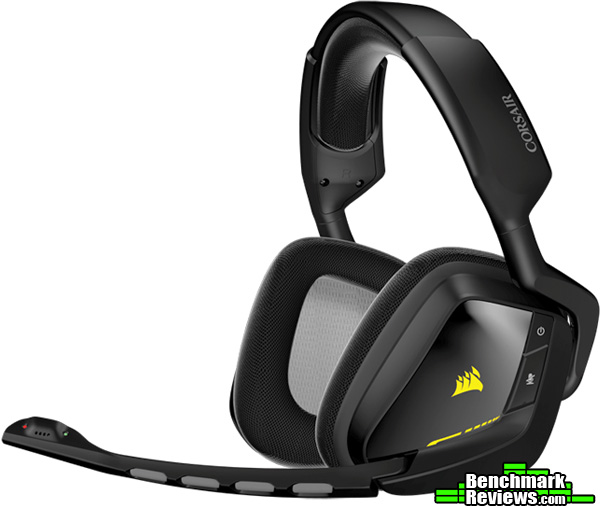
In the world of computer peripherals and hardware, most of us are well aware of Corsair’s existence. This is an organization that has well-earned reputation for producing quality components; components that are going to be high-performing, intelligently designed, and very likely to provide its owners with years of service. Therefore, it is no surprise that when Corsair develops a new product, such as the Corsair VOID Wireless Dolby 7.1 Gaming Headset, it doesn’t take long before it is in high demand.
If you haven’t heard of Corsair Gaming’s new RGB line, you’re about to get an education. There are three new products in this line, which include the Corsair VOID family of gaming headsets, the Corsair SCIMITAR gaming mouse, and the Corsair STRAFE mechanical gaming keyboard. These devices maintain a symbiotic relationship through the Corsair Utility Engine (CUE). On its website, Corsair explains that, together, these RGB devices are equipped with “groundbreaking new features that are precision forged to help you win.” Considering how many times we’ve seen Corsair back up its claims, there is no reason to doubt the statement regarding the RGB line.
- 16.8 million color options to match your gear and your individual style
- 2.4GHz wireless freedom from up to 40 feet away from your PC
- 16 hours of uninterrupted gaming between charges
- Dolby 7.1 audio, with 0.0 cables
- Efficient 50mm neodymium drivers
- “True Form” shaped, microfiber-wrapped memory foam ear pads enable extended play.
- The noise-cancelling microphone puts your voice in the spotlight – and nothing else
- InfoMic brings critical information to the end of your microphone
- Headphones
- Type: Dolby Headphone 7.1 positional audio
- Frequency Response: 20Hz to 20kHz
- Impedance: 32 Ohms @ 1kHz
- Sensitivity: 107dB (+/-3dB)
- Drivers: 50mm
- Connector: USB Type A
- Wireless range: up to 40 feet (12m)
- Battery life: Up to 16 hours
- Microphone
- Type: Unidirectional noise-cancelling condenser with adjustable, rotating boom and infoMic lighting
- Impedance: 2.2k Ohms
- Frequency Response: 100Hz to 10kHz
- Sensitivity: -38dB (+/-3dB)
There are so many factors to consider when searching for a gaming headset. Obviously, we want it to sound fantastic regardless of the listening activity and, when in-game, we want our headset to help us identify the origin of sounds so we can defeat our opponents. We also want our gaming headset to be comfortable so that we can hang in there for long gaming sessions. Oh yeah, let’s not forget the importance of effective communication with our teammates. Does the Corsair VOID Wireless gaming headset provide these qualities? Let’s find out…

Currently, the Corsair VOID Wireless Dolby 7.1 Gaming Headset comes in two different flavors; the standard version, which is the unit we are assessing in this review, and the Special Edition, a.k.a. the “Yellowjacket.” In terms of functionality, the two versions are identical. From a visual perspective, the Special Edition is adorned with more gold accenting.
In the box, you will find the Corsair VOID Dolby 7.1 Gaming Headset, obviously, and the accouterments include the wireless USB adapter, the USB charging cable, the Quick Start Guide, and other miscellaneous literature, such as the Warranty Guide. The base station extender is M.I.A. in this version.
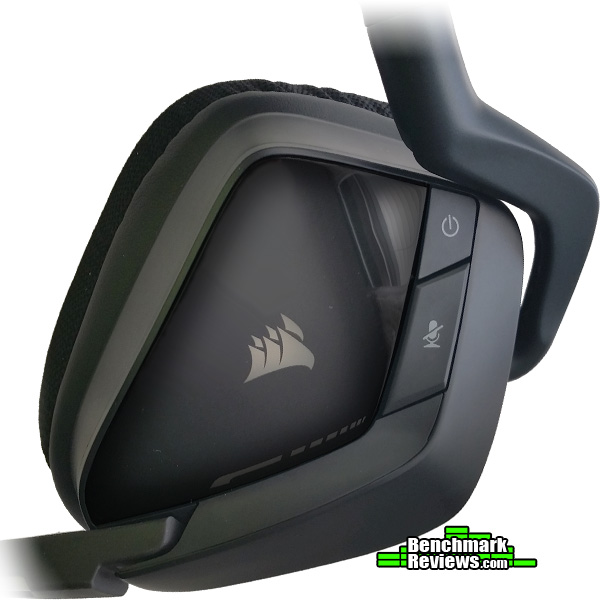
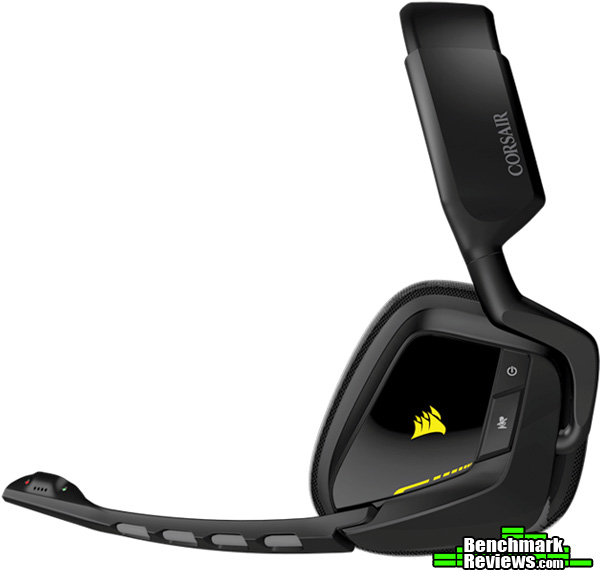
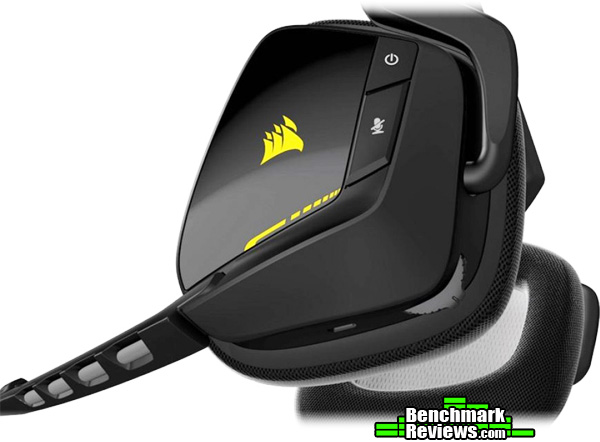
On the outside of the left earcup, you will find the power button and the microphone mute button. The mute button sticks out further than the power button, which makes it easier to find. You will also notice the Corsair logo and some matching trim about an inch or so beneath it. These two items greatly contribute to the light show that the VOID is capable of providing.

A couple of things you will notice in the above image. First, the earcups have a unique shape to them. Instead of an oval or round shape, Corsair went with a shape that is more conducive to surrounding the ear rather than sitting on top of it, or at least some part of it. The other point to take away from this view is that the earcups have quite a bit of horizontal swivel in them. They also have some movement vertically. This freedom of movement provided by the earcups helps to ensure that the Corsair VOID Wireless will accommodate many head shapes and sizes.
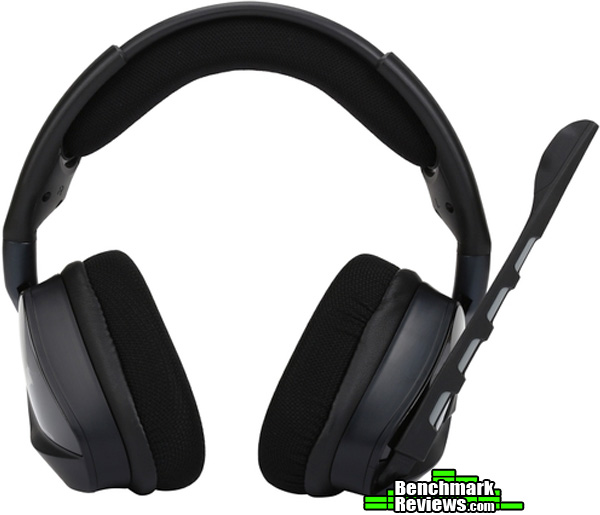
The head-on view in the image above provides a bit of perspective in terms of the bulk that the Corsair VOID maintains. Those 50mm neodymium drivers have quite a bit to do with the overall size, and so does the generous padding that was incorporated into the design.
This isn’t Corsair’s first attempt at developing a wireless gaming headset. The VOID’s predecessor, the H2100, is an outstanding wireless gaming headset that I had the privilege of reviewing late last year. So, I can confirm and have seen firsthand that these guys are very astute at improving upon an already sound design.
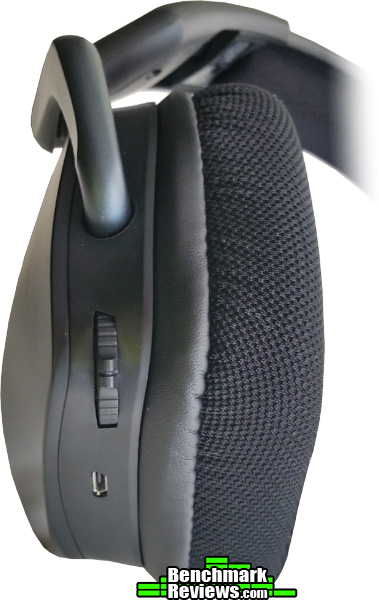
Above, you will notice a switch or toggle of some sort. That is the CUE Control, which allows for the manipulation of not only the volume, but also equalizer and Dolby surround settings. To control the volume, simply move the dial in one direction or the other. To change from one predefined equalizer setting to the other, depress the dial; it doubles as a button. In order to turn Dolby surround off and on, depress and hold the dial down until you are audibly informed that the setting change has succeeded.

The microfiber-wrapped memory foam ear pads are quite soft and comfortable on the VOID, which is an upgrade from the ear padding on the H2100. Even though the ear pads on the two headsets appears to be the same, the padding on the H2100 was more dense and less forgiving. Those ear pads are still comfortable, just not as comfortable as the ear pads on the Corsair VOID Wireless gaming headset.

The headband on the VOID is also an upgrade over the headband on the H2100. The Corsair VOID’s headband is thinner, softer, and is made of a microfiber-wrapped memory foam pad. The H2100’s headband had a thin pad wrapped in faux leather.

The microphone is of the noise cancelling variety. In the manual, it suggests adjusting the microphone so that it is no more than 1 – 2 inches from your mouth. This microphone is called an “InfoMic” due to the fact that it has two LED lights that indicate EQ settings, Dolby, microphone mute status, and battery life.

The CUE is a very well thought out GUI and will be extremely beneficial with all of the RGB devices installed on your PC. With only the VOID Wireless gaming headset attached, you still have the ability to create profiles that individualize audio and lighting settings for different games and programs. If the opportunity is presented, a thorough review of the CUE will be provided with all three RGB peripherals active and working in unison.
There’s a little more involved when testing a wireless gaming headset. Not only is the sound quality and comfort being judged, but also qualities such as range and battery life must be tested. All of the findings that you read below regarding the Corsair VOID Wireless Dolby 7.1 Gaming Headset are based on my unbiased opinion of it over the course of approximately 20 hours of use. Plenty of different activities were part of the testing phase. These activities included watching movies, listening to music, playing games, and communicated via Skype.
- Motherboard: Gigabyte GA-990FXA-UD3
- System Memory: 16GB (2 x 8GB) DDR3 1333 G.Skill Ripjaws X Series
- Processor: AMD FX-6100 Zambezi 3.3 GHz Six-Core Processor
- Audio: ASUS XONAR DG PCI 5.1 Audio Card
- Video: HIS Radeon HD 7950 IceQ Boost Clock 3GB GDDR5 PCI-E Graphics Card
- PSU: Corsair HX Series HX750 750W GOLD Certified Modular Active PFC Power Supply
- Monitor: AOC e2752Vh (27?) & Samsung SyncMaster PX2370 (24?)
- Operating System: Windows 7 Ultimate
To date, the Corsair VOID Wireless gaming headset provided the best in-game audio that I have personally experienced. Much of this opinion is based on Battlefield 4 sessions. The detail was truly stunning; there’s nothing on the Battlefield that, from an audio standpoint, I missed. I was able to easily identify the origin of gunshots, the location of footsteps, and the genesis of other ambient noises. As was the claim with the H2100, Corsair states that the VOID also, “delivers lethally accurate positional audio.” Believe it.
Corsair boasts that the 50mm neodymium drivers “create staggering bass, scintillating highs, and towering dynamic range.” If you read the paragraph above, there’s no reason why you’d believe that I would refute that claim. Considering the hardware this headset is packing and with the assistance of the CUE, the VOID gaming headset can be adjusted to suit anyone’s ear. This is obviously beneficial when employing the VOID for other purposes, such as listening to music or watching movies. Plus, the CUE helps you to build profiles, so your preferred settings can be saved for each medium.
The bottom line in terms of audio quality for the Corsair VOID, it doesn’t have a weakness. The H2100, while sounding great in-game, had a “flat” sounding quality when listening to other medium. Obviously, Corsair took an already impressive design, which is the H2100, and made improvements. The result is the Corsair VOID Wireless gaming headset.
The visual element, in terms of lighting, is something that was a major focus of this organization when developing the Corsair VOID. Even I, as someone who prefers more of a clean and simple look, was impressed by the lighting options and the output of said lighting. I can only imagine how cool all three RGB peripherals must look when working in concert. The ripple and wave effects look impressive when applied to the VOID; it must be a sight when running across three devices.
The improvements over the H2100 continue… The comfort level provided by the VOID is far superior. The ear padding is much softer and the shape of the ear cups is more accommodating to the ear. Also, the headband, while thinner, has softer padding and more of it to ensure that the top of the head won’t end up being tender after long gaming sessions. The VOID just might be the most comfortable headset I’ve had on.
The noise-cancelling microphone does what it is advertised to do, which is to “put your voice in the spotlight.” However, it does not provide “crystal clear voice communication.” I was informed that, even though the folks on the other end could hear me, I sounded a bit muffled. One bit of advice; make sure that you heed the suggestion in the Quick Start Guide and adjust the microphone so that it sits between an inch and two inches from your mouth.
Corsair claims that the wireless range of the VOID is about 40 feet. I could only test line-of-sight to about 25 feet, and the connection held true. When the line-of-sight element was removed from the equation, the connection was interrupted. In other words, try to use them without introducing a wall or some other type of barrier between the headset and the wireless adapter.
So, does the battery life compliment the great sound and comfort that the Corsair VOID Wireless gaming headset delivers? It certainly seems as if it did. Not a definitive statement, I know, but who is really going to use it for 16 hours straight? Okay, well, maybe some of you will, but not me. I used it for several different sessions that added up to 16 hours, and it finally fizzled out around the time I expected it to drop. Bottom line, the battery life is as advertised.
Corsair is one of those companies that produce such great products that people almost become programmed to believe that, if it has “Corsair,” slapped on the side of it, it’s going to be awesome. The Corsair VOID Wireless Dolby 7.1 Gaming Headset helps to further solidify that stereotype. There isn’t an audio event I could throw at this thing that didn’t end up sounding fantastic. This is the first time I’ve been able to make the following statement; I believe an audiophile would appreciate the sound quality produced by this gaming headset. What makes this headset’s appeal even greater is that it is built for comfort. The shape of the earcups, the density and thickness of the memory foam padding, and the microfiber wrapping were all perfect choices for ensuring that the VOID could be employed comfortably for long periods of time.
There was a head-scratcher for me, though. As innovative and useful as the concept of the “Infomic” appears to be, I could not, for the life of me, figure out how to be able to see the LED lights while wearing the Corsair VOID Wireless gaming headset. This completely defeats the purpose of the Infomic. It appears as if the only individuals that will benefit from the LED lights on the mic are those individuals NOT wearing it.
I would like to offer one final suggestion to Corsair; include the base station extender with each version of the VOID. I’m sure there is another way to distinguish this version of the VOID from the “Special Edition” version. Throw the extender in every box of every version, please.
In this section, I will conclude the Corsair VOID Wireless Dolby 7.1 Gaming Headset review by breaking it down into categories and producing a brief summary for each category. The categories include appearance, performance, construction, functionality, and value. As you read my concluding remarks, keep in mind that they are based on my experience with the VOID. Another reviewer may have had a different experience with this gaming headset.
In its dormant state, the Corsair VOID Wireless gaming headset is an attractive piece of hardware. Clearly, much thought was put into its unique shape, which is far more appealing that a standard set of cans. I also am a fan of the color scheme of this version of the VOID, which is a tasteful combination of both matte and glossy black finish. Some may find it a bit drab. However, it isn’t until the lights come on when Corsair really shows off the VOID. Cutting-edge styling coupled with a light show that is second-to-none; aesthetically, the VOID is a winner.
In my opinion, Corsair’s marketing effort for the VOID and the other RGB peripherals was focused mainly on the light show that these devices can produce. I can’t yet speak for the SCIMITAR and the STRAFE, but as for the VOID, Corsair needs place more emphasis on the performance of this headset. The statements made regarding the VOID’s performance are nearly identical to that of the H2100’s, yet I found the VOID to be far superior in sound quality. In every facet of testing, the Corsair VOID Wireless gaming headset far exceeded my expectations. As cool as the lighting effects are, the performance of this device is top-shelf. The only performance-based item that was ordinary was the noise-cancelling microphone.
There are a couple of other performance points that need addressing. First, the Corsair VOID Wireless gaming headset is extremely comfortable and very much suited to those marathon gaming sessions. The smartly designed earcups are the perfect shape for most anyone’s ear and the microfiber-wrapped memory foam padding on both the earcups and the headband eliminate any possibility of soreness. Second, in terms of both battery life and wireless range, the VOID was on par with Corsair’s claims.
The Corsair VOID Wireless gaming headset is made primarily of plastic, but it is a solid device. My first impression of it was, “well, it doesn’t seem to be built as well as the H2100.” However, the more time I spent with it, the more I realized why Corsair made the choices it did on the VOID in terms of construction. On the H2100, one of the design elements that makes it appear to be so well constructed is the headband, which is made of faux leather with gold stitching. The VOID doesn’t have that level of detail, but I found it to be far more comfortable than the H2100. Bottom line, I have no doubt that the Corsair VOID Wireless gaming headset will provide you with many years of service.
One of the most compelling features offered on the Corsair VOID Wireless gaming headset is the “CUE Control,” which allows you to adjust the volume, change equalizer settings, or switch Dolby off or on all with one appendage. I also appreciate the raised mute button that is fairly easy to locate. However, the “Infomic” is another issue. Why place LED lights that indicate status on the headset if they cannot be seen by the individual wearing it?
As of mid-September 2015, the Corsair VOID Wireless Dolby 7.1 Gaming Headset can be purchased online for $129.99 (Amazon | B&H | Newegg). That certainly isn’t a pittance to pay for a headset, but if you consider the performance you are getting in a wireless gaming headset, the value is easily there.
+ Fantastic sound regardless of application
+ Cutting-edge design
+ CUE Control
+ CUE GUI
+ Extremely comfortable
+ Raised mute button
+ Earcup shape
+ Battery Life
– Hey, I can’t see my Infomic LED’s!
– Where’s my base station extender?
-
Performance: 9.50
-
Appearance: 9.25
-
Construction: 9.00
-
Functionality: 8.50
-
Value: 9.00
Excellence Achievement: Benchmark Reviews Golden Tachometer Award.
COMMENT QUESTION: How important do you consider the lighting options to be on a gaming headset?


7 thoughts on “Corsair VOID Wireless Gaming Headset Review”
I wrote a personal review of this headset a few weeks back and completely agree with your conclusions. One added point I’d like to make is that if you wear eye glasses like I do you will find this headset to be the most absolute comfortable headset available. It’s probably one of the very few that don’t give me a headache. Other headsets pinch the ear frames of my eye glasses which is very uncomfortable.
Yes the price isn’t cheap but if you want comfort while gaming as well as some of best in-gaming audio this headset is the best available. Corsair is for the win. (a.k.a rjohnson11, volunteer EVGA forum moderator)
Robert!
Thanks for sharing! That’s a great comment for those folks wearing prescription eyeglasses. It might be good news for those of us who are looking into or have already purchased gamer glasses. I’m not sure how much traction gamer glasses have, but the VOID would be a great option here.
Thanks again!
Greg
Why would you want lights on a headset?
Are you supposed to set a mirror in front of you so you can stare at yourself, as a Canary stares at itself in a mirror?
Are the lights supposed to indicate something? So that every time you need to make an adjustment you have to remove the headset every single time to confirm through the lighting whatever settings you are making?
Are you supposed to think that you don’t look like a complete idiot by wearing a headset with lights?
Inquiring minds want to know why this isn’t the most ludicrous thing Corsair has come out with to try and sell you something you neither need nor should ever want?
Hey kzinti 1!
Thanks for your post! I get what you’re saying; if you’ve read any of my reviews in the past, you’d know I’m more of a function over form guy myself. That’s what I tried to focus on in this review. From a functionality standpoint, the VOID is a great headset. It sounds fantastic and the buttons are easy to find and manipulate so in-game adjustments can be made with ease.
In terms of the lighting effects, it seems as if Corsair’s intent is to market the RGB line as a set. In other words, if you purchase all three devices, the VOID headset, the SCIMITAR mouse, and the STRAFE keyboard, you’ll benefit from these devices working in unison to put on a fantastic light show. Aesthetics grab attention and sell product. If I’m a betting man, I would bet that an organization the caliber of Corsair did their homework and, after doing some market research, realized that this campaign will lead to plenty of sales. That’s my take anyway. I could be wrong.
You asked if the lights are meant to indicate something. The only lights that are meant to indicate something are the LED lights on the “Infomic,” which are located on the end of the microphone. I talked about this in the review. Great concept, but unfortunately, you cannot see those lights while wearing the headset. I think someone dropped the ball there.
In all honesty, I don’t care if it’s hot pink with lace trim; if it is a great device, that’s all I care about. Okay, maybe that’s taking it a bit far, but I think you get my point. The VOID is a great headset. If you don’t like the lights, you can always turn them off.
Thanks again for the post!
Greg
Hi!
You didn’t mentioned anything about sound isolation in Your review.
Is this set quiet (on the outside) or not? Can it be used few feets from ie. a sleeping spouse? 🙂
So far the worst headset in this matter was Creative Rage 3D Wireless. It was so loud that it didn’t matter if I used speakers or headset while gaming. They were both loud…
Hey Radek!
You are absolutely correct; I did not mention anything about sound isolation! When I write a review, I try to focus on addressing the claims made about the specific device as well as covering points that are common to the type of device. I missed this one because I didn’t see any claims made by Corsair regarding the VOID’s ability in terms of sound isolation. So, I’ll do that now…
It’s pretty simple; Corsair didn’t talk about sound isolation because it clearly wasn’t a focus. Microfiber-wrapped memory foam padding is great when comfort and breathability is the focus, but it is not conducive to sound-proofing. If you want sound isolation, you’re probably going to have to find a headset that has leather or faux leather-wrapped padding. They’ll likely still be comfortable until you start sweating.
Suggestion, if you want the VOID, get the wife some comfortable earplugs or do the white noise thing… you know, turn a fan on or get an app that has nature noises like rain or waves crashing on the shore.
Thanks for the great question!
Greg
@Radek: our bedroom is next to my gaming room and my wife never complains about noise from the VOID headsets no matter how many aliens I am trying to kill. In fact she probably complains more about the mouse clicks than anything else. She used to complain about the keystrokes as well, but she said my new STRAFE keyboard is not as loud as the previous model.
Comments are closed.