By Olin Coles
Manufacturer: Ubisoft Entertainment
Product Name: Tom Clancy’s Splinter Cell Blacklist
Price As Tested: $59.99 for DVD or Digital Download (Amazon)
Full Disclosure: The product sample used in this article has been provided by NVIDIA.
Tom Clancy’s Splinter Cell Blacklist is a Unreal Engine 2.5 video game that has been modernized to include DirectX 11 special effects thanks to direct support by NVIDIA. Single-player ‘Solo’ missions also enable a second player to join for ‘Co-op’ mode, while online multiplayer ‘Spies vs. Mercs’ mode expands the action for up to eight gamers. In this article Benchmark Reviews explores DirectX 11 Tessellation and NVIDIA TXAA features that help bring this game to life.
According to Tom Clancy’s Splinter Cell Blacklist, the United States of America maintains a military presence in two-thirds of countries around the world. Some countries (most it seems) have had enough of the American presence. A large group of highly-organized terrorists calling themselves “The Engineers” initiate a terror ultimatum called the Blacklist – a deadly countdown of escalating attacks on US interests at home and abroad. Their threats are real, and the regular military appears to be outmatched.
Action hero Sam Fisher is back in his ops suit and goggles, and he’s more lethal and agile than ever. Joined by Grim, Briggs, and Charlie Cole to form Fourth Echelon, the President grants them freedom to do whatever it takes to stop the Blacklist. Sam and his crew fly aboard the C-1478 Paladin Multi-Mission Aircraft, from exotic locales to US cities, and race against the clock to find out who’s behind the devastating “Blacklist” threat.

Splinter Cell Blacklist builds on the stealth roots of the franchise, while exploring new directions to embrace the realms of action and adventure. Players can define their personal play styles and be rewarded for those choices: Ghost players want to remain undetected, Assault players rely on instincts and firepower to deal with a situation, Panther players strike lethally from the shadows in the most efficient and silent way.
Co-op Team Gaming
Through the use of the Stategic Mission Interface (SMI), the lines between the Single-Player campaign and CO-OP are blurred as the narrative between Sam and Briggs is deepened. Earn in-game currency and unlock additional weapons or gadgets via specialized missions assigned by members of the Fourth Echelon.
Multiplayer Game: Spies vs. Mercs
Spies vs. Mercs is a unique multiplayer experience that innovates from the roots of the Splinter Cell franchise.
On one end, you have a team of agile, stealthy Spies looking to infiltrate a location and hack terminals to gather information, all while remaining undetected. On the other end, you have a team of heavily armed and powerful Mercs that must defend their terminals and stop the Spies from gathering the data by any means necessary.
Each team has different abilities and tools that they must leverage to outsmart their opponents, setting the tone for big rivalries and very fun competitive gameplay.

Tom Clancy’s Splinter Cell Blacklist video game is based on Unreal Engine 2.5 developed by Epic Games, and introduced in the original Splinter Cell title that debuted in 2004. UE2.5 offers improved rendering, basic physics, particle effects, and 64-bit support.
For Splinter Cell Blacklist, Ubisoft teamed with NVIDIA to breathe new life into their aging game engine. Primary among the improvements is DirectX 11 Tessellation effects and NVIDIA TXAA graphics quality.
In the image below, graphics quality is set to “Low”. Notice that round objects are comprised of large triangles due to lack of tessellation, causing objects such as Sam’s ear to show flat discernible angles. The detail is much less sharp, causing walls, floors, and clothing to appear blurred. Shadows are coarse and jagged, and lighting is unnatural.

With graphics quality set to “Medium” for the image below, textures sharpen for map objects such as the stone wall, tile floor, and wooden bench. Buttons appear more defined, and cloth now has wrinkles in the fabric. Tessellation is still not employed, causing unrealistic round objects. Shadows are slightly smoother with fewer jagged edges, but light sources remain unnatural.

Adjusted to “High” quality for the image below, textures are much sharper overall yet round objects still generate sharp or flat angles instead of smooth curves. Shadows are smooth, with shaded portions of textures, such as fabric and hair. Objects do not receive tessellation at this setting, so rounded surfaces are still comprised of many flat angles.

With graphics quality set to “Ultra” in the image below, Splinter Cell Blacklist utilizes its most detailed textures and shadows. Most round objects feature smooth curves thanks to DirectX 11 tessellation, with only a few detectable flat angles. Small objects such as Sam’s ear and worker’s fingers appear more realistic, yet both buffer wheels and the belt pulley display large flat transitions. Shadows have soft diffused edges, while dynamic ambient occlusion causes light sources to appears more natural.

Finally, with “Ultra” graphics quality and 4x NVIDIA TXAA enabled, Tom Clancy’s Splinter Cell Blacklist looks its best. Tessellation hasn’t changed, but TXAA has dulled some of the sharpest edges to make flat curves appear slightly less conspicuous. Shadows appear soft and deep with larger area coverage, and light sources use Horizon Based Ambient Occlusion technologies.

Most all modern GeForce GTX video cards will enjoy Tom Clancy’s Splinter Cell Blacklist set to the highest graphics quality, but features such as NVIDIA TXAA and Field AO & HBAO+ may be more suitable for single-player missions than the much-darker Spies vs. Mercs multiplayer game where enemy lurk in the shadows. Ultimately, a custom combination of settings will yield the best graphical quality and frame rate performance.
In this section we take a look at how DirectX 11 Tessellation effects and NVIDIA TXAA help take a crude finished product and turn it into a refined representation of a realistic object. These technologies elevate Tom Clancy’s Splinter Cell Blacklist from Quake III texture quality levels to something much more modern. Each of the images below is taken from the scene from the previous section, and feature different quality setting levels.
In the image of Sam Fisher’s head show below, graphics quality is set to “Low”. The texturing for hair is very coarse with no definition, making it resemble a paint flat surface. Sam’s ear, nose, and chin shows flat discernible angles instead of smooth curves, due to the lack of tessellation.

With graphics quality set to “Medium” for the image below, textures sharpen allowing hair to look slightly more realistic and defined. His facial hair appears more distinct, and less flat. Tessellation is still not employed, causing unrealistic round edges around the ear and chin.

Adjusted to “High” quality for the image below, textures are much sharper overall. Sam’s hair is well defined, and individual colored strands can be observed. Round objects still generate sharp or flat angles instead of smooth curves, as tessellation is not employed at this quality level.

With graphics quality set to “Ultra” in the image below, tessellation is enabled and Sam Fisher finally gets round ears and chin thanks to DirectX 11 tessellation. Textures are their sharpest yet and offer more detail, but still remain flat and without realistic volume or movement.

With “Ultra” graphics quality and 4x NVIDIA TXAA enabled, the overall detail is softened for all objects in Tom Clancy’s Splinter Cell Blacklist. While this could make a texture appear more fluid and less sharply distinct, it might also remove some of the realistic details that pop out. Tessellation softens the edges to create smoother curves, and TXAA further dulls these edges to make all angles appear slightly less conspicuous.

For gamer’s wanting realism from Tom Clancy’s Splinter Cell Blacklist, DirectX 11 technologies such as tessellation are absolutely essential to rounding sharp corners and curves. NVIDIA’s TXAA helps to further soften the harsh edges and color blends with very little performance penalty, making it ideal for solo/single-player campaigns where you can spend time to take in all the game’s artistic details.
Back in 1998 I purchased my first-ever PC video game: Tom Clancy’s Rainbow Six. It was a difficult game with colorful (albeit flat) graphics and lots of ambient sounds that gave you noise cues. Tom Clancy’s Splinter Cell Blacklist doesn’t seem far removed, despite the difference of fifteen years. The Unreal Engine (UE2.5) is from 2004 vintage, and despite NVIDIA’s best attempts at adding some modern effects the game still doesn’t look very fresh. Breaking-down Tom Clancy’s Splinter Cell Blacklist means pointing out the good, the bad, and the ugly.
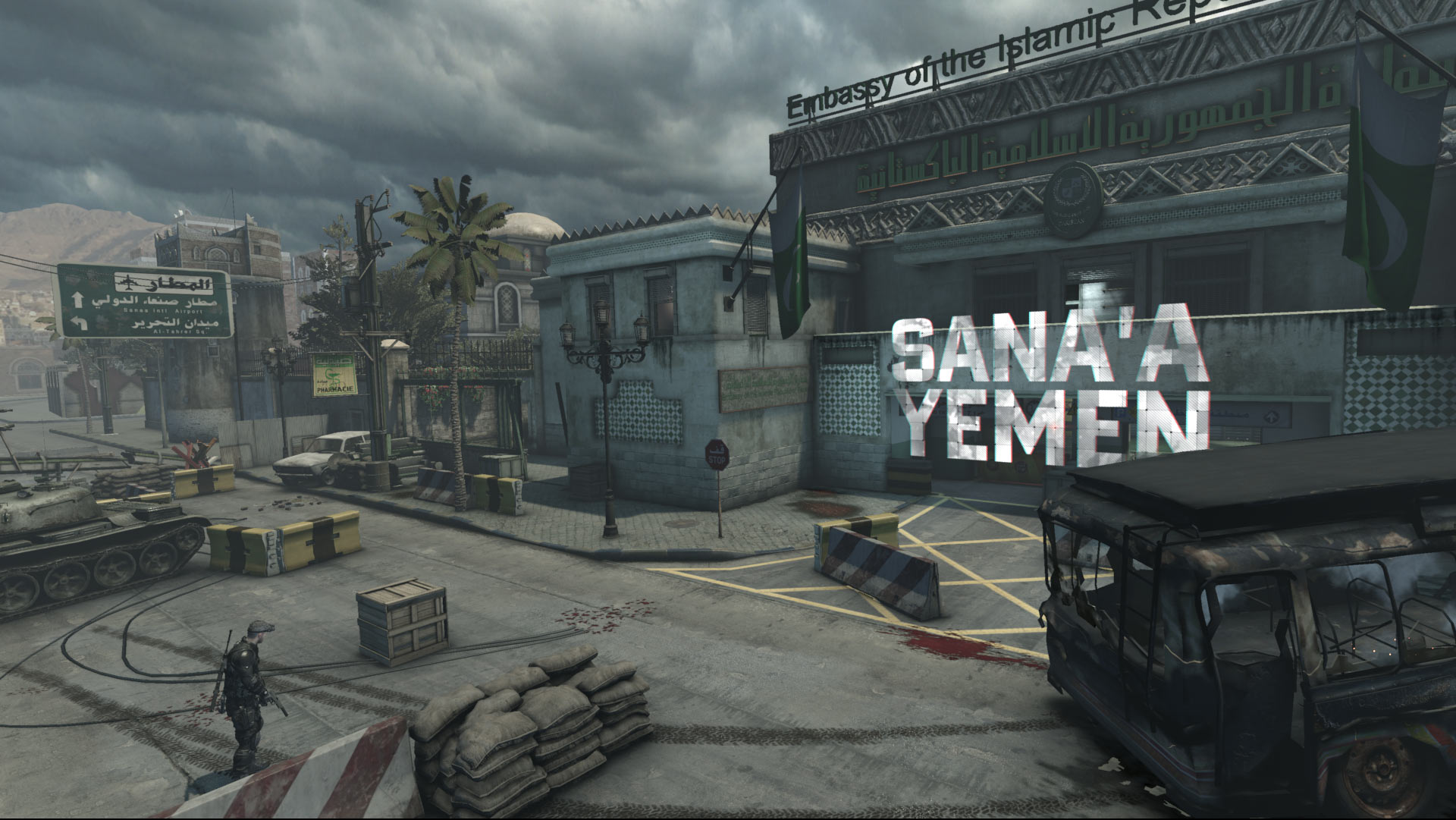
Single-player ‘Solo’ campaign missions are at the heart of Splinter Cell Blacklist, and offer the best view of Tom Clancy’s clandestine operator’s world. These missions allow players to outfit Sam Fisher with much more gear and weaponry than available elsewhere, most of which is not available in multiplayer ‘Spies vs. Mercs’ game play. These solo missions take Sam to various locations on every continent, and require him to employ different tactics to successfully complete each mission. Campaign maps are richly detailed and diverse, with very little repetitious scenery or setting. The game developer uses modern-day news headlines and topics to form the story, honing-in on controversial real-world events to grab your interest.
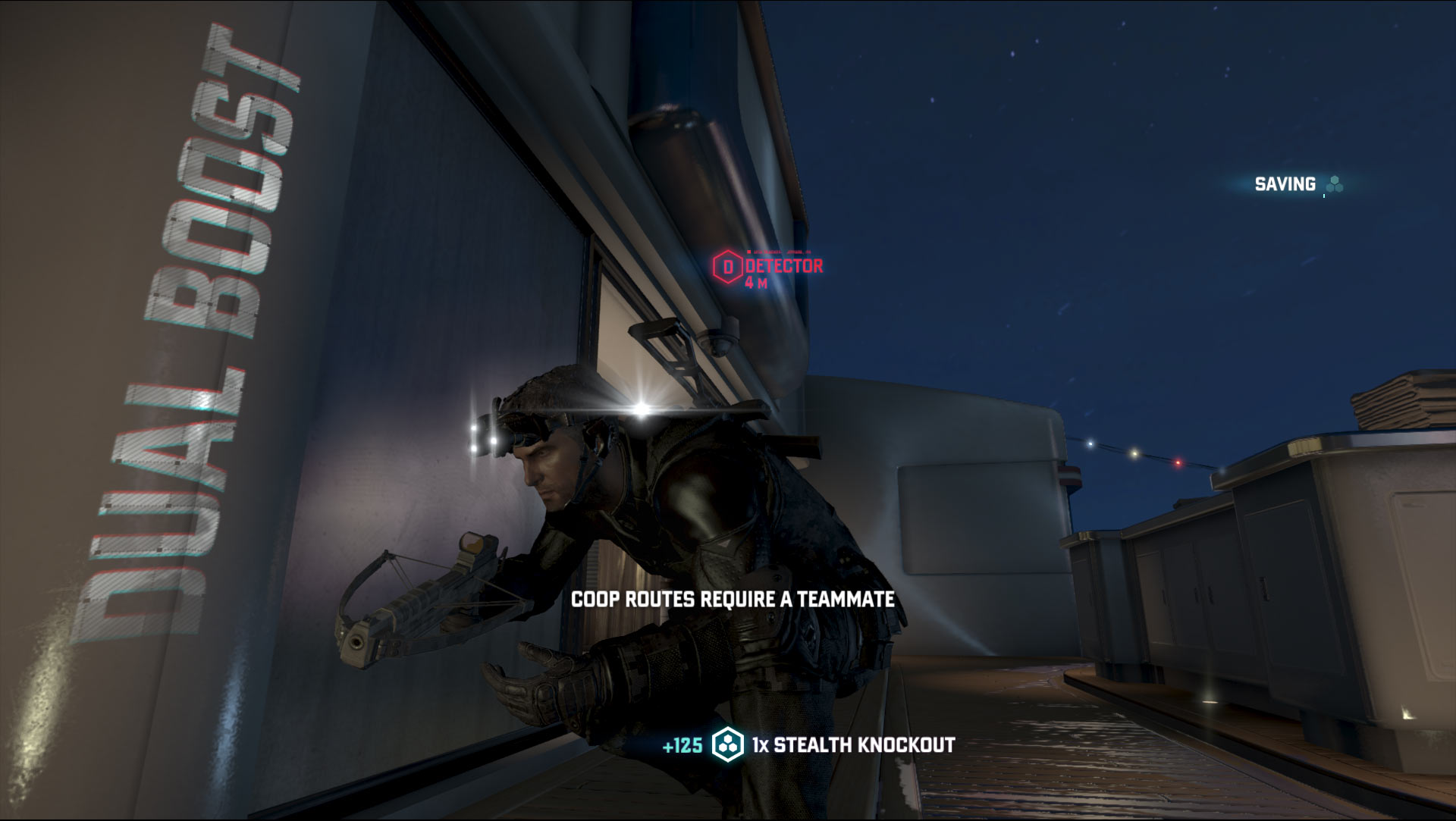
One key aspect of the game is stealth, and while multiplayer ‘Spies’ depend on this tactic the solo missions incorporate it as a means to balance predictable computer AI. Despite the adjusted tactics to complete each mission, computer AI tends to only pose any real challenge at ‘Perfectionist’ skill level. Many missions can (or must) be completed online with a second ‘buddy’ for Co-Op mode. This is helpful for missions where the game’s preferred ‘Ghost’ path are not so evident, and require cooperation to reach tall ledges or bait and clear enemy.
Most new games are expected to have a few small bugs discovered after launch, which weren’t found in the alpha- and beta-testing phases of development. Tom Clancy’s Splinter Cell Blacklist seems to have used the retail launch as their testing phase, because two full update packages have been released in just as many weeks after debut. My experience with the PC version is that even after the updates, most mechanical aspects of the game are broken. Game crashes are far too common and uPlay occasionally doesn’t report bonus equipment purchases to the game, but my personal favorite was when I completed the final solo campaign the game’s ending cut-scene videos only produced sound with no cinema movie displayed. Bravo, Ubisoft, bravo!

Online multiplayer mode features a peer-to-peer networking system that is just plain broken. There are times when the SMI (Sam’s menu interface) offer players an opportunity to assassinate a rogue agent for bonus XP, only to be joined onto the losing team of a match with literally one second left on the clock and no chance of earning the bonus. If you’re lucky enough to join into a game that has just started and manage to kill the rogue agent, everything still depends on the original ‘host’ player to decide if that game continues to its end or not. If the game’s host is someone on the losing team, chances are your game won’t reach the match’s final conclusion where points are handed out. The message “Host has changed. Migrating Match” is all too common.
Spies vs. Mercs has several fun game modes in concept, the best being 4 vs 4 team death match, but actual SvM games can be harshly skewed. I discovered that the game’s match maker system doesn’t take rank, skill level, or point standing into consideration. It also doesn’t keep track of how often your team is down a player to keep things even. Matches where a team with three level 1-9 players are arranged to compete against four level 40-51 players happens more often than you think. Since even new players can be good at the game this shouldn’t be a real problem, except for that many ‘elite’ gear items and weapons become available only after a player reaches rank 51.
The online system also seems to be lacking a working balance system, since matches that start 4 vs 4 can become and remain 4 vs 1. I’ve played in matches, even after the 1.02 patch, where team Spies lose three players and team Mercs loses one, only to have the next joining player fight with the Mercs in a 4 vs 1 battle for the remainder of the match.
RATING DISCLAIMER: Although the rating and final score mentioned in this conclusion are made to be as objective as possible, be advised that every author perceives these factors differently. While we each do our best to ensure that all aspects of the product are considered, there are often times unforeseen market conditions and manufacturer revisions that occur after publication which could render our rating obsolete. Please do not base any purchase solely on this conclusion, as it represents our rating specifically for the product tested which may differ from future versions. Benchmark Reviews begins our conclusion with a short summary for each of the areas that we rate.
The Unreal Engine 2.5 has been around since 2004, so it’s had plenty of time to be tweaked and optimized for best performance. This translates into fast frame rates for even the most meek of video cards, and scalable graphics quality for gamers with the latest hardware. My best experience was seen using custom settings that include Tessellation as well as Field AO & HBAO+ lighting. Solo campaigns were made realistic using NVIDIA TXAA combined with maximum (Ultra) shadow quality, while the pitch-black online Spies vs. Mercs maps were better off with low-quality shadows.
Despite NVIDIA’s best efforts to improve Tom Clancy’s Splinter Cell Blacklist, ultimately it was up to Ubisoft to develop decent textures and employ modern graphical effects. The dichotomy of these forces are best illustrated in the scene below, where Sam’s sculpted features and detailed weapon crouch beside a table with some of the worst looking bottles and lemon slices you’ve ever seen. The bottom line is that Ubisoft didn’t put as much effort into the game’s graphics as it focused on the story, and it shows.

Writers have argued for years about what makes a video game successful. Most will agree that a game has to be fun, first and foremost, or it won’t get played. Tom Clancy’s Splinter Cell Blacklist should be a very fun game to play by design, but in execution the player’s experience certainly differs. Nobody likes their game to crash, repeatedly, before a match starts or as you’re about to complete the mission. Gamers have even less patience for these things, especially after installing a huge 1.7 GB self-titled “Day 1 Patch” followed by a second 484 MB patch only days later. This relegates ‘fun’ gameplay to those moments in-between crashes or when you can play a multiplayer match to completion.

As of September 2013, the Tom Clancy’s Splinter Cell Blacklist video game is available online for $59.99 (DVD or Digital Download: Amazon). This seems to be the going price for all new video games, regardless of the effort put into making them, so value depends on what’s delivered in the game. Considering how immature the finished product is, the price seems better fitted for those titles that actual deliver a stable game at retail launch. Splinter Cell Blacklist isn’t one of those titles.
Lucky for Ubisoft that NVIDIA stepped in to improve graphics, or the aging UE2.5 game engine would be a much bigger issue. The solo campaigns feature beautiful scenery and a myriad of choices that make them very entertaining, so long as the game itself doesn’t crash right as you complete a mission. With limited players split across six different multiplayer modes (counting coop), I won’t suggest this game to anyone wanting online action. Multiplayer mode is not balanced, and when your team is winning a round the game seldom reaches the end before the losing ‘host’ shuts down the entire match. There are better games out there that deserve the full retail asking price, so wait for this one to hit the discount bin… maybe by then there will be enough patches released to make this game stable.
+ Colorful map location scenery
+ Enjoyable solo campaign story
+ Plenty of weapon customization
+ Coop missions and gameplay perks
+ Good performance on DX11 cards
+ NVIDIA TXAA improves visual quality
– Uses aging game engine
– Rough graphics with few special effects
– Online multiplayer plagued with problems
– Retail alpha version: too many bugs
– Unstable after patching
– Rage-quitting host ends match
-
Performance: 8.50
-
Graphics: 8.25
-
Development: 7.50
-
Gameplay: 9.00
-
Value: 6.50
COMMENT QUESTION: What is your favorite Tom Clancy game or book?


2 thoughts on “Tom Clancy’s Splinter Cell Blacklist PC Video Game Review”
COMMENT QUESTION: What is your favorite Tom Clancy game or book?
N/A. They’ve all been turds.
I have several uplay games. Luckily, they’ve all come free with videocard purchases, as none would’ve been bought separately.
This review puts my thoughts of this game into a far better perspective than I have words for.
I’ve always despised on-line games. Giving “bonuses” to people only if they play a game on-line, does nothing to endear me to any game publisher who practices such nonsense. Especially when I pay for a game that doesn’t come free with a piece of equipment.
I’d much rather Nvidia give out rebate coupons which you can either use for cash, or whatever game that they happen to be pushing with their videocards. I’d certainly take the cash every single time.
Especially as the bulk of these games can be purchased a few months later for pennies on the dollar.
That was a good review.
It is a shame that the quality assurance for the game was so low. It’s getting to be the low standard of choice for some companies to “beta test” their products at the time of release. Too many times the excuse is “we ran out of time.” That’s just bad business in general, and will eventually cause a bad rep for the company.
Comments are closed.