While the shape is pretty typical of tower coolers, there are some detailed features that remain unique to Noctua – so let’s take a look.
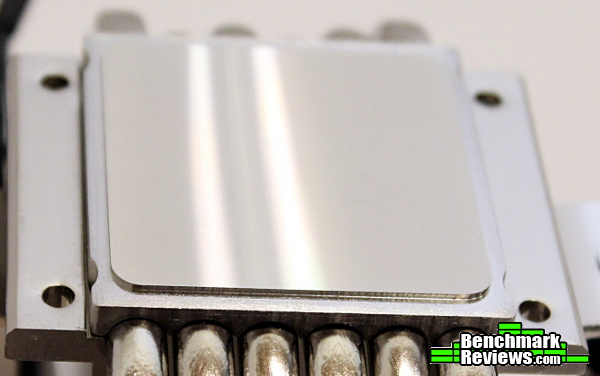
This has got to be one of the finest mirror polishes I’ve seen on a factory CPU cooler. A little of the machining marks are visible, but the surface itself is highly polished. I tried to capture the very slight convex surface of the contact plate, which should result in a superior application of thermal interface material (as well as greater contact pressure right over the hottest part of most CPUs).

If you look closely, you can see some of the wavy machining marks in the mounting surface of the NH-U14S, but these marks are completely covered by a very high quality mirror finish. I really should have flipped the tube of included Noctua NT-H1 thermal paste so you could see the letters reflected in the cooler’s surface – Noctua really cements their reputation as a premium distributer of CPU cooling products with details like this. It’s rare that manufacturers will take the time to polish the mating surface of their coolers to this extent; maybe it’s only good for a degree of performance but as we’ll see later these small details add up.

The NH-U14S uses Noctua’s SecuFirm2 Mounting System. Containing a different set of brackets depending on the socket you’re installing the cooler on, all of the pieces you’ll need are in a nicely labeled box (with common components in a third box). For the AM3+ socket on the testbed, this consists of four standoffs and two brackets (with four screws to attach them all). It’s a little unfortunate that you won’t be able to choose the orientation of the cooler (at least on AMD sockets), but for many systems this won’t be a problem and is a common approach with tower coolers anyway.
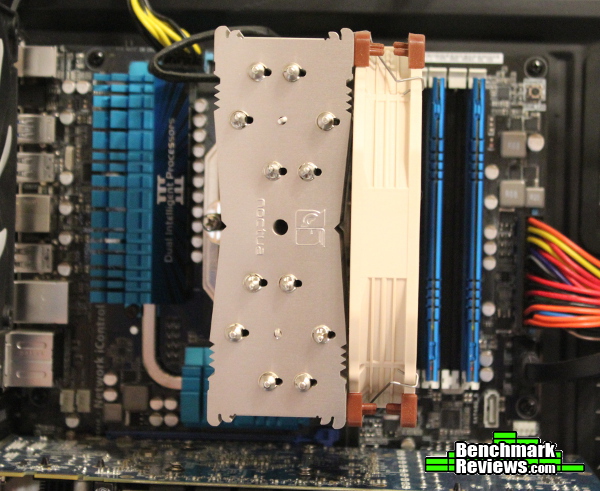
Installing the heatsink is easy, but you’ll still need to remove the fan to do so. It was here I found myself drifting back to the SilverStone Argon coolers I had tested a few months ago – the fan mounting system they had developed made this process much easier. Yes, it’s splitting hairs (metal clips aren’t that hard to work with either) but it shows there’s still room for innovation.

The NH-U14S showcases the NH-U series selling point of RAM clearance. The heatsink’s width (depth) of 52mm means even fans on both sides won’t intrude on the DIMM slots (of course, this is if the motherboard manufacturer follows the socket area specifications of AMD and Intel – ITX boards are usually a toss-up if a cooler will fit or not).

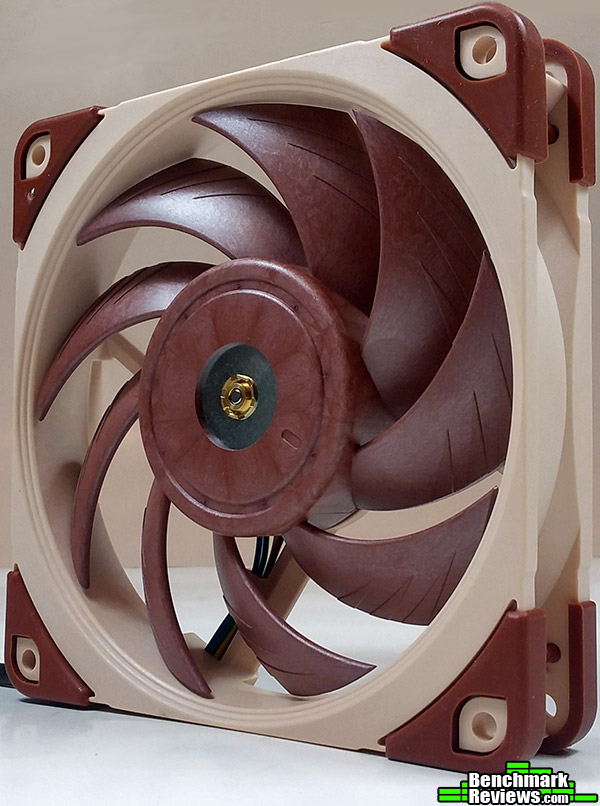
Adding a second fan involves swapping out the brown vibration-dampening corners with the thicker set included in the NH-U14S accessory box. Seen in the picture above, these will add a bit of space in front of the fan blades which I’m sure helps to cut down on noise (moving blades placed against stationary fins/mesh/filters tend to emit all sorts of sounds). I did test the NH-U14S in a push/pull configuration, and it resulted in a 1.2C change (for the better). This is pretty typical of most of the heatsinks I test – while I don’t normally include the results of push/pull setups I’ll commonly throw an extra fan on a heatsink out of curiosity. So far, most 140mm-sized heatsinks will usually shed about one degree Celsius with an additional fan, and the Noctua is no different. The larger mass and additional heatpipes generally mean more surface area – essentially the larger the heatsink, the less help it needs to shed heat. Smaller heatsinks tend to benefit more from adding another fan, as the smaller surface area usually needs the extra help to remove the heat from the heatsink.
Usually I don’t include these results as the extra noise and cost are rarely worth the small performance gain. In the Noctua’s case though, adding a premium fan like the NF-A15 didn’t add much noise at all – while still an expensive improvement, at least it remains a quiet one. This makes it an easier option to consider if you really need an extra bump in performance.
It bears repeating here that no heat-sink will work effectively unless it transfers heat from the CPU. To do that, it needs to be in contact with the CPU heat spreader or die, with the greater the contact surface the greater the potential for heat transfer. One of our own writers here at Benchmark Reviews has done a lot of work in this area, and it is certainly worth the time it takes to read (and re-read) the discoveries he made during the famous 80+ thermal paste tests (I still see Newegg reviews reference the discoveries made therein).
I mention this because I still see this as a major source of misinformation – most end users will use far too much thermal interface material when switching CPU coolers. Possibly through little fault of their own – I’ve read official repair manuals stating to use the entire tube of thermal paste when replacing a CPU and heat-sink. This is, in almost every case, FAR too much – to the point of being harmful in most cases. So do yourself a favor and get acquainted with CPU Cooler Preparations and Thermal Paste Application.
Processor and CPU cooler surfaces are not perfectly smooth and flat surfaces, and although some surfaces appear polished to the naked eye, under a microscope the imperfections become clearly visible. As a result, when two objects are pressed together, contact is only made between a finite number of points separated by relatively large gaps. Since the actual contact area is reduced by these gaps, they create additional resistance for the transfer of thermal energy (heat). The gasses/fluids filling these gaps may largely influence the total heat flow across the surface, and then have an adverse affect on cooling performance as a result.
The only reason for using Thermal Interface Material is to compensate for flaws in the surface and a lack of high-pressure contact between heat source and cooler, so the sections above are more critical to good performance than the application of TIM itself. This section offers a condensed version of our Best Thermal Paste Application Methods article.
After publishing our Thermal Interface Material articles, many enthusiasts argued that by spreading out the TIM with a latex glove (or finger cover) was not the best way to distribute the interface material. Most answers from both the professional reviewer industry as well as enthusiast community claim that you should use a single drop “about the size of a pea”. If there was ever any real advice that applies to every situation, it would be that thermal paste isn’t meant to separate the two surfaces but rather fill the microscopic pits where metal to metal contact isn’t possible.
After discussing this topic with real industry experts who are much more informed of the process, they offered some specific advice that didn’t appear to be a “one size fits all” answer:
- CPU Cooling products which operate below the ambient room temperature (some Peltier and Thermo-electric coolers for example) should not use silicon-based materials because condensation may occur and accelerate compound separation.
- All “white” style TIM’s exhibit compound breakdown over time due to their thin viscosity and ceramic base (usually beryllium oxide, aluminum nitride and oxide, zinc oxide, and silicon dioxide). These interface materials should not be used from older “stale” stock without first mixing the material very well.
- Thicker carbon and metal-based (usually aluminum-oxide) TIM’s may benefit from several thermal cycles to establish a “cure” period which allows expanding and contracting surfaces to smooth out any inconsistencies and further level the material.
The more we researched this subject, the more we discovered that because there are so many different cooling solutions on the market it becomes impossible to give generalized advice to specific situations. Despite this, there is one single principle that holds true in every condition: Under perfect conditions the contact surfaces between the processor and cooler would be perfectly flat and not contain any microscopic pits, which would allow direct contact of metal on metal without any need for Thermal Interface Material. But since we don’t have perfectly flat surfaces, Thermal Material must fill the tiny imperfections. Still, there’s one rule to recognize: less is more.
CPU coolers primarily depend on two heat transfer methods: conduction and convection. This being the case, we’ll concentrate our attention towards the topic of conduction as it relates to the mating surfaces between a heat source (the processor) and cooler. Because of their density, metals are the best conductors of thermal energy. As density decreases so does conduction, which relegates fluids to be naturally less conductive. So ideally the less fluid between metals, the better heat will transfer between them. Even less conductive than fluid is air, which then also means that you want even less of this between surfaces than fluid. Ultimately, the perfectly flat and well-polished surface is going to be preferred over the rougher and less even surface which required more TIM (fluid) to fill the gaps.
This is important to keep in mind, as the mounting surface of your average processor is relatively flat and smooth but not perfect. Even more important is the surface of your particular CPU cooler, which might range from a polished mirror finish to the absurdly rough or the more complex (such as Heat-Pipe Direct Touch). Surfaces with a mirror finish can always be shined up a little brighter, and rough surfaces can be wet-sanded (lapped) down smooth and later polished, but Heat-pipe Direct Touch coolers require some extra attention.
To sum up this topic of surface finish and its impact on cooling, science teaches us that a smooth flat mating surface is the most ideal for CPU coolers. It is critically important to remove the presence of air from between the surfaces, and that using only enough Thermal Interface Material to fill-in the rough surface pits is going to provide the best results. In a perfect environment, your processor would mate together with the cooler and compress metal on metal with no thermal paste at all; but we don’t live in perfect world and current manufacturing technology cannot provide for this ideal environment.
Probably one of the most overlooked and disregarded factors involved with properly mounting the cooler onto any processor is the amount of contact pressure applied between the mating surfaces. Compression will often times reduce the amount of thermal compound needed between the cooler and processor, and allow a much larger metal to metal contact area which is more efficient than having fluid weaken the thermal conductance. The greater the contact pressure between elements, the better it will conduct thermal (heat) energy.
Unfortunately, it is often times not possible to get optimal pressure onto the CPU simply because of poor mounting designs used by the cooler manufacturers. Most enthusiasts shriek at the thought of using the push-pin style clips found on Intel’s stock thermal cooling solutions. Although this mounting system is acceptable for casually-used computers, there is still plenty of room for improvement when overclocking.
Generally speaking, you do not want an excessive amount of pressure onto the processor as damage may result. In some cases, such as Heat-pipe Direct Touch technology, the exposed copper rod has been pressed into the metal mounting base and then leveled flat by a grinder. Because of the copper rod walls are made considerably thinner by this process, using a bolt-through mounting system could actually cause heat-pipe rod warping. Improper installation not withstanding, it is more ideal to have a very strong mounting system such as those which use a back plate behind the motherboard and a spring-loaded fastening system for tightening.
Heat-pipe technology uses several methods to wick the cooling liquid away from the cold condensing end and return back towards the heated evaporative end. Sintered heatpipe rods help overcome Earth’s gravitational pull and can return most fluid to its source, but the directional orientation of heatpipe rods can make a significant difference to overall cooling performance.
The following is retained word for word from the source article, but note that not every CPU cooler will be or can be tested in a horizontal orientation. Please refer to the testing methodology on the next page or the pictures in the article to see how each specific cooler was tested.
For the purpose of this article, all CPU-coolers have been orientated horizontally so that heatpipes span from front-to-rear with fans exhausting upward and not top-to-bottom with fans blowing towards the rear of the computer case. This removes some of the gravitational climb necessary for heatpipe fluid working to return to the heatsink base. In one example, the horizontally-mounted tower heatsink cooled to a temperature 3° better than when it was positioned vertically. While this difference may not be considered impressive to some, hardcore performance enthusiasts will want to use every technique available to reach the highest overclock possible.
The CPU coolers tested were installed in a computer case in its normal, upright orientation (a NZXT H630). A 200mm top/rear exhaust fan was added to the enclosure to aid in cooling VRMs and most of the front drive cages were removed to clear the path from the 200mm intake fan. The GPU remained installed during testing. All fans were set to 100% to remove that variable from the results (motherboard fan control was disabled). In the case of liquid coolers, they were mounted in the rear exhaust location if possible (otherwise, as in the case of the Swiftech H220 and the TD02*, mounted in the “floor” of the H630 as an intake). This is how I would assume most enthusiasts would set up a similar case while overclocking a similar platform.
All tests were performed using the AIDA64 Extreme Edition System Stability test, using 100% fan settings on an Asus M5A99FX PRO R2.0 (PWM/motherboard fan controls were disabled for testing). The test was allowed to run until temperatures plateaued, then I recorded the ambient temperature of the intake air and began logging temperatures over the next minute. After an initial warm-up run, I ran each test at least three times (more if I received inconsistent results), and recorded the ambient temperature again. Once I had “good data,” I dropped the best and worst results and subtracted the (average over the test) ambient temperature from the median result to arrive at the delta T temperature you see in the chart.
Each time a heatsink was swapped, the Tuniq TX-2 thermal interface material I used for each application was cleaned off of the contact surfaces with Arctic Silver’s ArctiClean two-step TIM remover, and an appropriate amount of TX-2 replaced for the next heatsink. Due to the nature of applying TIM and mating two surfaces, I would like to adopt a 3% margin of error – even though my thermometers and the built-in thermal diode measure temperatures down to one-tenth of a degree Celsius, it could be assumed that temperatures within a degree of each other are essentially the same result.
*The SilverStone TD02 was oriented and tested in the same location as the Swiftech H220, but the hoses were not long enough to actually mount the radiator to the chassis.
-
Motherboard: Asus M5A99FX-PRO R2.0 w/ 1708 BIOS/UEFI
-
System Memory: 8GB (2x4GB) GSkill Ares 1600MHz DDR3 CL8
-
Processor: AMD FX-8320 Vishera/Piledriver, 4.6GHz/1.428V
-
Audio: On-Board
-
Video: Sapphire Radeon 7950 3GB 1000MHz Core, 1300MHz mem
-
Disk Drive 1: OCZ Vertex 2 240GB
-
Enclosure: NZXT H630, +200mm exhaust fan (top/rear)
-
PSU: Rosewill Lightning 800W Modular 80+ Gold
-
Monitor: 1920×1080 120Hz
-
Operating System: Windows 7 Ultimate 64-bit w/SP1

I think it is important to point out the Noctua NH-U14S is sitting right in the middle of a pack of AIO liquid cooling units. These results were obtained with one fan; subtract one degree Celsius from the above results and that’s what you could expect from adding another Noctua NF-A15. You can read some of my other articles to discover why I don’t record noise levels, but remember that all of these results are using 100% fan levels. I don’t need a sound pressure meter to tell you the 140mm JetFlo fans were much louder than the Noctua NF-A15s at full RPM (2000 RPM for the JetFlos, 1500 RPM for the Noctuas), lending some credence to evaluating coolers on a performance/noise scale…
In short, Noctua’s reputation for quiet performance (two words that are not normally used to describe one product) is intact with the NH-U14S.
The NH-U14S sells its own image – I’m not sure if you can find anyone familiar with the Noctua brand that doesn’t instantly recognize the horrible (in my opinion) brown and beige/cream color scheme. The thing is, everyone recognizes it and wants it anyway! When you get a chance to install one yourself, you can see why. This cooler’s reputation makes it attractive, and that’s pretty impressive. I’m still wishing for an updated color scheme; surely there’s got to be a unique combination left that doesn’t involve brown…but at this point Noctua’s color choice is almost a trademark by itself. Even if they did offer different colors, somehow it wouldn’t be the same…
I don’t think it is any accident why Noctua’s brand name gets continually thrown around as a top-tier CPU cooler manufacturer. The NH-U14S is constructed to an extent beyond that of almost every cooler I’ve tested – the very finely polished contact surface, nickel-plated heatpipes (that are soldered to the fins – no rattling aluminum here) and base, and the included NF-A15 fan is an engineering marvel. With a manufacturer warranty of six years, it’s a safe bet there’s a level of construction at work here that you just don’t find in every product.
The NH-U14S is pretty functional for a 140mm tower CPU cooler. Even in a push/pull arrangement this NH-U series cooler will clear banks of RAM on either side of any socket (that is, if your motherboard follows the rules). Mounting hardware is included for every major socket – about the only thing missing is a way to orient the cooler in various directions, but that functionality is missing among most of the NH-U14S’s peers as well.
At the end of November 2013, the NH-U14S was listed online for $75.99 (NewEgg / Amazon). Take a look at the performance results, and I’ll give you a moment to let that sink in. For an easy three-fourths the price of some of the closest competition (which needed twin 140mm fans as well – much louder fans, I might add) you get a product that ranks up there with the best in performance and does so with a noticeable reduction in noise.
AIO liquid coolers have become very popular this year, and they have their own unique benefits too. The NH-U14S shows that you don’t need to move to water to obtain class-leading performance; air cooling is not dead by any stretch of the imagination. If you’re looking for performance and aren’t willing to sacrifice a lot of noise to get it, Noctua has a great option with the NH-U14S. Still, there’s some hungry competition out there, and I do prefer the fan mounting systems of some other products. Noctua impressed me with their engineering (it’s clear they “know what they’re doing”) and all of those details really add up: you simply cannot argue with the performance result. It’s obvious why Noctua deserves a recommendation and the NH-U14S continues that reputation with ease.
Pros: 
+ Noctua.
+ High-level engineering
+ Noise/Performance ratio beats anything out there
+ Premium technologies incrementally add up to great performance
Cons:
– Other manufacturers have developed better fan mounting systems
– Cannot change orientation on AMD sockets (typical of most coolers for AMD)
– …I just can’t get over the color scheme…
-
Performance: 9.00
-
Appearance: 7.00
-
Construction: 9.25
-
Functionality: 8.00
-
Value: 9.75
Recommended: Benchmark Reviews Seal of Approval.
COMMENT QUESTION: Who makes your favorite CPU heatsink?


One thought on “Noctua NH-U14S 140mm Tower CPU Cooler Review”
Hey Tom,
It’s interesting watching the CPU cooler battle go back and forth. This super-tower, in dual fan configuration seems to do pretty well, even compared to the dual towers.
I know that this is a bit off topic for this review, but have you ever seen Cryrorig’s AF41?
See here:
https://www.cryorig.com/af41.php
Basically, that is a 4 tower cooler. Not sure if it will ever go on sale though.
Comments are closed.