By Olin Coles
Manufacturer: Micro Star International
Product Name: R9 270X GAMING 2GD5
Model Number: 912-V303-002
UPC: 824142016237 EAN: 4719072313852
Price As Tested: $199 (Amazon / NewEgg)
Full Disclosure: The product sample used in this article has been provided by MSI.
When AMD unveiled their latest series of graphics cards, MSI was ready to improve upon their design by adding military-grade components cooled by Twin Frozr dual 10cm propeller fans. In this article, Benchmark Reviews tests the MSI Radeon R9 270X GAMING 2GB video card. For $199 gamers get a 1120 MHz factory-overclocked UltraHD 4K resolution-ready graphics card with 1280 Stream processors capable of fast frame rates, and support for the upcoming DirectX 11.2 API.
AMD have been working to extend their graphics reach into emerging markets, primarily through the use of integrated GPUs. This hasn’t slowed their pursuit in the discrete graphics market, where the AMD Radeon series continues to battle for supremacy in some of the most demanding DirectX 11 video games available on PC. The AMD Radeon R9 270X is an example of this effort, designed to compete against the NVIDIA GeForce GTX 660. In this article Benchmark Reviews tests the custom-designed MSI R9 270X GAMING video card using several highly-demanding DX11 video games such as Metro: Last Light, Batman: Arkham City, and Battlefield 3.
What’s new in Radeon R9 270X: revamped AMD Graphics Core Next Architecture supports upcoming DirectX 11.2 API, UltraHD 4K resolution-ready via DisplayPort MST streams, and a new AMD CrossFire technology via hardware DMA engine.

MSI Radeon R9 270X Gaming Specifications
- Total Stream Processors: 1,280
- Engine Clock: 1030 MHz base speed, up to 1120 MHz Boost
- Compute Performance: 2.69 TFLOPS
- Memory Configuration: 2GB or 4GB GDDR5 / 256-bit
- Memory Speed: 5.6 Gbps
- Power Connectors: 2x 6-pin
- Typical Board Power: 180W
- PCI-E Standard: PCI-E 3.0
- API Support: DirectX 11.2, OpenGL 4.3, Mantle
- Warranty: 3-Year support service
UltraHD 4K Resolution is:
- 3840 x 2160 30 Hz TV
- 4096 x 2160 24 Hz TV
- Half frame 1920 x 2160 60 Hz IT
- Half frame 2048 x 2160 60 Hz IT
The MSI Radeon R9 270X GAMING graphics card, model 912-V303-002, sells online for $199.99 (Amazon / NewEgg). The kit comes with an accessory package that includes: product manual, driver CD, CrossFireX cable, passive HDMI to DVI cable, and of course the MSI Radeon R9 270X GAMING graphics card.
If you’ve owned or read reviews for previous-generation AMD video cards in the past few years, you’re probably familiar with the classic “black slab with red accents” styling that AMD has traditionally used. Even these new Curacao XT-based cards use this same familiar styling, most of which will merely receive a vendor-specific sticker for branding. MSI has decided that these new video cards deserve better:

The first thing you’ll notice is the dual-fan Twin Frozr GPU cooler. This high-performance cooler is quite elaborate: MSI replaces the basic AMD cooler with a large vapor chamber cooler of their own design. Four heat-pipe rods span away from the base plate, out to a massive collection of aluminum fins that dissipate the heat. These fins are cooled by a pair of 10cm propeller fans, which force large amounts of air over the heatsink without the noise of high-RPM fans.
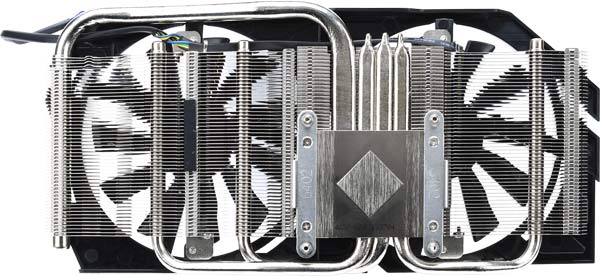
An aluminum Twin Frozr fan shroud wraps around the upper half of this graphics card, protecting the aluminum heatsink and fan blades from damage while at the same time focusing air pressure in towards the GPU. This is best illustrated in the image above, which reveals how the two 120mm PWM fans are directly over the heat-pipes and contact base. During normal operation heated air escapes from around the sides of the card, with vents in the header panel to help exhaust outside the computer case.

The MSI Radeon R9 270X GAMING graphics card measures 10.25″ long x 5.1″ wide x 1.5″ tall (260 x 129 x 38mm). Ideally, the R9 270X will be installed into a tower computer case with adequate internal cooling , but the reduced overall size lends itself to compact enclosures designed for mATX form-factor components.

The available output connectors for the MSI Radeon R9 270X GAMING graphics card include two DVI ports, one HDMI port, and one DisplayPort. The primary DVI connector is positioned closest to the board and enables 120Hz dual-link display. The secondary DVI connector is located beside the vents, and can be used for an additional display device.

MSI’s Radeon R9 270X GAMING video card requires two 6-pin PCI-E power connectors for proper operation. While AMD suggests 180W typical power consumption (maximum), our own testing indicated the R9 270X GAMING card to draw only 150W at full load.

With the Twin Frozr GPU heatsink cooler removed (illustrated below), a large aluminum head-spreader covers a portion of the printed circuit board where GDDR5 memory and power VRMs are located. This component assists in dissipating accumulated heat, and further extends the life of components such as the Hi-C CAP, SFC, and solid CAPs that already meet MIL-STDSTDSTD-810G military standard to ensure the best stability.

In the next section, we share details on the new AMD ZeroCore Power Management technology featured on MSI’s Radeon R9 270X GAMING graphics card…
Source: AMD
When a discrete GPU is in a static screen state it works to minimize idle power by enabling a host of active power saving functions including (but not limited to); clock gating, power gating, memory compression, and a host of other features. However, GPUs with AMD’s exclusive AMD ZeroCore Power technology can take energy savings to entirely new heights by completely powering down the core GPU while the rest of the system remains active.
Nearly all PCs can be configured to turn off their displays after a long period of inactivity. This is known as the long idle state; where the screen is blanked but the rest of the system remains in an active and working power state (ACPI G0/S0). As soon as the system goes into long idle state and applications are not actively changing the screen contents, the GPU enters the AMD ZeroCore power state. In the AMD ZeroCore power state, the GPU core (including the 3D engine / compute units, multimedia and audio engines, displays, memory interfaces, etc.) is completely powered down. However, one cannot simply remove the GPU and its associated device context completely; particularly when it is the only GPU in the system as is the case in many enthusiast platforms. The operating system and SBIOS must still be aware that a GPU is still present in the system. For this reason, the AMD ZeroCore Power state maintains a very small bus control block to ensure that GPU context is still visible to the operating system and SBIOS. The AMD ZeroCore power state also manages the power sequencing of the GPU to ensure that the power up/down mechanism is self-contained and independent of the rest of the system.
The enablement of the AMD ZeroCore Power feature is controlled by the driver. The driver monitors the display contents and allows the GPU to enter the AMD ZeroCore Power in the condition that the GPU enters long idle and subsequent work requests are no longer being submitted to the engine. If any applications update the screen contents, AMD ZeroCore Power technology can periodically wake the GPU to update the framebuffer contents and put the GPU back into the AMD ZeroCore Power state. Furthermore, applications such as Windows 7 desktop gadgets are architected to minimize activity and save power in the long idle state. These applications are active during screen-on mode to display dynamic content such as weather, RSS feeds, stock symbols, system status, etc. but also have the intelligence to suspend any updates and activity when the system enters long idle. These applications will not wake the GPU from the AMD ZeroCore Power state in long idle.
AMD ZeroCore Power technology delivers tremendous energy savings. Many PCs remain in the long idle state for a variety of use cases that are highly relevant to everyday consumers, enthusiasts and professionals. In AMD ZeroCore Power mode, users can still enjoy non-graphics activities such as file serving/streaming, motherboard audio and music, and remote access while the GPU core is essentially powered off.
In the next section, we detail our test methodology and give specifications for all of the benchmarks and equipment used in our testing process…
The Microsoft DirectX-11 graphics API is native to the Microsoft Windows 7 Operating System, and will be the primary O/S for our test platform. DX11 is also available as a Microsoft Update for the Windows Vista O/S, so our test results apply to both versions of the Operating System.
In each benchmark test there is one ‘cache run’ that is conducted, followed by five recorded test runs. Results are collected at each setting with the highest and lowest results discarded. The remaining three results are averaged, and displayed in the performance charts on the following pages.
A combination of synthetic and video game benchmark tests have been used in this article to illustrate relative performance among graphics solutions. Our benchmark frame rate results are not intended to represent real-world graphics performance, as this experience would change based on supporting hardware and the perception of individuals playing the video game.
- Motherboard: ASUS P9X79 Deluxe Motherboard (Intel X79 Express)
- Processor: Intel Core i7-3960X Extreme Edition (six cores/3300 MHz)
- System Memory: G.SKILL Ripjaws-Z 32GB DDR3-1600
- Power Supply Unit: OCZ Z-Series Gold 850W OCZZ850
- Monitor: Lenovo ThinkVision LT3053p IPS LED-Backlit 30″ LCD
- 3DMark11 Professional Edition by Futuremark
- Settings: Performance Level Preset, 1280×720, 1x AA, Trilinear Filtering, Tessellation level 5)
- Aliens vs Predator Benchmark 1.0
- Settings: Very High Quality, 4x AA, 16x AF, SSAO, Tessellation, Advanced Shadows
- Batman: Arkham City
- Settings: 8x AA, 16x AF, MVSS+HBAO, High Tessellation, Extreme Detail, PhysX Disabled
- BattleField 3
- Settings: Ultra Graphics Quality, FOV 90, 180-second Fraps Scene
- Lost Planet 2 Benchmark 1.0
- Settings: Benchmark B, 4x AA, Blur Off, High Shadow Detail, High Texture, High Render, High DirectX 11 Features
- Metro 2033 Benchmark
- Settings: Very-High Quality, 4x AA, 16x AF, Tessellation, PhysX Disabled
- Unigine Heaven Benchmark 3.0
- Settings: DirectX 11, High Quality, Extreme Tessellation, 16x AF, 4x AA
| Graphics Card | GeForce GTX650Ti | Radeon HD6970 | GeForce GTX580 | GeForce GTX660Ti | MSI R9 270X | Radeon HD7950 | GeForce GTX760 | GeForce GTX670 | Radeon HD7970 |
| GPU Cores | 768 | 1536 | 512 | 768 | 1280 | 1792 | 1152 | 1344 | 2048 |
| Core Clock (MHz) | 925 | 880 | 772 | 915 | 1030 | 850 | 980 | 915 | 925 |
| Shader Clock (MHz) | N/A | N/A | 1544 | 980 Boost | 1120 Boost | N/A | 1033 Boost | 980 Boost | N/A |
| Memory Clock (MHz) | 1350 | 1375 | 1002 | 1502 | 1400 | 1250 | 1502 | 1502 | 1375 |
| Memory Amount | 1024MB GDDR5 | 2048MB GDDR5 | 1536MB GDDR5 | 2048MB GDDR5 | 2048MB GDDR5 | 3072MB GDDR5 | 2048MB GDDR5 | 2048MB GDDR5 | 3072MB GDDR5 |
| Memory Interface | 128-bit | 256-bit | 384-bit | 192-bit | 256-bit | 384-bit | 256-bit | 256-bit | 384-bit |
- NVIDIA GeForce GTX 650Ti (925 MHz GPU/1350 MHz vRAM – Forceware 306.38)
- AMD Radeon HD 6970 (880 MHz GPU/1375 MHz vRAM – AMD Catalyst 13.3)
- NVIDIA GeForce GTX 580 (772 MHz GPU/1544 MHz Shader/1002 MHz vRAM – Forceware 306.23)
- NVIDIA GeForce GTX 660Ti (915 MHz GPU/980 MHz Boost/1502 MHz vRAM – Forceware 306.23)
- MSI Radeon R9 270X GAMING (1030 MHz GPU/1120 MHz Boost/1400 MHz vRAM – Catalyst 13.11)
- AMD Radeon HD 7950 (850 MHz GPU/1250 MHz vRAM – AMD Catalyst 13.9)
- NVIDIA GeForce GTX 760 (980 MHz GPU/1033 MHz Boost/1502 MHz vRAM – Forceware 320.39)
- NVIDIA GeForce GTX 670 (915 MHz GPU/980 MHz Boost/1502 MHz vRAM – Forceware 306.23)
- AMD Radeon HD 7970 (925 MHz GPU/1375 MHz vRAM – AMD Catalyst 13.9)
FutureMark 3DMark11 is the latest addition the 3DMark benchmark series built by FutureMark corporation. 3DMark11 is a PC benchmark suite designed to test the DirectX-11 graphics card performance without vendor preference. Although 3DMark11 includes the unbiased Bullet Open Source Physics Library instead of NVIDIA PhysX for the CPU/Physics tests, Benchmark Reviews concentrates on the four graphics-only tests in 3DMark11 and uses them with medium-level ‘Performance’ presets.
The ‘Performance’ level setting applies 1x multi-sample anti-aliasing and trilinear texture filtering to a 1280x720p resolution. The tessellation detail, when called upon by a test, is preset to level 5, with a maximum tessellation factor of 10. The shadow map size is limited to 5 and the shadow cascade count is set to 4, while the surface shadow sample count is at the maximum value of 16. Ambient occlusion is enabled, and preset to a quality level of 5.

- Futuremark 3DMark11 Professional Edition
- Settings: Performance Level Preset, 1280×720, 1x AA, Trilinear Filtering, Tessellation level 5)


3DMark11 Benchmark Test Results
| Graphics Card | GeForce GTX650Ti | Radeon HD6970 | GeForce GTX580 | GeForce GTX660Ti | MSI R9 270X | Radeon HD7950 | GeForce GTX760 | GeForce GTX670 | Radeon HD7970 |
| GPU Cores | 768 | 1536 | 512 | 768 | 1280 | 1792 | 1152 | 1344 | 2048 |
| Core Clock (MHz) | 925 | 880 | 772 | 915 | 1030 | 850 | 980 | 915 | 925 |
| Shader Clock (MHz) | N/A | N/A | 1544 | 980 Boost | 1120 Boost | N/A | 1033 Boost | 980 Boost | N/A |
| Memory Clock (MHz) | 1350 | 1375 | 1002 | 1502 | 1400 | 1250 | 1502 | 1502 | 1375 |
| Memory Amount | 1024MB GDDR5 | 2048MB GDDR5 | 1536MB GDDR5 | 2048MB GDDR5 | 2048MB GDDR5 | 3072MB GDDR5 | 2048MB GDDR5 | 2048MB GDDR5 | 3072MB GDDR5 |
| Memory Interface | 128-bit | 256-bit | 384-bit | 192-bit | 256-bit | 384-bit | 256-bit | 256-bit | 384-bit |
| Graphics Card | MSI R9 270X | Radeon HD 7950 | GeForce GTX 770 | Radeon HD 7970 | GeForce GTX 780 |
| GPU Cores | 1280 | 1792 | 1536 | 2048 | 2304 |
| Core Clock (MHz) | 1030 | 900 | 1046 | 925 | 863 |
| Shader Clock (MHz) | 1120 Boost | N/A | 1085 Boost | N/A | Boost 902 |
| Memory Clock (MHz) | 1400 | 1250 | 1753 | 1375 | 1502 |
| Memory Amount | 2048MB GDDR5 | 3072MB GDDR5 | 2048MB GDDR5 | 3072MB GDDR5 | 3072MB GDDR5 |
| Memory Interface | 256-bit | 384-bit | 256-bit | 384-bit | 384-bit |
BattleField 3 Benchmarks
- BattleField 3 Campaign
- Settings: 2560×1600 Resolution, Ultra Graphics Quality, FOV 90, 180-second Fraps Scene
 Battlefield 3 Benchmark Test Results
DX11: Metro 2033 Benchmarks
-
DX11: Metro 2033 Benchmark
-
Settings: 2560×1600 Resolution, Very-High Quality, 4x AA, 16x AF, Tessellation, PhysX Disabled

Metro 2033 Benchmark Test Results
- Unigine Heaven Benchmark 3.0
- Settings: 2560×1600 Resolution, DirectX 11, High Quality, Extreme Tessellation, 16x AF, 4x AA
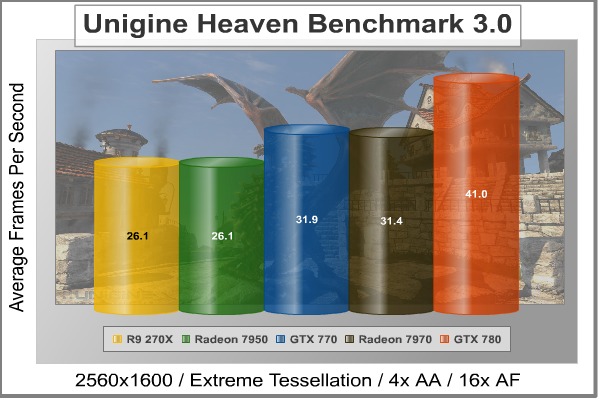 Heaven Benchmark Test Results
In this section, PCI-Express graphics cards are isolated for idle and loaded electrical power consumption. In our power consumption tests, Benchmark Reviews utilizes an 80-PLUS GOLD certified OCZ Z-Series Gold 850W PSU, model OCZZ850. This power supply unit has been tested to provide over 90% typical efficiency by Chroma System Solutions. To measure isolated video card power consumption, Benchmark Reviews uses the Kill-A-Watt EZ (model P4460) power meter made by P3 International. In this particular test, all power consumption results were verified with a second power meter for accuracy.
The power consumption statistics discussed in this section are absolute maximum values, and may not represent real-world power consumption created by video games or graphics applications.
A baseline measurement is taken without any video card installed on our test computer system, which is allowed to boot into Windows 7 and rest idle at the login screen before power consumption is recorded. Once the baseline reading has been taken, the graphics card is installed and the system is again booted into Windows and left idle at the login screen before taking the idle reading. Our final loaded power consumption reading is taken with the video card running a stress test using graphics test #4 on 3DMark11, and again with FurMark’s “Torture Test” for comparison.
This section discusses power consumption for the MSI Radeon R9 270X GAMING graphics card, model 912-V303-002 with BIOS firmware 270XG-STD.121. This product operates at factory-overclocked speeds, which means that our power consumption results are not representative of the entire Radeon R9 270X-series product family which may feature modified designs by various board partners. Radeon R9 270X requires two 6-pin PCI-E power connections for normal operation, and will not activate the display unless proper power has been supplied.
In our real-world test results indicate the MSI Radeon R9 270X GAMING graphics card consumed 12W at the lowest idle reading, and 150W during high-demand graphics from 3DMark11. Using FurMark’s “Torture Test” under full load with fan operating at 100%, power consumption increased to 230 watts. AMD suggests typical board power at 180W. If you’re familiar with electronics, it will come as no surprise that less power consumption equals less heat output as evidenced by our thermal results below…
This section reports our temperature results subjecting the video card to maximum load conditions. During each test a 20°C ambient room temperature is maintained from start to finish, as measured by digital temperature sensors located outside the computer system. GPU-Z is used to measure the temperature at idle as reported by the GPU, and also under load.
Using a modified version of FurMark’s “Torture Test” to generate maximum thermal load, peak GPU temperature is recorded in high-power 3D mode. FurMark does two things extremely well: drives the thermal output of any graphics processor much higher than any video games realistically could, and it does so with consistency every time. Furmark works great for testing the stability of a GPU as the temperature rises to the highest possible output:
| Video Card | Ambient | Idle Temp | Loaded Temp | Max Noise | ||||
| ATI Radeon HD 5850 | 20°C | 39°C | 73°C | 7/10 | ||||
| NVIDIA GeForce GTX 460 | 20°C | 26°C | 65°C | 4/10 | ||||
| AMD Radeon HD 6850 | 20°C | 42°C | 77°C | 7/10 | ||||
| AMD Radeon HD 6870 | 20°C | 39°C | 74°C | 6/10 | ||||
| ATI Radeon HD 5870 | 20°C | 33°C | 78°C | 7/10 | ||||
| NVIDIA GeForce GTX 560 Ti | 20°C | 27°C | 78°C | 5/10 | ||||
| NVIDIA GeForce GTX 570 | 20°C | 32°C | 82°C | 7/10 | ||||
| ATI Radeon HD 6970 | 20°C | 35°C | 81°C | 6/10 | ||||
| NVIDIA GeForce GTX 580 | 20°C | 32°C | 70°C | 6/10 | ||||
| NVIDIA GeForce GTX 590 | 20°C | 33°C | 77°C | 6/10 | ||||
| AMD Radeon HD 6990 | 20°C | 40°C | 84°C | 8/10 | ||||
| NVIDIA GeForce GTX 650 Ti BOOST | 20°C | 26°C | 73°C | 4/10 | ||||
| NVIDIA GeForce GTX 650 Ti | 20°C | 26°C | 62°C | 3/10 | ||||
| NVIDIA GeForce GTX 670 | 20°C | 26°C | 71°C | 3/10 | ||||
| NVIDIA GeForce GTX 680 | 20°C | 26°C | 75°C | 3/10 | ||||
| NVIDIA GeForce GTX 690 | 20°C | 30°C | 81°C | 4/10 | ||||
| NVIDIA GeForce GTX 670 | 20°C | 27°C | 79°C | 3/10 | ||||
| NVIDIA GeForce GTX 770 | 20°C | 27°C | 78°C | 3/10 | ||||
| MSI Radeon R9 270X GAMING | 20°C | 27°C | 80°C | 5/10 | ||||
| NVIDIA GeForce GTX 780 | 20°C | 28°C | 80°C | 3/10 |
Everything that consumes electricity produces heat, so while power consumption for Radeon R9 270X is relatively tame it could still benefit from an improved thermal management system. This is exactly what was done with the MSI R9 270X GAMING video card. Utilizing their own Twin Frozr dual-fan design with large aluminum GPU heatsink, temperatures reached 80°C after ten minutes of 100% load, which is really not much of a peak temperature by comparison. Idle temperatures were nearly stone-cold and remained at a cool 27°C.
The temperatures discussed in this section are relative maximum values, and may not represent real-world temperatures created by video games or graphics applications. Your results may vary depending on ambient room temperature and firmware revision.
IMPORTANT: Although the rating and final score mentioned in this conclusion are made to be as objective as possible, be advised that every author perceives these factors differently. While we each do our best to ensure that all aspects of the product are considered, there are often times unforeseen market conditions and manufacturer revisions that occur after publication which could render our rating obsolete. Please do not base any purchase solely on this conclusion, as it represents our rating specifically for the product tested which may differ from future versions. Benchmark Reviews begins our conclusion with a short summary for each of the areas that we rate.
My ratings begin with performance, where the $199 MSI Radeon R9 270X GAMING 2GD5 graphics card competes with NVIDIA’s GeForce GTX 660 base model (according to AMD) that currently costs $179. While the name is very similar, the GeForce GTX 660 Ti and GTX 660 TI Boost each have twice as many CUDA cores as the standard GTX 660, and start around $249. This ultimately places the Radeon R9 270X in-between GTX 660 and GTX 660 Ti, at least in terms of price.
In DirectX 11 tests the MSI R9 270X GAMING usually outperformed the GeForce GTX 660 Ti, and easily surpassed the GeForce GTX 580 and AMD Radeon HD 6970 in our benchmarks. Ultra-demanding DX11 games such as Batman: Arkham Asylum produced 79 FPS from this factory-overclocked R9 270X, which outperformed the GTX 660 Ti’s 60 FPS while closing in on the Radeon HD 7950’s generated 87 FPS. Battlefield 3 actually gave the MSI R9 270X GAMING a small 1-FPS lead over the Radeon HD 7950 when Ultra quality settings were used, and got within 4-FPS of GTX 760. Lost Planet 2 played well on all graphics cards when set to high quality with 4x AA, but was a test anomaly that forced the MSI R9 270X GAMING to trail behind the GTX 660 Ti by 15-FPS. In Aliens vs Predator the performance was more competitive, with R9 270X GAMING ahead by 11-FPS over GTX 660 Ti while trailing Radeon HD 7950 by 7-FPS. Metro 2033 is another demanding game that requires high-end graphics to enjoy high quality visual settings, and the MSI R9 270X GAMING used its factory overclock to outpace GeForce GTX 660 Ti by 6-FPS while trailing the 7950 by only 3-FPS.
Synthetic benchmark tools offer an unbiased read on graphics products, allowing video card manufacturers to display their performance without special game optimizations or driver influence. Futuremark’s 3DMark11 benchmark suite strained our high-end graphics cards with only mid-level settings displayed at 720p, allowing the MSI R9 270X GAMING to build a slight lead over the GeForce GTX 660 Ti, and usually enough power to outperform the upper-class Radeon HD 7950. Unigine Heaven 3.0 benchmark tests used maximum settings that tend to crush most products, yet the MSI R9 270X GAMING still beat the GeForce GTX 660 Ti by 5-FPS while matching the Radeon HD 7950.

Appearance is a much more subjective matter, especially since this particular rating doesn’t have any quantitative benchmark scores to fall back on. AMD’s Radeon HD series has traditionally used the same recognizable ‘black and red brick’ design over the past few years, which tends to dull consumer appeal. MSI breathes new life into this aging look with their Twin Frozr twin-fan cooler and Gaming Series-branded fan shroud. Unfortunately this modified design exhausts most of the heated air back inside the computer case, which may increase operating temperatures on less-ventilated enclosures. Fashionably good looks could earn points with some consumers, but it’s the card’s low heat output and quiet operation that should leave the biggest impression.
Nobody enjoys returning their video card for service because it usually means going without use of the computer, but thankfully construction is the one area MSI graphics cards continually shine. Thanks to extremely cool operation paired with highly efficient GPU cores, the MSI Radeon R9 270X GAMING 2GD5 consumes less energy while emitting less heat. The card requires two 6-pin PCI-E power connections, which are available on practically every mainstream power supply unit. This series offers support for DirectX 11.2, and comes ready for Ultra-HD 4K screen resolutions. Additionally, consumers can have a high-performance single-GPU solution capable of driving three monitors with AMD HD3D support using the two DL-DVI ports with supplementary DisplayPort outputs.
As of October 2013, the MSI Radeon R9 270X GAMING 2GD5 graphics card hits the retail market for $199 (Amazon / NewEgg). This is $49 less than the GeForce GTX 660 Ti that it outperforms on every benchmark, proving itself worthy of value-seeking mainstream gamers. A three-year product warranty ensures that their money doesn’t go to waste if something breaks.
My conclusion: the MSI Radeon R9 270X GAMING 2GD5 graphics card (model 912-V303-002) runs cool under full load and seems ideal for standalone installation for mainstream gaming, but CrossFire sets are also entirely possible inside larger enclosures with above-average ventilation and cooling. For under $200, you’re getting plenty of bang for the buck.
+ Outperforms GeForce GTX 660 Ti
+ DirectX 11.2 ready
+ Supports CrossFireX and DisplayPort output
+ Triple-display and AMD HD3D support
+ Twin Frozr keeps GPU very cool
+ Relatively low power consumption under full load
+ 2GB GDDR5 video RAM
+ UltraHD 4K display support
– Heated exhaust is circulated back into enclosure
– Shorter warranty period than others offer
-
Performance: 9.00
-
Appearance: 9.25
-
Construction: 9.50
-
Functionality: 9.00
-
Value: 8.00
Quality Recognition: Benchmark Reviews Silver Tachometer Award.
COMMENT QUESTION: How much are you willing to spend on a graphics card?


