By Julian Duque
Manufacturer: SilverStone Technology Co.
Product Name: Tundra TD03-E All-In-One CPU Cooler
Model Number: SST-TD03-E
UPC: 4710007221754
Price As Tested: $86.99 ( Newegg l Amazon)
Full Disclosure: The product sample used in this article has been provided by SilverStone.
Summer is approaching us, and with temperatures expecting to get hot it means that Benchmark Reviews is evaluating what CPU cooler manufacturers are bringing forward in 2015. In this article, the spotlight will be on the newest SilverStone Cooler, the Tundra TD03-E, the successor of the TD03, and the smaller brother of the TD02-E. As expected from any SilverStone product, expectations are quite high, even if this is merely the first update to SilverStone’s Tundra series, which made it’s debut back in 2013.
SilverStone is mostly known for being a very innovative company. As expected, most of their products have patents, and they continue to appear every time they release a new product. This time, SilverStone has added two features to the Tundra series that set them apart from other coolers. First is the all metal construction of the copper base which has no screws for superior reliability. Second is the premium soldered heatsink fin array in the radiators which should provide a higher heat transfer with fins touching all sides of the liquid piping flowing through the radiator.

Courtesy of SilverStonetek.com.
| Water block | Dimension | 60mm (L) x 55mm (W) x 33.5mm (H) |
| Material | Copper base with nickel-plated aluminum unibody | |
| Pump | Motor speed | 2500±200RPM |
| Rated Voltage | 12V | |
| Rated Current | 0.28A | |
| Fan | Dimension | 120mm (L) x 120mm (W) x 25mm (D) |
| Speed | 1500~2500RPM | |
| Noise level | 18~35 dBA | |
| Rated Voltage | 12V | |
| Rated Current | 0.3A | |
| Max airflow | 92.5CFM | |
| Pressure | 3.5mm/H2O | |
| Connector | 4 Pin PWM | |
| Radiator | Dimension | 159mm (L) x 124mm (W) x 27mm (H) |
| Material | Aluminum | |
| Tube | Length | 310mm |
| Material | Rubber | |
| Application | Intel Socket LGA775/1150/1155/1156/1366/2011/2011-v3 AMD Socket AM2/AM3/FM1/FM2 |
|
| Net Weight | 1063g | |
There are several misconceptions when it comes to the ordeal of choosing a cooler for your processor. It is true that Water-Cooling may yield better cooling results, mostly due to water’s higher thermal conductivity when compared to the ethanol and ammonia mixture found in most heat-pipes based coolers. But that does not mean that air coolers should not be considered as an option for enthusiasts. Unlike water-coolers, air-coolers do not need a pump, and can be “Passively Cooled” for quieter operation. Although pumps have become more silent and reliable, they should still be considered as another moving part inside your system that may be subject to failure, as well as being a source of noise. Another important factor to take into consideration when choosing the right CPU cooler is compatibility, Most heatsinks require certain parameters to be met including the CPU cooler height limit of your case, and motherboard clearance compatibility. In contrast, water-coolers only require a place to mount the radiator inside your case, as most CPU blocks are small enough to not interfere with important components near the CPU socket.
As usual with any of our cooler reviews, we first look at the aesthetical characteristics of the unit itself. The Tundra TD03-E, like most SilverStone products, comes well packaged. I usually avoid talking about a product’s packaging, but SilverStone definitely deserves a worthy mention, since a well packaged item can be a sign of a great product. We are on for a good start with this one.

Included with the SilverStone Tundra TD03 are two 120 mm PWM fans, a 4-pin Y-splitter, a 4 pin to molex power adapter, thermal paste, the necessary screws to mount the cooler on most Intel and AMD sockets of the last decade, and an instruction manual.
Tubing measurements of the Tundra TD03-E are average. At 310 mm, they are shorter than the Cooler Master Nepton 120XL, but longer than those of both the Corsair H80 and H80i. The tubes’ rubber construction allow it to be easily flexed without kinking. The tubes are attached to the side of the cooler’s block using 90 degree swivel barbs which should avoid any kinks near the block.
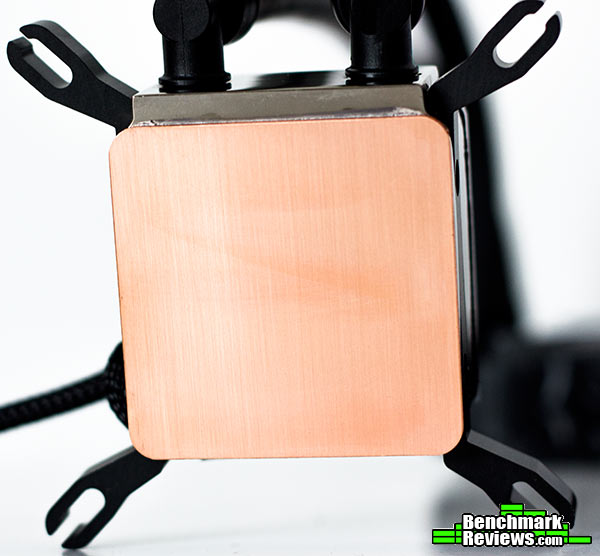
At the bottom of the head unit we find a copper based cold plate with no screws, which should in theory allow for thermal paste to sit more evenly between the block and the processor. There are no major deviations or seams, however the base could benefit from being polished.Aside from the base, the base of the cooler is made with an aluminum uni-body, with a nickle plated exterior for a more stylish look.

Like the body of the pump, the radiator is also constructed using aluminum. The radiator measures 159mm (L) x 124mm (W) x 27mm (H), which is fairly standard for a 120 mm radiator. Unlike other radiators were the fins are stacked in a grooved pattern, the fins in this radiator are completely flat, perpendicular to the water channels on the radiator. SilverStone claims that this allows for better cooling by allowing the fins to touch all sides of the piping.

Adorning the side of the radiator, is a carbon fiber pattern covered by a plastic cover which should protect the radiator from scratches. The radiator also has appropriate spacing between the fins and the screw hole points to prevent the fins from being bent. SilverStone also added some noise-dampening material in the screw joints to prevent rattling from occurring. These small features are greatly appreciated, and come at no surprise from a company like SilverStone.
Before we inspect each member of our new CPU cooler collection, let’s establish that our tests consist of methods we have determined to be the best for our one singular purpose. Our methodology isn’t written in stone, and could very likely be changed or modified as we receive justification (and feedback from the community). Our scope is limited to stand-alone products only, meaning those products which can be installed and operated without additional critical components needed or kit construction. This is the reason for this first test, in which the mounting system for each cooler is tested. Since this is not an apple to apples comparison, but rather a subjective description of each of the kits available without any form of quantitative data, it does not affect the numerical scores we give for each product. The purpose of this test is to inform our readers on how the mounting system of each processor cooler can affect the buying experience.
As usual, we will mount the cooler in one of our Intel test platforms. This time, we will be using an XFX MB-N780-ISH9 LGA 775 motherboard to test the mounting system included with the SilverStone Tundra TD03-E, which SilverStone lists as one of the supported sockets.

Installing the SilverStone TD03-E starts with locating the four silver screws and the back-plate. Unfortunately SilverStone does not individually package each of the mounting kit components, which can lead to confusion between components. Included in the components is also a spacer for the LGA 775 socket which helps to prevent the solder points located at the back of the socket from making contact with the back-plate itself.

Now this is were it all falls apart for the TD03-E’s mounting system. SilverStone;s choice of spacers between the socket and the screw points for the block do not hold the backplate in place. This means that in order to install the cooler on a motherboard, you will need to remove the motherboard from the case, or have a second person help you to hold the pins in place when pushing them through the retention bracket.

With the retention bracket in place, it is all just a matter of adjusting the included thumb screws and connecting the three pin fan plug which is in charge of powering the pump and the LED inside the block.
With the cooler installed, it is time to look at some numbers.
Benchmark Reviews is always looking to improve our testing methodology over the past few years. We have always solicited suggestions from the enthusiast community, and received guidance from the experts in this field. This particular time we will be using a fresh testing methodology. Benchmark Reviews continues to test CPU coolers using the stock included fan and thermal interface material (whenever applicable), and then replace it with a high-output fan and aftermarket TIM.
Manufacturers are not expected to enjoy this sort of comparison, since we level the playing field for all coolers by replacing their included fan and TIM with common units which are then used for every CPU cooler tested. Many manufacturers include fans with their heatsink products, but most ‘stock’ fans are high-RPM units that offer great airflow at the expense of obnoxiously loud noise levels. By using the same model of cooling fan and TIM throughout our second test, we can assure our results are comparable across the board. This is one of the more significant changes we have made to our test methodology, since many of the benchmark tests we have conducted in the past have compared the total package. Ultimately we’re more interested in the discovering the best possible cooler, and we believe that you’ll feel the same way.
-
Motherboard: Asus Gryphon Z87 Motherboard
-
Processor: Intel Core I5 4670k
-
Enclosure: Phanteks Enthoo Mini XL
-
Operating System: Windows 7 Professional.
Testing was conducted in a loosely scientific manner. Ambient room temperature levels were maintained within one degree of fluctuation, and measured at all times throughout testing. The processor received the same amount of thermal paste in every test, which covered the ICH with a thin nearly-transparent layer. The cooler being tested was then laid down flat onto the CPU, and compressed to the motherboard using the supplied retaining mechanism. If the mounting mechanism used only two point of force, they were tightened in alternation; standard clip-style mounting with four securing points were compressed using the cross-over method. Once installed, the system was tested for a baseline reading prior to testing.
At the start of each test, the ambient room temperature was measured to track any fluctuation throughout the testing period using Asus AI Suite and two of the included temperature sensors located at the front intake of our test system. Aida 64 Engineer was utilized to create 100% CPU-core loads and measure each individual processor core temperatures. It’s important to note that software-based temperature reading reflects the thermal output as reported from the CPU to the BIOS. For this reason, it is critically important (for us) to use the exact same software and BIOS versions throughout the entire test cycle, or the results will be incomparable. All of the units compared in our results were tested on the same motherboard using the same BIOS and software, with only the CPU-cooler product changing in each test. These readings are neither absolute nor calibrated, since every BIOS is programmed differently. Nevertheless, all results are still comparable and relative to each products in our test bed (see The Accuracy Myth section below).
All test results utilize Aida 64 Engineer to report core temperature averages (within the statistics panel), which gives us more precise readings. To further compensate for this, our tests were conducted several times after complete power down thermal cycles. Conversely, the ambient room temperature levels were all recorded and accurate to one-tenth of a degree Celsius at the time of data collection.
All modern processors incorporate an internal thermal diode that can be read by the motherboards’ BIOS. While this diode and the motherboard are not calibrated and therefore may not display the actual true temperature, the degree of accuracy is constant. This means that if the diode reports 40°C when it’s actually 43°C, then it will also report 60°C when it’s truly 63°C. Since the design goal of any thermal solution is to keep the CPU core within allowable temperatures, a processor’s internal diode is the most valid means of comparison between different heatsinks, or thermal compounds. The diode and motherboard may be incorrect by a small margin in relation to an actual calibrated temperature sensor, but they will be consistent in their margin of error every time.
Our first CPU Cooler Performance Test takes use of the included TIM and fans included with each CPU cooler. The SilverStone Tundra TD03-E includes two fans for a push pull setup, and a small tube of SilverStone branded TIM which can be reused for multiple installations. The purpose of this test is NOT to prove which cooler is better, but rather to give our readers an expectation of what to expect from each cooler using the stock fans and TIM.

| Dimension | 120mm (L) x 120mm (W) x 25mm (D) |
| Speed | 1500~2500RPM |
| Noise level | 18~35 dBA |
| Rated Voltage | 12V |
| Rated Current | 0.3A |
| Max airflow | 92.5CFM |
| Pressure | 3.5mm/H2O |
| Connector | 4 Pin PWM |
In our first test, the SilverStone TD03-E impresses by keeping up and even beating the Raijintek Triton using the stock fans. The SilverStone TD03-E managed to keep an average temperature of 50o throughout the entirety of the test. A measurement that is more than adequate for our I5 4670k at stock clocks. It should be noted the included SilverStone fans managed to reach 2300 rpm. Only the smaller fan from the Noctua’s NH-L9x65 managed to spin faster.

Under heavier temperatures, we start to see the SilverStone TD03-E depart from the top spot in our test. The TD02-E which features a bigger radiator, benefits greatly from having a larger surface area to displace the heat produced by the processor. However, averaging around 57o C the TD03-E still managed to pass this test with flying colors by beating other important names.
It’s time for our second and most important test. In this test we look to compare each cooler side by side by eliminating all the variables that may hamper our results. This means using our choice of fans and TIM throughout the entirety of this test. Buyers may benefit from buying custom fans and TIM by gaining performance, as well as by reducing the noise coming from the high RPM fans included with most cooling units. Our choice of TIM is Prolimatech PRO-PK3-5G which is an aluminum based solution that does not require any burn in time to reach peak performance.
Our choice of fans include the Yate-Loon D12SM-12 120 mm and D14SM-12 140 mm fans. Yate-Loons are mostly known for their quiet operation, and very low price. They are also very common among power supply fans, and are well known for the many re branded versions available from different companies.
| Model #: | D12SM-12 | D14SM-12 |
|---|---|---|
| Dimensions: | 120 x 120 x 20 mm | 140 x 140 x 20 mm |
| Air Flow Max.: | 70.5 CFM | 62.0 CFM |
| Noise Level Max.: | 33 dBA | 29 dBA |
| Fan Speed: | 1650 RPM ± 10% | 1400 RPM ± 10% |
| Rated Voltage: | 12 V DC | 12 V DC |
| Input current Max.: | 0.30 Amps | 0.70 Amps |

The stock performance of the SilverStone TD03-E is right on par with most 120 mm All-In-Ones. It manages to beat the all mighty Cooler Master Hyper 212 Evo and comes close to beating the bulky Cryorig R1 Ultimate.This comes as no surprise, as we don’t expect such a small cooler to outperform the beasts in the market. As more coolers are released throughout 2015 we will continue to update this chart.

Our overclocked temperature measurements further increase the gap between the SilverStone TD03-E and other coolers. Both the SilverStone TD03-E and TD02-E are greatly affected by a lack of airflow, however this can be interpreted as both the SilverStone TD03-E and TD02-E response greatly to an increased airflow. This can be clearly seen with the stock fans, which happened to have a higher CFM rating than the Yate-Loons we are using for test 2. Using the included fans, temperatures dropped by 4 degrees. But how much louder were they?
As per request from many members of the enthusiast community, Benchmark Reviews has added noise measurements to our CPU cooler testing methodology. Each test is conducted in a noise isolated room, during the night time to avoid any minor disturbances caused by normal daytime activities near our location. Our base ambient temperature was measured at 15 dB, for each of our tests. Noise was measured using a Brüel & Kjær type 2225 sound level meter located at 1 meter from the fan/fans. Fans were placed so that the axis of rotation of the fan is perpendicular to our line of measurement. For our dual fan noise measurements, fans were placed in series (facing each other) with a 10 cm gap between them. All fans were tested at 12 Volts.
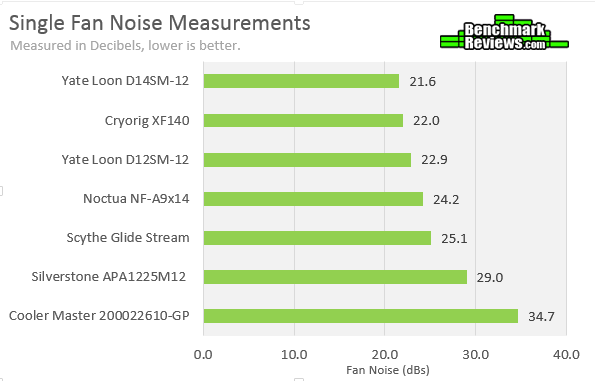
The fans included with both the SilverStone TD03-E and TD02-E have the model number APA1225M12. Unfortunately, SilverStone has not released this same model as a standalone item, and there is very little information about this model online. However, it is clear that they are loud, really loud, coming in as the second loudest fans in our single fan measurements. It should be noted that the Raijintek Boreas included with the Raijintek Triton were not included, as they are powered by the same 3-pin header and can only be run in dual fan configurations.
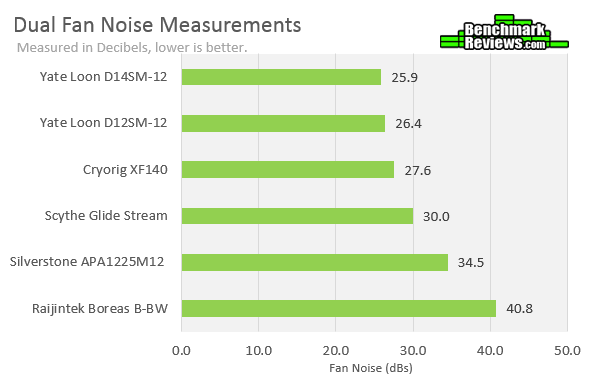
At the moment of writing this review, we only had one Cooler Master Hyper 212 Evo OEM fan. However between the SilverStone APA1225M12, and the Raijintek Boreas there is little to be said. After the 30 dB mark, noise levels are almost unbearable, to the point were the Raijintek Boreas B-BW fans are as loud as a small vacuum. I hope that by know, It is clear why the Yate Loon D12SM and D14SM are extremely common among the enthusiast community.
My final opinion on the SilverStone TD03-E is fairly positive. It performs as expected and although we cant test for reliability, it shows the usual quality and attention to detail of any SilverStone product. But there are still some things that SilverStone could work upon to make the buying experience more positive. Starting with the mounting mechanism, which feels outdated and is difficult to install, SilverStone should include a better retention mechanism for the back-plate, which easily fell if not being held from behind. There should also be an LED turn off switch, in order to match the color scheme of buyers.

The performance of the SilverStone Tundra TD03-E is right on the expectation level of most 120 mm all in one coolers. Using the included fans and TIM, it managed to beat some of the 240 mm water-coolers on our first test. In our second test, the TD03-E still passed our Aida64 Stability Test with flying colors, although average temperatures increased by 4 degrees when compared to the stock fan and TIM configuration.
It can almost be proved that I am biased towards SilverStone’s choices of design, but then again, beauty is very subjective and can change from person to person. The SilverStone TD03-E follows SilverStone’s design philosophy with a glossy black finish on the block surrounded by a nickle plated cover at the bottom. The radiator has carbon fiber accents along the side, which is a really nice addition. My only complaint is the blue LED located on top of the block, which unfortunately can not be turned off.
Unfortunately, it is impossible for us to test the reliability of most of the products we review. However, the TD03-E shows some very positive signs when it comes to it’s overall construction. The mounting mechanism is sturdy and showed no signs of flex, it also included the appropriate washers to prevent damage to the motherboard mounting holes in our mounting test. The radiator has the appropriate spacing between the screw joints and the fins to prevent the fins from being damaged. The copper base plate has no screws which should in fact prevent leaks from occurring at the bottom of the plate.
Is the SilverStone TD03-E functional? Like most all-in-one coolers nowadays, the TD03-E comes pre-filled and ready to be used out of the box. There are no complicated steps or problems that should prevent amateur builders from buying the SilverStone TD03-E.
Our last score pertains to the value of the product at hand. The SilverStone TD03-E is priced at $86.99 ( Newegg l Amazon) which is a fairly steep price for a 120 mm water-cooler. However, you do get a product with the uppermost quality backed by a 5 year warranty and SilverStone’s great customer support.
+ Two PWM 120 mm fans included.
+ Stylish design.
+ Above average performance.
+ 5 Year Warranty.
– Mounting mechanism could use some improvement.
– Expensive for a 120 mm AIO.
-
Performance: 8.5
-
Appearance: 9.50
-
Construction: 9.50
-
Functionality: 9.00
-
Value: 7.50