By Jason Maxfield
Manufacturer: Reeven LLC
Product Name: NAIA 240 Advanced AIO Liquid Cooler With Coolant Dye
Model Number: RW-2401
UPC: 840636100169 EAN: 4717011050165
Price As Tested: $111.95 (Amazon)Full Disclosure: The product sample used in this article has been provided by Reeven
Reeven is a company based out of Taiwan, that was founded by a group of engineers back in 2009. Reeven isn’t a name that I’m familiar with, personally, but I have a feeling they will be making a big impression with the Naia 240 AIO liquid cooler.
In this article for Benchmark Reviews, we have Reeven’s Naia 240 AIO Liquid Cooler up for review (model RW-2401). Reeven manufactures a variety of air coolers, fans, cases, and a few other things, but this is their first foray into the all-in-one liquid cooler segment. From the looks of things, Reeven is off to a great start with this AIO unit.
Reeven has done some interesting things with the Naia 240. First, we have LED lighting. The lighting is just a simple white LED, but you do have included dyes to customize the color to your liking. Secondly, and probably the coolest feature of this AIO cooler is the ability to re-fill the unit. While this may not be anything new to custom loops, it is not very common with sealed AIO coolers, and in my opinion, a very welcome feature!
In this article for Benchmark Reviews, I’ll be comparing the Reeven Naia 240 against the stock Wraith Spire cooler, and a SilverStone TD-02 Slim cooler that I reviewed in November 2015. How will the Naia 240 stack up? Let’s find out!

| Model Number: | RW-2401 |
| Socket: | INTEL: LGA 115x / 1366 / 2011(V3) AMD: AM2(+) / AM3(+) / AM4 / FM1 / FM2(+) |
| Overall Dimension: | (W)2,720 x (H)52 x (D)120 mm (with fan) |
| Fan Dimension: | 120 x 120 x 25 mm |
| Fan Speed: | 300(+300/-100)~1600(±10%) RPM |
| Air Flow: | 6.93~90.28 CFM |
| Static Pressure: | 0.003~0.08 inch H₂O |
| Noise Level: | 6.5~30.9 dBA |
| Weight (with Fan): | 1,290g |
| UPC Code: | 840636100169 |
| EAN Code: | 4717011050165 |
Product specifications taken from Reeven’s website.
Next we’ll take a look at the Reeven Naia 240 and see what’s inside the box!
The REEVEN NAIA 240 Advanced AIO Liquid Cooler With Coolant Dye kit, model RW-2401, is presently available online for $111.95 (Amazon). Below is a shot of the box the Reeven Naia 240 AIO cooler comes in.

Reeven has packed the Naia 240 very well. They even wrapped the radiator in a cardboard sleeve for further protection of the thin aluminum fins in the radiator.

Below we have the manual, and installation guide for your Intel or AMD based CPU. The parts box includes all the mounting screws and brackets, as well as the 24 pin power plug to run your pump before installation. Also included is 3 sets of dye, red, blue, and green to make custom colors, if you so wish.
Included is a Y-adapter for the fans if you do not have CPU and CPU_OPT headers on your motherboard. And lastly, we have enough fluid to refill your Naia 240, which can be changed anytime, using the drain cap located on the back of the radiator.

Here is a look at the radiator and ribbed hosing of the Naia 240. The hose is very flexible. The overall diameter feels a bit smaller than my SilverStone TD-02 Slim cooler and feels more plastic-y than rubber. Hopefully this won’t be a point of possible degradation and failure after many heat cycles are put through the radiator.
Other than that, it’s a pretty standard radiator. It is 27mm thick, and has a drain cap on the end of it, for changing out the coolant.

On the next page we’ll get into some of the detailed features of the Reeven Naia 240 AIO cooler.
Now we’ll get into some detailed features of the Reeven Naia 240.
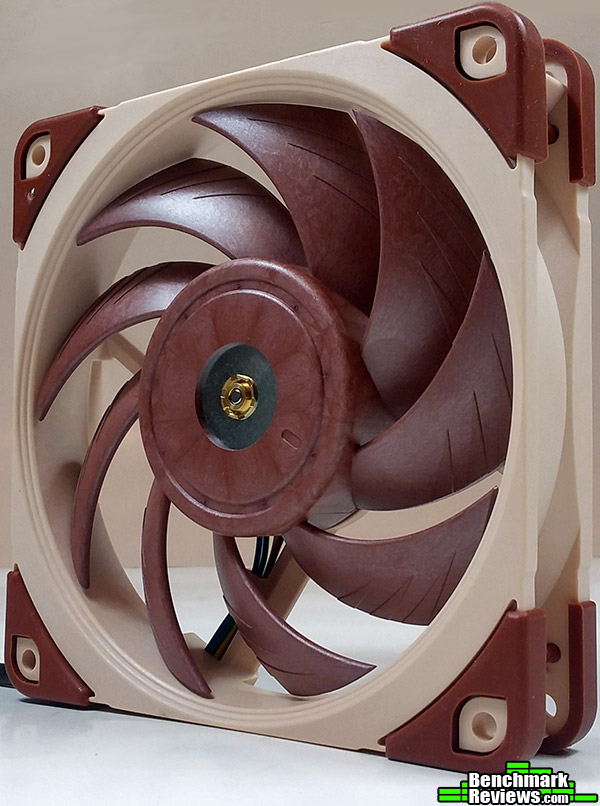
Below is a picture of the included 120mm fans. They are an 11 blade design and can go from as little as 300 RPM to 1600 RPM at 100% power (±10%).
The fans are decently quiet during normal operation and even full blast at 100% they are audible but not to the point of annoyance. Granted this is a very subjective statement, what might be tolerable to some is not to others.

I took this next shot with the pump powered on with the use of the included 24 pin power connector that has a pig-tail fan header to attach the pump. This is a great idea, and allows you to test the pump and radiator for leaks. Reeven recommends doing this for at least 30 minutes. I did this for several hours while I watched some TV, just to be sure there wasn’t any leaks.
Also, you get a look at the reservoir cap. This cap can be removed to allow you to refill the unit with the supplied coolant, or to add colors. Reeven suggests only adding color after you have drained the fluid to about 30% level in the reservoir.
I did add some color before installing and testing in it my PC, which I’ll go over later in the Testing and Results page of this article.

Below is a picture of the drain cap. This is where you drain the fluid from the Naia 240 when it’s time to clean it out and re-fill it. I haven’t tested it out myself, but I’ll assume it’ll work just fine.

Here is a shot of the mounting bracket. It’s made of plastic, which has me concerned for longevity, but it’s reinforced and pretty thick. It should hold up fairly well.
Also, the LED lighting is white. It comes out with a bluish tinge when photographed, but it is white when you haven’t added any dye to the coolant. Also, I realized after taking the pictures that there is a plastic film over the Reeven logo on top of the pump. It appears to be brushed aluminum and looks really cool once the plastic film is removed. I have pictures of it in the testing and results section of this article with the film removed.

Next, we’ll go into CPU cooler preparation of all the coolers used in this article.
It bears repeating here that no heat-sink will work effectively unless it transfers heat from the CPU. To do that, it needs to be in contact with the CPU heat spreader or die, with the greater the contact surface the greater the potential for heat transfer. One of our own writers here at Benchmark Reviews has done a lot of work in this area, and it is certainly worth the time it takes to read (and re-read) the discoveries he made during the famous 80+ thermal paste tests (I still see Newegg reviews reference the discoveries made therein).
I mention this because I still see this as a major source of misinformation – most end users will use far too much thermal interface material when switching CPU coolers. Possibly through little fault of their own – I’ve read official repair manuals stating to use the entire tube of thermal paste when replacing a CPU and heat-sink. This is, in almost every case, FAR too much – to the point of being harmful in most cases. So do yourself a favor and get acquainted with CPU Cooler Preparations and Thermal Paste Application.
Processor and CPU cooler surfaces are not perfectly smooth and flat surfaces, and although some surfaces appear polished to the naked eye, under a microscope the imperfections become clearly visible. As a result, when two objects are pressed together, contact is only made between a finite number of points separated by relatively large gaps. Since the actual contact area is reduced by these gaps, they create additional resistance for the transfer of thermal energy (heat). The gasses/fluids filling these gaps may largely influence the total heat flow across the surface, and then have an adverse affect on cooling performance as a result.
The only reason for using Thermal Interface Material is to compensate for flaws in the surface and a lack of high-pressure contact between heat source and cooler, so the sections above are more critical to good performance than the application of TIM itself. This section offers a condensed version of our Best Thermal Paste Application Methods article.
After publishing our Thermal Interface Material articles, many enthusiasts argued that by spreading out the TIM with a latex glove (or finger cover) was not the best way to distribute the interface material. Most answers from both the professional reviewer industry as well as enthusiast community claim that you should use a single drop “about the size of a pea”. If there was ever any real advice that applies to every situation, it would be that thermal paste isn’t meant to separate the two surfaces but rather fill the microscopic pits where metal to metal contact isn’t possible.
After discussing this topic with real industry experts who are much more informed of the process, they offered some specific advice that didn’t appear to be a “one size fits all” answer:
- CPU Cooling products which operate below the ambient room temperature (some Peltier and Thermo-electric coolers for example) should not use silicon-based materials because condensation may occur and accelerate compound separation.
- All “white” style TIM’s exhibit compound breakdown over time due to their thin viscosity and ceramic base (usually beryllium oxide, aluminum nitride and oxide, zinc oxide, and silicon dioxide). These interface materials should not be used from older “stale” stock without first mixing the material very well.
- Thicker carbon and metal-based (usually aluminum-oxide) TIM’s may benefit from several thermal cycles to establish a “cure” period which allows expanding and contracting surfaces to smooth out any inconsistencies and further level the material.
The more we researched this subject, the more we discovered that because there are so many different cooling solutions on the market it becomes impossible to give generalized advice to specific situations. Despite this, there is one single principle that holds true in every condition: Under perfect conditions the contact surfaces between the processor and cooler would be perfectly flat and not contain any microscopic pits, which would allow direct contact of metal on metal without any need for Thermal Interface Material. But since we don’t have perfectly flat surfaces, Thermal Material must fill the tiny imperfections. Still, there’s one rule to recognize: less is more.
CPU coolers primarily depend on two heat transfer methods: conduction and convection. This being the case, we’ll concentrate our attention towards the topic of conduction as it relates to the mating surfaces between a heat source (the processor) and cooler. Because of their density, metals are the best conductors of thermal energy. As density decreases so does conduction, which relegates fluids to be naturally less conductive. So ideally the less fluid between metals, the better heat will transfer between them. Even less conductive than fluid is air, which then also means that you want even less of this between surfaces than fluid. Ultimately, the perfectly flat and well-polished surface is going to be preferred over the rougher and less even surface which required more TIM (fluid) to fill the gaps.
This is important to keep in mind, as the mounting surface of your average processor is relatively flat and smooth but not perfect. Even more important is the surface of your particular CPU cooler, which might range from a polished mirror finish to the absurdly rough or the more complex (such as Heat-Pipe Direct Touch). Surfaces with a mirror finish can always be shined up a little brighter, and rough surfaces can be wet-sanded (lapped) down smooth and later polished, but Heat-pipe Direct Touch coolers require some extra attention.
To sum up this topic of surface finish and its impact on cooling, science teaches us that a smooth flat mating surface is the most ideal for CPU coolers. It is critically important to remove the presence of air from between the surfaces, and that using only enough Thermal Interface Material to fill-in the rough surface pits is going to provide the best results. In a perfect environment, your processor would mate together with the cooler and compress metal on metal with no thermal paste at all; but we don’t live in perfect world and current manufacturing technology cannot provide for this ideal environment.
Probably one of the most overlooked and disregarded factors involved with properly mounting the cooler onto any processor is the amount of contact pressure applied between the mating surfaces. Compression will often times reduce the amount of thermal compound needed between the cooler and processor, and allow a much larger metal to metal contact area which is more efficient than having fluid weaken the thermal conductance. The greater the contact pressure between elements, the better it will conduct thermal (heat) energy.
Unfortunately, it is often times not possible to get optimal pressure onto the CPU simply because of poor mounting designs used by the cooler manufacturers. Most enthusiasts shriek at the thought of using the push-pin style clips found on Intel’s stock thermal cooling solutions. Although this mounting system is acceptable for casually-used computers, there is still plenty of room for improvement when overclocking.
Generally speaking, you do not want an excessive amount of pressure onto the processor as damage may result. In some cases, such as Heat-pipe Direct Touch technology, the exposed copper rod has been pressed into the metal mounting base and then leveled flat by a grinder. Because of the copper rod walls are made considerably thinner by this process, using a bolt-through mounting system could actually cause heat-pipe rod warping. Improper installation not withstanding, it is more ideal to have a very strong mounting system such as those which use a back plate behind the motherboard and a spring-loaded fastening system for tightening.
Next page we move along to the testing and results!
The CPU tested was mounted in a Thermaltake V51 case. The case was in it’s normal upright orientation and case doors were fully closed during testing. There are two 140mm front intake fans, and one 140mm exhaust fan, as well as an addition 120mm intake fan above the VRMs of the motherboard in the top of the case.
The front 140mm fans are running from a 7v input so there is no variance in fan speed from test to test. The exhaust fan is set to 50%. The top 120mm fan is set to run at 100% speed. As far as the CPU cooler fans go, I set them to run 100% so any variance from the BIOS controlling the fans would be eliminated. Settings were left the same for all coolers while testing was done.
The GPU was left installed and running with fans set to a static 35% to keep any variance from the GPU out of the equation.
CPU cooler prep included cleaning and prepping the CPU coolers with the same TIM that was included with the Reeven Naia 240 cooler. The same amount of TIM was applied to all coolers for this test.
Testing was performed with AIDA64 Engineer software using their stability test application, which generates 100% CPU usage during the entire test run. The stability test was run until CPU temperatures had plateaued, then began to record ambient air temperature and CPU temperatures over the next minute. I then shutdown the PC completely and turned it back on after a minute or so and ran the test 3 times in total.
After swapping and running the test 3 times in the exact same way with the Reeven Naia 240, SilverStone TD-02 Slim, and AMD Wraith Spire cooler, I took the results of the CPU temperatures and discarded the highest and lowest temperature results and subtracted that result from the ambient room temperature.
Ambient room temperatures was measured in degrees Celsius using a thermometer with 1/10 decimal point accuracy.
-
Motherboard: ASUS Prime X370-Pro
-
Processor: AMD Ryzen 5 1600 OC 3.8Ghz 1.334vCore
Listed from best to worst, the Reeven Naia 240 beats out the SilverStone Tundra TD02 Slim by a narrow 2.7C. This was expected, since the Reeven unit has a thicker radiator, and full 25mm fans, although it’s not as big of a gap as I thought there would be. This could be because Reeven has opted to use an aluminum heat-plate instead of copper. I can see why Reeven would go this route, as aluminum is cheaper, but this can also help avoid things like galvanic corrosion from mixed metals in the same liquid loop.
The AMD Wraith Spire simply is not built to handle overclocking, and it’s dreadful performance shows, hitting 55.1C over ambient temperature, a whole 20.1C higher than the Reeven Naia 240!
I decided not to include idle temps simply because the variance was only by a degree or two between all coolers. The CPU vCore drops when idling, so not much heat is being produced, and even the Wraith Spire cooler kept the CPU within a couple degrees of ambient temperature.

I chose to combine some blue and green dye to try for an aqua blue color. I had to add some red to darken it up a bit. Mixing the colors is pretty much a trial and error affair. Your results will vary greatly here, depending on the volume of dye used from each color.

From the side you can see some of the green showing through, and gives it a two-tone effect I wasn’t expecting as a result. I think it looks pretty good though.
In hind-sight I think I would of preferred to go with just the blue dye, as it would match my keyboard color better, and I can always change my Asus motherboard to the color of the fluid with a bit of tweaking.

Next page I go over my final thoughts and conclusion of the Reeven Naia 240 AIO liquid cooler.
While I can’t say for sure the Reeven Naia 240 is an awesome AIO liquid cooler, since I do not have a plethora of coolers to compare it against, I can say it does the job I need it to do, and looks pretty cool doing it!
For Reeven’s first AIO liquid cooler, the Naia 240, it’s hard to find any faults. Reeven definitely did their homework when they designed this cooler.
I hope other companies take note of the ability to re-fill the Naia 240. I would love to see this feature become standard on AIO units. Custom loops are great, but can get expensive, as well as having a greater potential for leaks. I’m lazy, and just prefer the ease that an AIO unit provides, with bolt and go convenience.
For Reeven’s first AIO liquid cooler, I think they did an awesome job. I can’t find any fault in the design. And for utility, being able to customize colors and actually re-fill the unit is just outstanding. Reeven even included extra coolant for you to use when filling it back up. That’s just an awesome touch and adds extra value to this kit.
I do think the performance of the Naia 240 is slightly hampered by using an aluminum heat-plate, but by how much, I can’t say. It may not be as big of an impact as I think it is. Otherwise, it did beat out the SilverStone TD-02 cooler, that does have a copper heat-plate, although by a very slim margin.
Reeven did a good job making this unit have some appeal in the looks department. The reservoir style clear cap over the pump looks really nice with the LED light on. I do however wish that you could turn it off. At least it’s not bright enough to be annoying, and perhaps this is something Reeven will consider with future models.
Construction feels solid. Even with the plastic mounting plate on the pump/heatsink it doesn’t feel flimsy at all. The only point of concern I have is the tubing. It feels a bit thin and very plastic-y. Only time will tell if the tubing is up to snuff or not for years of use, considering this unit can be cleaned and re-filled.
The Naia 240 has performed flawlessly so far. Everything is working as it should. It keeps my R5 1600 nice and cool.
Reeven’s MSRP is $109 USD, although as of October (2017) the Naia 240 was available for $111.95 (Amazon). This is roughly in-line with other 240 AIO liquid coolers, and considering the extras Reeven includes: The extra coolant and dyes, I think this is a great value. Although, when comparing performance to the SilverStone TD02-Slim, however, priced almost $30.00 dollars less, the value becomes a bit less, as the TD-02 Slim performs pretty close in cooling ability. Value really depends on the individual, and the fact that the Reeven Naia 240 can be re-filled and the SilverStone TD02-Slim can not, at least not in it’s functional design gives the Naia 240 and edge in overall value.
So far Reeven has impressed me with this AIO cooler. The Naia 240 is a good cooler and is easy to install. I would highly recommend the Naia 240 to anyone looking to use liquid cooling, but not want the complexity of a custom loop and still have the ability to clean and re-fill the system, giving it the potential to out-last other sealed AIO units because of this feature.
+ Refillable system
+ Custom dyes
+ Solid construction
– Thin plastic-y hoses
– 2 year warranty is lacking compared to the competition
-
Performance: 9.25
-
Appearance: 9.0
-
Construction: 9.25
-
Functionality: 9.50
-
Value: 8.00
COMMENT QUESTION: Do you prefer liquid or air cooling?