By Aidan Moore
Manufacturer: SilverStone Technology Co., Ltd.
Product Name: Ensemble Series EB03
Model Number: SST-EB03B
UPC: 844761010621
Price As Tested: $189.99 (Amazon)
Full Disclosure: The product sample used in this article has been provided by SilverStone Technology Co. Ltd.
Silverstone has recently introduced two audio products to their extensive collection of computer peripherals. The Ensemble Series now includes the EB03 headphone amplifier, which is the subject of this review, and the companion EB01-E DAC.
Headphone amplifiers exist in a world of their own, where prices can range from a few dollars to thousands of dollars. SilverStone has priced the EB03 headphone amplifier at the low end of the spectrum for this type of product.
The EB03 amplifier is clearly intended to be used with the companion EB01-E DAC, although it functions perfectly well as a standalone headphone amplifier.

In this article, Benchmark Reviews will look at the SilverStone EB03 headphone amplifier and evaluate how the device performs with a range of headphones and audio content.
The SilverStone EB03 has the following features:
(From SilverStone Web site)
- Premium amplifier designed to deliver full sound to headphones
- Classic SilverStone Ensemble exterior design
- Extra RCA bypass connection included for easy pairing with additional device
- Studio-quality IC with THAT 1646W16-U & 1512S14-U
- Independent volume control knob
| Model No. | SST-EB03B (black) SST-EB03S (silver) |
| Color | Black or Silver |
| Material | Aluminum & steel chassis |
| Overall dimension | 152mm (W) x 82mm (H) x 176mm (D) |
| Dimension without knob, connectors, and feet | 152mm (W) x 55mm (H) x 156mm (D) |
| Input | RCA |
| Output | 6.3mm stereo jack, RCA connector (bypass) |
| IC | THAT 1646W 16-U & 1512S14-U |
| Headphone resistance | 16-600 ohm |
| Input Power | 12VDC |
At the most basic level, headphone amplifiers exist to provide adjustable power to a set of headphones. Higher priced amplifiers might offer additional features such as input and output impedance selection and multiple headphone outputs, but these are not essential features. SilverStone makes a statement with the functional simplicity of the EB03.
The SilverStone EB03 provides a single large volume control for adjusting the signal level to the headphones. The control works smoothly between the two limits of operation, and has a very light feel when the control is rotated.

The SilverStone EB03 is powered by an external 12 V DC wall-wart that is connected to the rear of the unit.
When the power switch is turned on, there is a noticeable delay before the audio is connected to the headphone. This is a feature of the amplifier which provides time for the amplifier output to settle before connecting to the headphones. Headphones are very low power devices, and any electrical transients produced when an amplifier is first powered on can result in damage to the headphones, and possibly your ears.
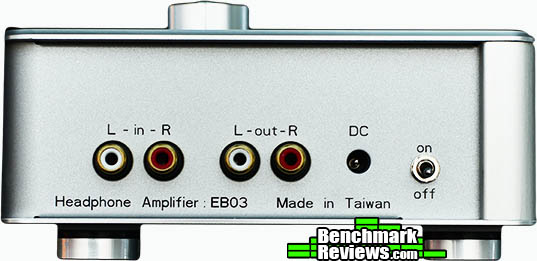
This is an analog only box with no I/O for digital audio. In most cases, the listener will connect the amplifier directly to the audio output from a computer, the EB01-E DAC, or the monitor output from a stereo amplifier.
When comparing the merits of different headphone amplifiers, it is common practice to look at the audio specifications of the competing devices and draw conclusions based on the published performance of the amplifiers.
SilverStone has done something interesting with the audio specifications for the EB03 headphone amplifier; they have not provided any. Instead, they list the audio ICs used in the design of the amplifier, and leave it to the user to further research the performance of those ICs.
This is an interesting approach, as it provides the technically inclined customer enough information to determine the expected performance of the headphone amplifier. On the other hand, it does not provide the customer with a guarantee of minimum audio quality for the EB03 amplifier design, but rather implies that the amplifier will have performance typical of the design recommended by the IC manufacturer.
The SilverStone EB03 uses the 1646W16-U and 1512S14-U audio ICs from THAT Corporation. THAT is a US headquartered company that has been designing professional audio components for about 25 years. The company was formed by engineers and managers from dbx Inc., whose noise reduction technology has been used in professional audio for decades.
Frequency Response and Noise
The EB03 design consists of two channels of the THAT 1512 preamplifier and 1646 audio driver ICs. Specifications provided in the datasheet for these components predict that:
- The EB03 amplifier should have a flat frequency response out past 20 kHz.
- The total amount of harmonic distortion at high listening volume should be less than 0.005 % or about 86 dB below the signal.
- The noise added by the amplifier should be difficult to measure without specialized measuring equipment.
Essentially, this amplifier should have a flat audio frequency response and should not introduce any noise or distortion that can be perceived by the casual listener.
Output Impedance
The typical output impedance of the THAT audio driver is 50 ohms.
Headphone amplifier output impedance can be a confusing topic. Headphones range in impedance from less than 32 ohms to over 600 ohms. A good headphone amplifier should be capable of providing enough current to drive a low impedance headphone while being able to provide enough voltage to drive a high impedance headphone to a satisfactory listening level.
The testing was performed with computer audio hardware and software that is available to the average computer user.
The EB03 amplifier was first tested using a 48 kHz sampled white noise waveform as the input. This input contains energy at all frequencies up to about 20 kHz, so it is a convenient way to quickly measure the frequency response of an amplifier.
A digital audio recorder was used to capture the audio output of the DAC, and then the output of the SilverStone EB03 with the DAC as the input. The input impedance of the digital audio recorder is 10k ohms, so a 600 ohm audio transformer was used between the EB03 and the digital recorder to simulate a headphone load.
In order to measure the signal-to-noise ratio, a 4 kHz digitally generated sine wave was used. By comparing the frequency spectrum of this signal before and after the EB03 headphone amplifier, it is easy to determine if the amplifier has introduced any noise or distortion.
The EB03 was tested with two pairs of headphones ranging in impedance from 32 ohms to 150 ohms. Subjective listening tests consisted of a variety of acoustic and electronic material from an iTunes library.
-
Audio DAC: MBOX DAC (24 bits, 48kHz sampling)
-
PC Platform: :Windows 8.1 PC 64 bit
-
Audio Program: Adobe Audition CS6
- Audio Recorder: Tascam DR60D
- Tamura MET-46 600 ohm audio transformer (Mouser)
- Low impedance headphones: BeyerDynamic T5p (32 ohms)
- High impedance headphones: Sennheiser PC350 (150 ohms)
- Audio Test Material 1: White noise 24 bits, 48kHz
- Audio Test Material 2: 4 kHz sine wave 24 bits, 48kHz
- Audio Test Material 3: iTunes AAC encoded
In order to see how the SilverStone EB03 performs, the performance of the test system itself has to be measured. The frequency sweep shown below is what the white noise spectrum looks like without the EB03 in the signal path.

Likewise, the signal-to-noise ratio and harmonic distortion of the system is shown in the spectrum plot below.

When the EB03 is placed in the system, the resulting spectrum shows that the frequency response is flat out to 20 kHz.

Looking at how the EB03 behaves with a 4 kHz sine wave shows the expected low noise output with all harmonic distortion 86 dB below the level of the 4 kHz sine wave. Note that there was originally some second harmonic noise in the test signal that needs to be subtracted from the measured harmonic distortion.

So it turns out that the performance of the SilverStone EB03 is almost exactly what would be expected from an amplifier built using the THAT ICs.
Subjective Listening Tests
It’s good to know that the SilverStone EB03 performs well in the above measurements, but of course it’s necessary to listen to the amplifier with a few different headphones to determine the subjective quality of the device.
A pair of 150 ohm headphones from Sennheiser was used to listen to a wide range of audio material. In order to drive these relatively high impedance headphones, the volume control was set to about 50% of its maximum level. With plenty of room left for more volume, the audio was clear and more than loud enough to reproduce solid bass and high frequency response.
At the low end of the impedance spectrum, a 32 ohm pair of headphones from Beyerdynamic was used. These phones don’t require nearly as much voltage to drive, and the headphones were very loud at about the 25% volume setting on the EB03 headphone amplifier. Again, the headphones produced a solid bass and crisp high frequency response.
After using this amplifier for a few weeks, I began to appreciate the convenience of a standalone headphone amplifier with a volume control within easy access. The SilverStone EB03 looks right at home on any computer desktop with its stylish silver enclosure.
Many customers will be tempted to pair this device with the companion EB01–E DAC to see what additional audio performance can be achieved in their listening configuration.
The SilverStone EB03 is a functional and attractive headphone amplifier for the casual or serious audiophile. Its performance is comparable to amplifiers that cost well upwards of $500.
The SilverStone Ensemble series of audio peripherals are all designed around a stylish sweeping design that is attractive and unobtrusive.The enclosure has a solid feel with a brushed metal finish. It’s unfortunate that the large volume control is made of plastic, as a heavier metal knob would have been more in line with the rest of the design.
SilverStone has included thoughtful extras in the EB03 such as the in-line audio relay and audio bypass outputs. Many headphone amplifiers costing much more do not include these features.
The EB03 has excellent audio specifications that reflect the choice of quality audio ICs. Excellent audio bandwidth and low noise put this amplifier in competition with much more expensive units.
SilverStone EB03 represents an excellent value for $189.99 (Amazon). While the concept of value in headphone amplifiers is highly subjective, this unit is capable of providing a very enjoyable listening experience for a very modest price.
+ Great audio performance
+ Attractive design
+ In-line audio relay
+ Easy integration into an existing audio setup
+ Good value
– Volume control feels inexpensive
– No digital audio inputs
-
Performance: 9.00
-
Appearance: 8.50
-
Construction: 9.00
-
Functionality: 9.00
-
Value: 8.50


One thought on “SilverStone Ensemble EB03 Headphone Amplifier Review”
great review great headphones!
Comments are closed.