By Olin Coles
Manufacturer: SanDisk Corporation (NASDAQ: SNDK)
Product Name: Extreme microSDXC UHS-I Card
Model Number: SDSDQX-064G-U46A (64GB Capacity)
UPC/EAN: 0619659096014
Price as tested: $99.99 (Amazon | Newegg)
Full Disclosure: The product sample used in this article has been provided by SanDisk.
Over the past several years I’ve amassed a collection of SD (Secure Digital) cards beyond count, likely the result of various devices that depended on this media for recording files to flash storage. As the technology improved, more and more devices began using the microSD format. Eventually the microSD card surpassed the competition to become the standard with its faster speeds, higher capacity, and compact lightweight profile. In this article Benchmark Reviews will test transfer speeds and performance of the extended capacity 64GB SanDisk Extreme UHS-I microSDXC card, model SDSDQX-064G-U46A.
The speed of the memory card determines how rapidly photos can be taken and stored, or how smoothly video is recorded. UHS Speed Grade 1 (U1) and Class 10 microSD memory cards are among fastest currently available, enabling devices to immediate store files without stutter or delay. 100 MHz UHS-I Speed Grade microSDHC or microSDXC memory cards increase write speeds to 50 MB/s or faster. Additionally, many devices are limited to 32GB microSD memory card capacity, which is where the SanDisk Extreme microSDXC (extended capacity) card comes in handy with twice the storage space.

Courtesy SanDisk
Up to 80MB/s Read Speed for Exceptional Performance
Featuring read speeds up to 80MB/s, the SanDisk Extreme microSDHC and microSDXC UHS-I Memory Cards save time moving it all from the camera to the computer. Enjoy quick photo editing and smooth Full HD video playback. You’ll also be able to transfer and retrieve files more efficiently.
Class 10 and UHS Speed Class 1 (U1) Video Recording Ratings for Uninterrupted 1080p Full HD Video
Class 10 and UHS Speed Class 1 (U1) video recording ratings keep up with the demands of fast-action 3D and Full HD video, so you get smooth video recording and playback without interruptions.
Storage Capacities Up to 64GB
With capacities up to 64GB, SanDisk Extreme microSDHC and microSDXC UHS-I memory cards provide plenty of space for your videos, photos, music, games, and other memory-intensive files.
SD Adapter for Versatility
This card comes with a convenient SD™ card adapter, so you can also capture and access data on the card with any device that has an SD card slot. You’ll be able to use your memory card with SD enabled cameras, camcorders, tablets, and laptops.
Durable Design
Designed to protect your memories from life’s mishaps, SanDisk Extreme microSDHC and microSDXC UHS-I Memory Cards are waterproof, shockproof, and X-ray proof. They can operate in temperatures ranging from -13 to 185 degrees Fahrenheit. Take your phone, tablet, or camera to the mountains, the ocean, or the desert. Even if your device doesn’t survive, your SanDisk memory card will.
Warranty
SanDisk Extreme microSDHC and microSDXC UHS-I Memory Cards are backed by a lifetime limited warranty.
SanDisk Corporation produces the Extreme microSDXC UHS-I card featured in this review. The SanDisk Extreme microSDXC series is available in 16GB, 32GB, and 64GB capacities. Online retailers sell the 64GB version (SDSDQX-064G-U46A) for $99.99 (Amazon | Newegg).
The SanDisk SDSDQX kit comes with three items: the SanDisk Extreme microSDXC card, microSD/SDHC/SDXC-to-SD adapter, and plastic carry case. The 64GB version receives U1/UHS-I speed grade ratings.

By design, microSD cards are extremely small items that live up to their name, verging on difficult to handle. The SanDisk Extreme series measure 15mm long by 11mm tall (0.59″ x 0.43″).

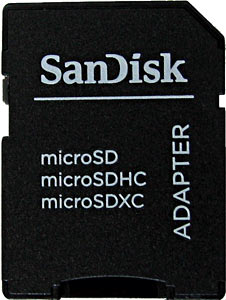
The SanDisk Extreme UHS-I microSDXC memory card kit comes with a SD card adapter, which fits the bundled microSDXC card, or any other microSD/microSDHC memory card.
- Form factor: microSDHC (16 GB and 32 GB), microSDXC (64 GB)
- Available capacities: 16 GB, 32 GB, 64 GB
- Performance/speed: Up to 80/50MB/s read/write speed (32 GB & 64 GB); Up to 80/30MB/s read/write speed (16 GB)
- Card dimensions: 0.59 in x 0.43 in x 0.04 in (15 mm x 11 mm x 1.0 mm)
- Operating temperature: -13ºF to 185ºF (-25ºC to 85 ºC)
- Storage temperature: -40ºF to 185ºF (-40ºC to 85ºC)
- Compatibility: Compatible with all microSDHC, microSDXC, microSDHC UHS-I, and microSDXC UHS-I supporting host devices
MicroSD cards are built on solid-state NAND flash technology, very similar to SSDs. Our test results were obtained after each SSD had been prepared using DISKPART or Sanitary Erase tools whenever possible. As a word of caution, applications such as these offer immediate but temporary restoration of original ‘pristine’ performance levels. In our tests, we discovered that the maximum performance results (charted) would decay as subsequent tests were performed. Benchmark Reviews includes both bandwidth benchmarks and application speed tests to present a conclusive measurement of product performance.
- Motherboard: ASUS P9X79 Deluxe Motherboard (Intel X79 Express)
- Processor: Intel Core i7-3960X Extreme Edition (six cores/3300 MHz)
- System Memory: G.SKILL Ripjaws-Z 32GB DDR3-1600
- SATA 6Gb/s Storage HBA: Integrated Intel C600 Controller
- AHCI mode – Intel Rapid Storage Technology Enterprise Driver 3.6.0.1086
- Operating System: Microsoft Windows 7 Ultimate Edition 64-Bit
- External Port: ASMedia ASM1042 SuperSpeed USB 3.0
- Transcend SuperSpeed USB 3.0 MicroSD Card Reader TS-RDF5K ($9 Amazon)
The following storage hardware has been used in our benchmark performance testing, and may be included in portions of this article:
- Transend Class-10 U1/UHS-I MicroSDHC Card TS32GUSDU1E ($22.99 Amazon)
- SanDisk Extreme U1/UHS-I microSDXC Card SDSDQX-064G-U46A ($99.99 (Amazon | Newegg)
- Finalwire AIDA64: Disk Benchmark component tests linear read and write bandwidth speeds
- AS SSD Benchmark 1.7.4739.38088: Multi-purpose speed and response time test
- ATTO Disk Benchmark 2.46: Spot-tests static file size chunks for basic I/O bandwidth
This article utilizes benchmark software tools to produce operational IOPS performance and bandwidth speed results. Each test was conducted in a specific fashion, and repeated for all products. These test results are not comparable to any other benchmark application, neither on this website or another, regardless of similar IOPS or MB/s terminology in the scores. The test results in this project are only intended to be compared to the other test results conducted in identical fashion for this article.
Many enthusiasts are familiar with the Finalwire AIDA64 benchmark suite (formerly Lavalys EVEREST), but very few are aware of the Disk Benchmark tool available inside the program. The AIDA64 Disk Benchmark performs linear read and write bandwidth tests on each drive, and can be configured to use file chunk sizes up to 1MB (which speeds up testing and minimizes jitter in the progress waveform). Because of the full sector-by-sector nature of linear testing, Benchmark Reviews endorses this method for testing solid-state products. AIDA64 Disk Benchmark does not require a partition to be present for testing, so all of our benchmarks are completed prior to drive formatting.
Using a SuperSpeed USB 3.0 adapter connected to the test system, the SanDisk Extreme UHS-I microSDXC memory card produced an average read speed of 89.0 MB/s, which is near to its peak speed of 90.0 MB/s. Results are shown in the image below:
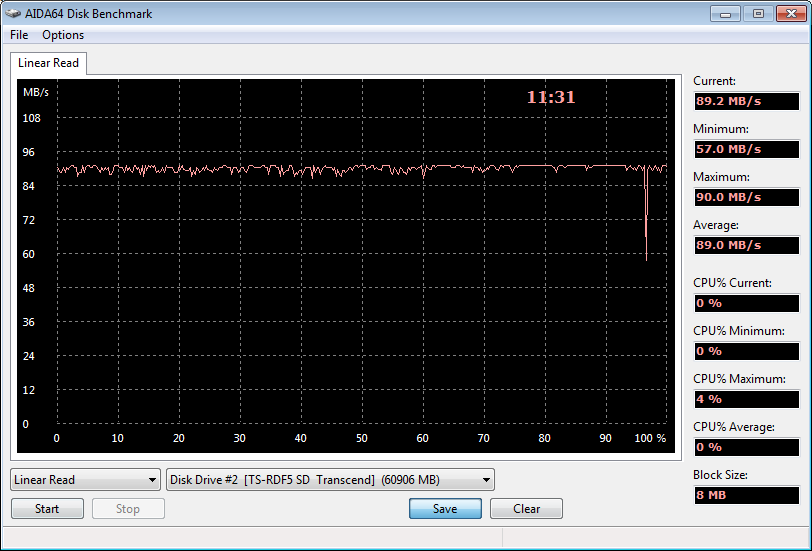
AIDA64 Read Results: SanDisk SDSDQX-064G
Test results with the Transend Class-10 U1/UHS-I microSDHC memory card TS32GUSDU1E produced average read transfer speeds of 88.6 MB/s, with a peak read speed of 91.9 MB/s. Waveform results are illustrated below:

AIDA64 Read Results: Transcend TS32GUSDU1E
Both microSD cards produced similar read results, but it’s the write performance that matters most for these products. The faster the write speed, the quicker a photo is saved and the camera is ready to take another, or the video stream is recorded without frame drop.
Write speeds were very consistent for the entire capacity of the SanDisk Extreme UHS-I microSDXC memory card, which produced 57.7 MB/s on average with a 58.7 MB/s peak write speed. With exception to a momentary drop, performance was extremely consistent across the capacity:
 AIDA64 Write Results: SanDisk SDSDQX-064G
The Transend TS32GUSDU1E shares the same Class-10 and U1/UHS-I certifications, yet this microSD memory card produced much slower write speeds. The maximum recorded write was only 20.2 MB/s, with a similar 19.6 MB/s average write speed. Progress results are illustrated below:

AIDA64 Write Results: Transcend TS32GUSDU1E
TEST SUMMARY: SandDisk’s Extreme series recorded much faster write transactions, with speeds up to 58.7 MB/s. The Transcend counterpart may be labeled with the same certifications, but with a maximum write speed of 20.2 MB/s it hardly compares.
Alex Schepeljanski of Alex Intelligent Software develops the free AS SSD Benchmark utility for testing storage devices. The AS SSD Benchmark tests sequential read and write speeds, input/output operational performance, and response times.
Beginning with sequential transfer performance, the 64GB SanDisk Extreme microSDXC memory card produced read speeds up to 88.40 MB/s and 56.64 MB/s writes. Response (access) time measured 0.710 ms for read requests, and 1.175 ms for write requests – both results are quicker than most SSDs can produce. Results are illustrated below:
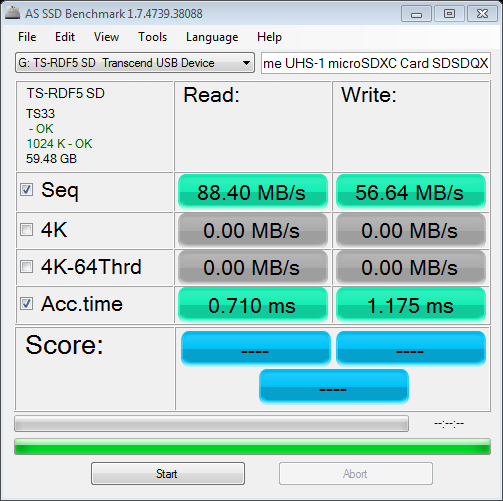 AS SSD Benchmark Results: SanDisk SDSDQX-064G
Next up was the 32GB Transend TS32GUSDU1E microSDHC card, which produced a near-identical 88.12 MB/s read speed. Write performance is where the two products go their separate ways, with the Transcend card measuring only 17.67 MB/s writes. Response time revealed why: 0.827 read access, but a lengthy 8.839 ms wait for write transactions. Test results shown below:
In the next section, Benchmark Reviews tests transfer rates using ATTO Disk Benchmark.
TEST SUMMARY: The SandDisk Extreme microSDXC memory card series completed write transactions 320% faster than the Transcend counterpart, and responded far quicker with a 1.175 ms access time compared to 8.839 ms for the Transcend memory card labeled with the same certifications.
The ATTO Disk Benchmark program is free, and offers a comprehensive set of test variables to work with. In terms of disk performance, it measures interface transfer rates at various intervals for a user-specified length and then reports read and write speeds for these spot-tests. There are some minor improvements made to the 2.46 version of the program that allow for test lengths up to 2GB, but all of our benchmarks are conducted with 256MB total length. ATTO Disk Benchmark requires that an active partition be set on the drive being tested. Please consider the results displayed by this benchmark to be basic bandwidth speed performance indicators.
Benchmark tests begin with the SanDisk Extreme microSDXC card, which produced peak read speeds of 94.7 MB/s with 64KB and larger files. Write performance reached speeds of 61.4 MB/s with 64KB and larger files. Performance results are illustrated below:

Next came the Transend TS32GUSDU1E microSDHC card, which performed read operations nearly as fast but faltered at matching SanDisk’s high-speed writes. Read speeds topped out at 96.5 MB/s for 128-512 KB files, while write performance peaked at 22.9 MB/s between 64-128 KB file sizes. Performance results are illustrated below:

TEST SUMMARY: Just because both memory cards are given the same Class-10 and HS-1 speed ratings, does not mean they’ll perform to the same speeds. SandDisk’s Extreme series recorded much faster write transactions, with write speeds reaching 61.4 MB/s, yet the Transcend microSDHC card struggled to produce a maximum write speed of 22.9 MB/s.
Up next… final thoughts and conclusion.
There’s a lot of confusion surrounding microSD card speeds, and it stems from nomenclature that seems intended to confuse. The SD Association defines standard speed classes for secure digital cards, which replace speed-x ratings:
Class 2 (C2) = 2 MB/s (replaces 16x rating, 13x actual)
Class 4 (C4) = 4 MB/s (replaces 32x rating, 27x actual)
Class 6 (C6) = 6 MB/s (replaces 48x rating, 40x actual)
Class 10 (C10) = 10 MB/s (replaces 100x rating, 67x actual)
UHS Speed Grade 1 (U1) = 10 MB/s
Then there’s the Ultra High Speed rating, which gets the same naming symbol but is divided into several sub-speed:
Ultra High Speed (UHS-I) = 50 MB/s (100 MHz)
Ultra High Speed (UHS-I / UHS104) = 104 MB/s (208 MHz)
As seen in this review, some UHS-I speed-graded memory cards do not perform to 50 MB/s minimum Ultra High Speed specifications yet maintain the 10 MB/s UHS Speed Grade 1 rating. This indicates that some manufacturers may have also been confused by the rating system, which makes it critically important to check reviews.
RATING DISCLAIMER: Although the rating and final score mentioned in this conclusion are made to be as objective as possible, be advised that every author perceives these factors differently. While we each do our best to ensure that all aspects of the product are considered, there are often times unforeseen market conditions and manufacturer revisions that occur after publication which could render our rating obsolete. Please do not base any purchase solely on this conclusion, as it represents our rating specifically for the product tested which may differ from future versions. Benchmark Reviews begins our conclusion with a short summary for each of the areas that we rate.
Our first rating is Performance, which compares how effective the SanDisk Extreme microSDXC memory card performs in read and write operations against competing SD-based solutions. In our tests we compared the SanDisk Extreme microSDXC card to another so-called UHS-I product, but only the SanDisk card could reach and surpass the 50 MB/s minimum write specification. ATTO Disk Benchmark produced a peak write speed of 62 MB/s, while AIDA64 and AS-SSD generated 57 MB/s write speeds.
There really isn’t very much that can be done to dress-up a dime-size product. SanDisk has matched their Extreme-series SD cards to the red and gold company color theme, which immediately improves upon the dull white text on black memory card seen everywhere else.
microSD cards are delicate, wafer-thin products that can snap if given too much pressure or melt if the card becomes too hot. Call it a side effect of the ‘micro’ design, but these are not durable components. However, SanDisk asserts their cards to be waterproof, X-ray proof, temperature proof, and shockproof. If any SanDisk Extreme microSD storage product does happen to fail during its limited-lifetime warranty period, end-users may contact SanDisk at their toll-free telephone number (866-726-3475) for technical support or customer service questions.
In terms of functionality, the SanDisk Extreme microSDXC UHS-I card does exactly what it’s been designed to do – and it does it very, very fast. The bundled SD card adapter allows users to retro-fit this product into older devices that use Secure Digital storage, instead of microSD cards. The adapter also enables easy transfer of files to computer systems using older SD card media ports.
As of July 2013, the 64GB SanDisk Extreme microSDXC memory UHS-I memory card was available online for $99.99 (Amazon | Newegg). With regard to value, this price matches every other product with the same specifications and capacity. However, SanDisk offers a limited lifetime product warranty in addition to toll-free product support, so not all products are truly the same.
Summary: unlike other SD cards we’ve tested, the SanDisk Extreme microSDXC memory UHS-I memory card actually performed to beyond specification and produced write transfers at up to 62 MB/s. 64GB is a lot of room for digital photos, but if you’re recording 1080p video at 30 FPS or better that capacity will fill quite fast. With phones, tablets, and other portable devices capable of HD video recording onto microSD cards, it makes sense to purchase the fastest and largest capacity available. I highly recommend the 64GB SanDisk Extreme microSDXC card for high definition video recordings and large-resolution digital photography.
+ 64GB microSDXC extended capacity
+ Very fast 62 MB/s write speeds
+ Ideal for high frame rate HD video recording
+ Includes SD card adapter for backwards compatibility
+ Limited lifetime product warranty
+ Exceptional 97 MB/s read speed
+ True UHS Speed Class 1 (U1) storage product
+ Waterproof, X-ray proof, temperature proof, and shockproof
– No notable concerns
-
Performance: 9.00
-
Appearance: 9.25
-
Construction: 9.25
-
Functionality: 9.50
-
Value: 8.00
Excellence Achievement: Benchmark Reviews Golden Tachometer Award.
COMMENT QUESTION: Does speed make a difference for your microSD memory card needs?