By Jason Maxfield
Manufacturer: SilverStone Technology Co.
Product Name: Tundra TD02 Super Slim Liquid Cooler
Model Number: SST-TD02-SLIM
UPC: 844761012274 EAN: 4710007222270
Price As Tested: $82.99 (Amazon | NewEgg)
Full Disclosure: The product sample used in this article has been provided by SilverStone Technology Co.
SilverStone has been busy of late with the release of their new Tundra Series Liquid Coolers. With the introduction of their latest models the Tundra TD02 Slim and TD03 Slim, SilverStone has quite the lineup of All-In-One(AIO) liquid coolers to select from.
In this article for Benchmark Reviews, I’ll be putting the SilverStone Tundra TD02 Slim liquid cooler to the test. As you might of guessed, the TD02 Slim is a thinner version of their bigger TD02 brethren. The TD02 Slim is designed to be compatible with more cases on the market, with a slim profile of just 37mm, including the radiator and fans. Can the TD02 Slim handle the heat? Let’s find out.

| Model No. | SST-TD02-SLIM | |
| Water block | Dimension | 65mm (L) x 65mm (W) x 39.2mm (H) |
| Material | Copper base with plastic body | |
| Pump | Motor speed | 2500±200RPM |
| Rated Voltage | 12V | |
| Rated Current | 0.28A | |
| Fan | Dimension | 120mm (L) x 120mm (W) x 15mm (D) |
| Speed | 800~2200RPM | |
| Noise level | 16.5~27.4 dBA | |
| Rated Voltage | 12V | |
| Rated Current | 0.02 ~ 0.15A | |
| Max airflow | 13.1 ~ 35.85CFM | |
| Pressure | 0.31 ~ 1.84 mmH2O | |
| Connector | 4 Pin PWM | |
| Radiator | Dimension | 273mm (L) x 120mm (W) x 22mm (H) |
| Material | Aluminum | |
| Tube | Length | 310mm |
| Material | Rubber | |
| Application | Intel Socket LGA775/115X/1366/2011/2011-v3 AMD Socket AM2/AM3/FM1/FM2 |
|
| Net Weight | 695g | |
Specifications taken from manufacturers page
As mentioned on the previous page, the SilverStone Tundra TD02 Slim is part of the Tundra Series liquid coolers. The SilverStone Tundra TD02 Slim offers higher compatibility than the larger TD02 Series coolers. The SilverStone Tundra TD02 Slim comes with two slim 120mm fans that are a mere 15mm in thickness.
The SilverStone Tundra TD02 Slim has Intel Socket compatibility with the following sockets: LGA775/115X/1366/2011/2011-v3. AMD has compatibility with sockets: AM2/AM3/FM1/FM2.
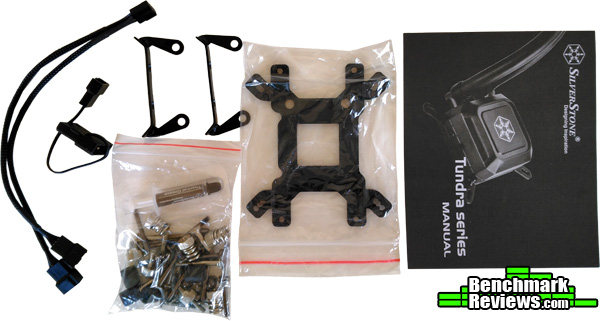
SilverStone has included a manual, and all the connectors you need to complete your installation. SilverStone has included 8 screws for installing 120mm fans that are 25mm thick, if you choose to forego using the included slim 120mm stock fans.
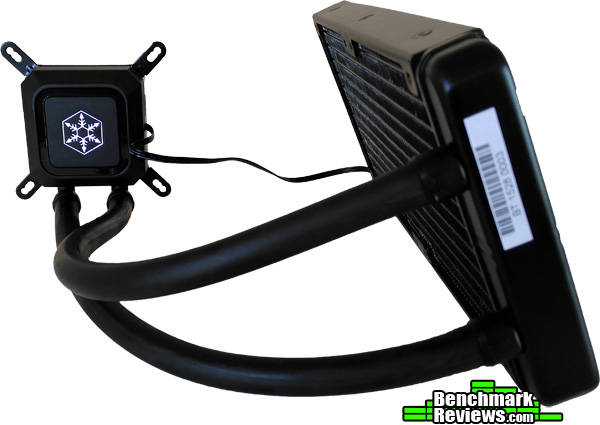
Here is a look at the pump and radiator of the SilverStone Tundra TD02 Slim. The radiator is 22mm in thickness. The hoses for the SilverStone Tundra TD02 Slim are 12mm thick and braided for extra durability.
The pump section of the SilverStone Tundra TD02 Slim has a nice large flat copper plate with 0.2mm micro-channel water block design for improved flow and heat dissipation. On the top of the pump you have SilverStones logo that also lights up blue around the edges of the logo when powered on.
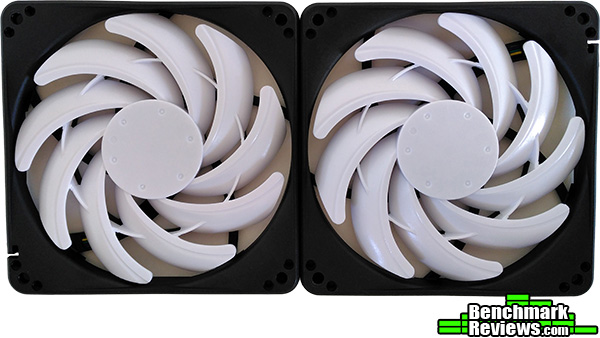
The included 120mm slim fans are optimized for static pressure, rather than high CFM. The fans measure 15mm in width. With the optional longer screws, you can replace these fans with 120mm fans with 25mm width.
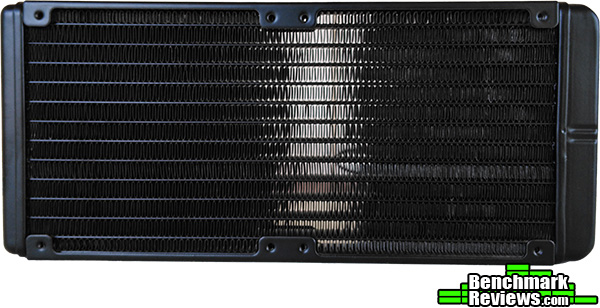
The radiator of the SilverStone Tundra TD02 Slim is pretty standard, other than it’s 22mm width.
It bears repeating here that no heat-sink will work effectively unless it transfers heat from the CPU. To do that, it needs to be in contact with the CPU heat spreader or die, with the greater the contact surface the greater the potential for heat transfer. One of our own writers here at Benchmark Reviews has done a lot of work in this area, and it is certainly worth the time it takes to read (and re-read) the discoveries he made during the famous 80+ thermal paste tests (I still see Newegg reviews reference the discoveries made therein).
I mention this because I still see this as a major source of misinformation – most end users will use far too much thermal interface material when switching CPU coolers. Possibly through little fault of their own – I’ve read official repair manuals stating to use the entire tube of thermal paste when replacing a CPU and heat-sink. This is, in almost every case, FAR too much – to the point of being harmful in most cases. So do yourself a favor and get acquainted with CPU Cooler Preparations and Thermal Paste Application.
Processor and CPU cooler surfaces are not perfectly smooth and flat surfaces, and although some surfaces appear polished to the naked eye, under a microscope the imperfections become clearly visible. As a result, when two objects are pressed together, contact is only made between a finite number of points separated by relatively large gaps. Since the actual contact area is reduced by these gaps, they create additional resistance for the transfer of thermal energy (heat). The gasses/fluids filling these gaps may largely influence the total heat flow across the surface, and then have an adverse affect on cooling performance as a result.
The only reason for using Thermal Interface Material is to compensate for flaws in the surface and a lack of high-pressure contact between heat source and cooler, so the sections above are more critical to good performance than the application of TIM itself. This section offers a condensed version of our Best Thermal Paste Application Methods article.
After publishing our Thermal Interface Material articles, many enthusiasts argued that by spreading out the TIM with a latex glove (or finger cover) was not the best way to distribute the interface material. Most answers from both the professional reviewer industry as well as enthusiast community claim that you should use a single drop “about the size of a pea”. If there was ever any real advice that applies to every situation, it would be that thermal paste isn’t meant to separate the two surfaces but rather fill the microscopic pits where metal to metal contact isn’t possible.
After discussing this topic with real industry experts who are much more informed of the process, they offered some specific advice that didn’t appear to be a “one size fits all” answer:
- CPU Cooling products which operate below the ambient room temperature (some Peltier and Thermo-electric coolers for example) should not use silicon-based materials because condensation may occur and accelerate compound separation.
- All “white” style TIM’s exhibit compound breakdown over time due to their thin viscosity and ceramic base (usually beryllium oxide, aluminum nitride and oxide, zinc oxide, and silicon dioxide). These interface materials should not be used from older “stale” stock without first mixing the material very well.
- Thicker carbon and metal-based (usually aluminum-oxide) TIM’s may benefit from several thermal cycles to establish a “cure” period which allows expanding and contracting surfaces to smooth out any inconsistencies and further level the material.
The more we researched this subject, the more we discovered that because there are so many different cooling solutions on the market it becomes impossible to give generalized advice to specific situations. Despite this, there is one single principle that holds true in every condition: Under perfect conditions the contact surfaces between the processor and cooler would be perfectly flat and not contain any microscopic pits, which would allow direct contact of metal on metal without any need for Thermal Interface Material. But since we don’t have perfectly flat surfaces, Thermal Material must fill the tiny imperfections. Still, there’s one rule to recognize: less is more.
CPU coolers primarily depend on two heat transfer methods: conduction and convection. This being the case, we’ll concentrate our attention towards the topic of conduction as it relates to the mating surfaces between a heat source (the processor) and cooler. Because of their density, metals are the best conductors of thermal energy. As density decreases so does conduction, which relegates fluids to be naturally less conductive. So ideally the less fluid between metals, the better heat will transfer between them. Even less conductive than fluid is air, which then also means that you want even less of this between surfaces than fluid. Ultimately, the perfectly flat and well-polished surface is going to be preferred over the rougher and less even surface which required more TIM (fluid) to fill the gaps.
This is important to keep in mind, as the mounting surface of your average processor is relatively flat and smooth but not perfect. Even more important is the surface of your particular CPU cooler, which might range from a polished mirror finish to the absurdly rough or the more complex (such as Heat-Pipe Direct Touch). Surfaces with a mirror finish can always be shined up a little brighter, and rough surfaces can be wet-sanded (lapped) down smooth and later polished, but Heat-pipe Direct Touch coolers require some extra attention.
To sum up this topic of surface finish and its impact on cooling, science teaches us that a smooth flat mating surface is the most ideal for CPU coolers. It is critically important to remove the presence of air from between the surfaces, and that using only enough Thermal Interface Material to fill-in the rough surface pits is going to provide the best results. In a perfect environment, your processor would mate together with the cooler and compress metal on metal with no thermal paste at all; but we don’t live in perfect world and current manufacturing technology cannot provide for this ideal environment.
Probably one of the most overlooked and disregarded factors involved with properly mounting the cooler onto any processor is the amount of contact pressure applied between the mating surfaces. Compression will often times reduce the amount of thermal compound needed between the cooler and processor, and allow a much larger metal to metal contact area which is more efficient than having fluid weaken the thermal conductance. The greater the contact pressure between elements, the better it will conduct thermal (heat) energy.
Unfortunately, it is often times not possible to get optimal pressure onto the CPU simply because of poor mounting designs used by the cooler manufacturers. Most enthusiasts shriek at the thought of using the push-pin style clips found on Intel’s stock thermal cooling solutions. Although this mounting system is acceptable for casually-used computers, there is still plenty of room for improvement when overclocking.
Generally speaking, you do not want an excessive amount of pressure onto the processor as damage may result. In some cases, such as Heat-pipe Direct Touch technology, the exposed copper rod has been pressed into the metal mounting base and then leveled flat by a grinder. Because of the copper rod walls are made considerably thinner by this process, using a bolt-through mounting system could actually cause heat-pipe rod warping. Improper installation not withstanding, it is more ideal to have a very strong mounting system such as those which use a back plate behind the motherboard and a spring-loaded fastening system for tightening.
The installation of the SilverStone Tundra TD02 Slim, was a bit of a pain. I chose the SilverStone PS11B-W case for this project. The reason for my decision was simple, the SilverStone PS11B-W doesn’t technically support liquid cooler installations. This is where the SilverStone Tundra TD02 Slim shines.
First of all, I had to install the back plate for the TD02 Slim. The installation varies depending on your CPU. I’m using an AMD board with an AM3 socket. The threaded pins slide through the holes in the motherboard and are fastened down with a stand-off and spring-tension nuts.
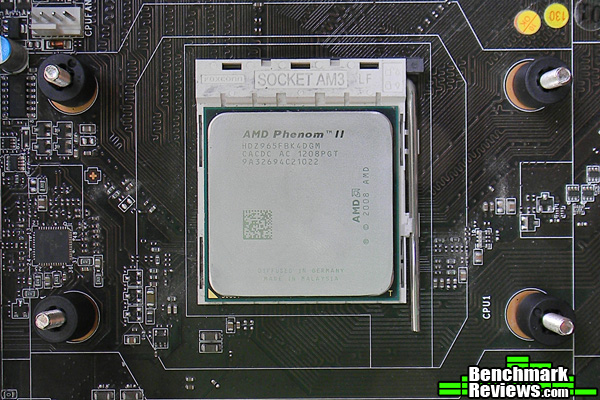
Here’s what it looks like from the front-side of the motherboard. The screws and standoffs dangle a bit loosely while waiting for you to finish installing the heatsink/pump unit.
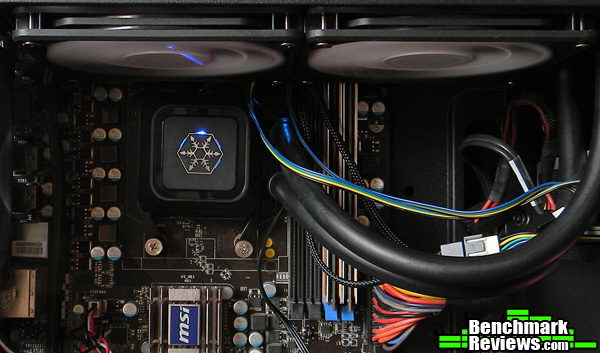
Getting to this point is where I have to explain things a bit. The normal method of installation according to the manual is to install the fans to the radiator, then attach the radiator to the top of your case. After that, you install the pump and connect the fans and pump to fan headers.
Well, that didn’t go as planned. The radiator blocks the CPU header, and the top two mounting screws for the heatsink/pump. I had to install the pump first while trying to keep the radiator from falling off of the top of the case.
This particular installation isn’t going to happen to everyone, unless you are using this specific case, SilverStone PS11B-W. You’ll also note that the retention clips for the RAM is also blocked at the top. And if my RAM wasn’t low profile, there would be no way to fit the Tundra TD02 Slim into this case.
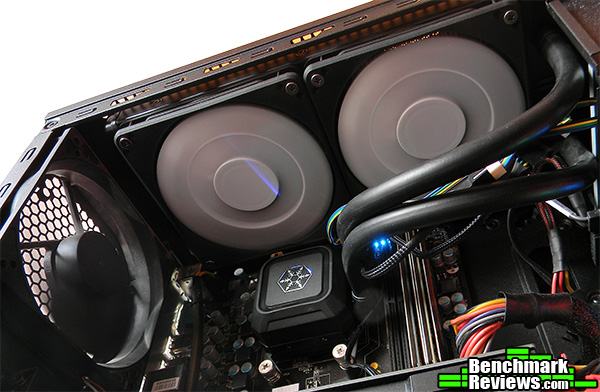
This shot shows just how little wiggle room there is in this case for installing the SilverStone Tundra TD02 Slim. The front part of the radiator where the hoses are attached could potentially block the use of the top-most 5.25″ drive bay.
Also, the PS11B-W has a filter mounted in the top of the case. This had to be removed to facilitate installation of the TD02 Slim because of the plastic pins that were used to hold the filter in place. I could have sandwiched the filter between the top of the case and the radiator, but I think it would impede airflow and filtering exhaust air wouldn’t do any good.
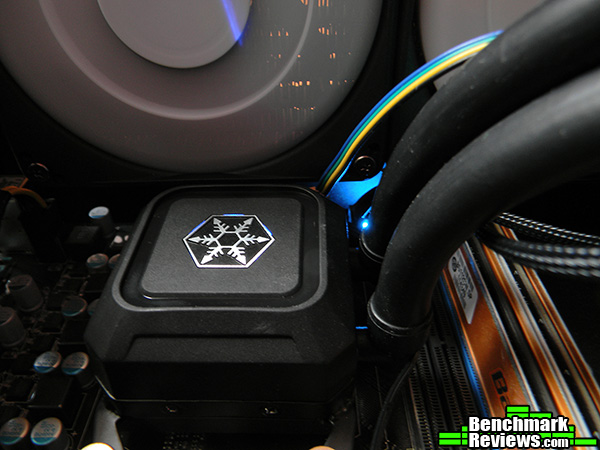
This closeup shot I tried to illustrate just how little space there is behind the radiator for the mounts and CPU header. You can see the LED’s faintly lit up on the edge of the SilverStone logo while the pump is powered on.
The CPU tested was mounted in a SilverStone PS11B-W case. The case was in it’s normal upright orientation and case doors were fully closed during testing. There are two 140mm front intake fans, and one 120mm exhaust fan.
The front 140mm fans are set to at 100%. The exhaust fan set to 50%. BIOS controlled CPU fans were set to 50% minimum speed with a target temp of 40°C. Settings were left the same for all coolers while testing was done. AMD Cool and Quiet was disabled for all testing.
CPU cooler prep included cleaning and prepping the CPU coolers with the same TIM that was included with the SilverStone Tundra TD02 Slim. The same amount of TIM was applied to all coolers for this test.
Testing was performed with AIDA64 Engineer software using their stability test application, which generates 100% CPU usage during the entire test run. The stability test was run until CPU temperatures had plateaued, then began to record ambient air temperature and CPU temperatures over the next minute. I then shutdown the PC completely and turned it back on after a minute or so and ran the test 3 times in total.
After swapping and running the test 3 times in the exact same way with the SilverStone Tundra TD02 Slim, Cooler Master Hyper D92, and AMD stock cooler, I took the results of the CPU temperatures and discarded the highest and lowest temperature results and subtracted that result from the ambient room temperature.
The EVGA GTX 560 Ti was left installed and running with fans set to a static 35% to keep any variance from the GPU out of the equation.
Ambient room temperatures were measured in degrees Celsius using a thermometer with decimal point accuracy.
-
Motherboard: MSI 870-G45
-
System Memory: Crucial Ballistix DDR3 4GB (2×2) 1600 CL8
-
Processor: AMD Phenom II x4 965 BE @ 3.7GHz 1.45 vCore
-
Audio: Onboard
-
Video: EVGA GTX 560 Ti 2GB
-
Disk Drive 1: WD Black 750GB SATA 2
-
Disk Drive 2: WD Scorpio Blue 350GB 2.5″ SATA 2
-
Optical Drive: DVD Burner 16x SATA
-
Enclosure: SilverStone PS11B-W
-
PSU: OCZ ModXstream 700 watt
-
Monitor: Acer X223w 24in 1680×1050
-
Operating System: Windows 10 Pro
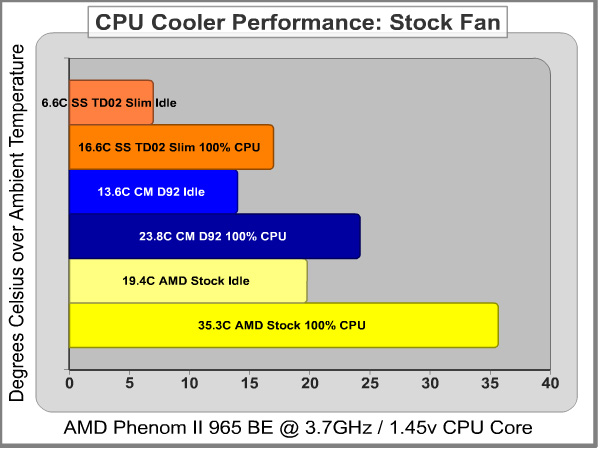
Listed from best to worst, the SilverStone Tundra TD02 Slim shows just how effective liquid cooling systems can be. With a 7C lower idle, and 7.2C lower 100% temperature over the CoolerMaster Hyper D92 it’s easy to see why enthusiasts like AIO liquid coolers.
At no time during testing could I hear any audible noise from the TD02 Slim pump. Normal fan speeds for the TD02 Slim set to 50% are roughly 1,400 to 1,500 RPM. During testing they would peak at 1,700 to 1,800 RPM. At that level I could not hear them over the sound of my 140mm intake fans on the front of the case. If you put your ear to the top of the case they are clearly audible, but not loud. The 120mm Slim fans were not audible until going over 2,000 RPM. The noise generated by the 140mm front fans is the only thing I can hear otherwise.
As a bit of fun to really see how much heat the TD02 Slim can handle I ran Prime 95 torture test with the in-place large FFT test selected. This generates a lot more heat and caused the TD02 Slim fans to push past 2000 RPM. I recorded the temperature at 24.5C over ambient. Observed temperature on the core was 45C. The Hyper D92 under the same conditions hits 59 to 60C on the core. And the stock cooler, forget it. The stock cooler will not handle the heat from Prime 95.
This being my first AIO liquid cooler, I’m fairly impressed with the SIlverStone Tundra TD02 Slim. It may not be the power-house of it’s bigger siblings, but in my case it definitely did an awesome job.
Enthusiasts can rejoice now that there is an option out there for a cooler that can fit in a bit smaller enclosure than normal AIO liquid coolers.
Installing the SilverStone Tundra TD02 Slim was a bit of a pain, but that was mostly due to my inexperience and not foreseeing the potential problems with installing the cooler in the manner the manual instructs you to.
Speaking of the manual, I really did not like the manual at all. Even the PDF version is no different. The small print is hard to read. In fact, I had to use my cell phone camera on macro mode to zoom in on the text to read it. Do yourself a favor and just download the PDF version if you have problems reading small print. Also, the explanations in the steps to install were scant and left a bit of guess work on my end. The illustrations were decent enough for me to understand. SilverStone should re-work their manual for the TD02 Slim, in my opinion.
The performance of the SilverStone Tundra TD02 Slim was admirable. The TD02 got the job done and did so without a hitch. The pump and fans perform quietly and only get noisy once the fans pass 2,000 RPM.
Appearance is always subjective. A radiator is always going to look like a radiator. It’s kind of hard to make a call on appearance. I’ll say that the pump looks nice. It’s simple, with a SilverStone logo, and LED lights that are understated. I do appreciate the looks of the rubber hoses though. I’m not fond of the rippled hose look on some other coolers.
The construction of the SilverStone Tundra TD02 Slim is outstanding. Everything fits nice and snug. There isn’t any alignment problems with the parts fitting or mounting holes. It’s perfect.
Functionality of the SilverStone Tundra TD02 Slim was good. The problems I had during installation were no fault of the unit itself. The TD02 fits in the SilverStone PS11B-W snugly, but it works just fine.
The value of the SIlverStone Tundra TD02 Slim is on par with the product segment. This cooler was available online for $82.99 (Amazon | NewEgg) at the time of review.
I would recommend the SilverStone Tundra TD02 Slim to anyone who is looking for a good AIO liquid cooler with a case that requires it. There are plenty of options on the market for AIO liquid coolers, but the TD02 has a special niche that just might be the ticket for your needs.
+ Slim design
+ Quiet operation
+ Solid construction
– Manual needs clarification
-
Performance: 9.00
-
Appearance: 8.75
-
Construction: 9.75
-
Functionality: 9.50
-
Value: 8.00
Excellence Achievement: Benchmark Reviews Golden Tachometer Award
COMMENT QUESTION: Is liquid cooling worth the added cost?